Showing posts with label Canada. Show all posts

Thursday, August 27, 2015

Around the world with burgers - where's your favourite burger joint?

"I'll gladly pay you Tuesday, for a hamburger today."
-  J. Wellington Wimpy
Those who really known me know I love burgers. I'm always on the lookout for a good burger and in Vancouver I'm always looking for new burger joints.

In the past month, I've found two new ones, one just last week.

That lunch last week got me thinking about my quest for burgers. I travel a lot, so I obviously got to thinking of all the places in the world where I've enjoyed a burger outside of Vancouver. While it is a North American dish, it is sold internationally - although you wouldn't expect the best burgers would be easily found in other countries.

The site of my first international burger, outside Belmopan.
However, I have enjoyed my share of burgers internationally as well as around Canada and the United States.

My first "out-of-country" burger was in Belize, my first out-of-country trip (aside from the U.S., which I'd been travelling in and out of, since I was seven)

We'd been kayaking, caving, exploring ruins and horseback riding in the jungles and highlands of that country for close to two weeks - all on a diet of seafood, chicken, rice-and-beans, and vegetarian fare.

So we were C-R-A-V-I-N-G some burgers in the worst possible way. Luckily, on our last day of the trip we were able to feed that craving, and feed it twice: once at the Belize Rodeo, and once at JB's Watering Hole, near the capital of Belmopan. They probably weren't the best burgers, but sitting in JB's, quaffing a cool one and munching on a burger was like heaven.

After Belize, the trips began to pile up, but I don't remember eating burgers in Africa, Ecuador, or any place else, until I went to the Rainforest Music Festival on Borneo, in Malaysia. And I have to confess, I didn't eat a "Malaysian burger."

A burger at BK in Bangkok.
I ate at Burger King.

After 17 days of really good local food, I was craving a burger. So, at the airport in Kuala Lumpur, the day I was leaving, I purchased a burger. I never eat at BK at home, but there it seemed like burger heaven (nothing like the place in New Westminster, B.C. though!)

That little dining adventure eventually became a tradition for me: when leaving a foreign country, eat a burger at BK in the airport. I repeated that in Thailand a few years later.

I tried to do it earlier this year when exiting from Mexico, but there was no BK to be found in the Puerto Vallarta airport. So I ate at Johnny Rocket's. Probably better than BK, but the next time I exit from another foreign airport, I will try to find a BK (tradition, you know?)

I've enjoyed many, many burgers in the U.S. A few memorable ones include the signature burger at The Saltwater Cowboy on St. Simon's Island, Georgia; the signature burger at A Cheeseburger in Parrotdise in the Little Torch Key, Florida (both since closed, unfortunately) - not to mention the burger named after Jimmy Buffet's classic song at his restaurant in Key West; and the Market Square Burger at Winghart's in Pittsburgh.

As far as Canada goes...

Who's up for a poutine burger?
Since this is where I've live, this is obviously we're I've enjoyed the most burgers. I've had my share of burgers from fast food outlets in almost every province I've lived in and visited: the Yukon, B.C., Alberta, Saskatchewan, Manitoba, Ontario, Quebec, New Brunswick, and Nova Scotia- but not PEI or Newfoundland. (I've been to PEI, but not long enough for a burger, and I have yet to see Newfoundland.)

I've visited so many burger joints, I can't really recall them all.

Ones that do come to mind immediately are the Cabo Diablo burger at Relish Gourmet Burgers, in Fredericton, NB; the "Lieutenant Burger" at Burgernator in Toronto's Kensington Market area; and several in B.C., including any burger at the aforementioned Burger Heaven; the poutine burger at Tap and Barrel; and burgers at the Two Parrots Bar and Grill; the Blue Canoe Waterfront Restaurant; the Flying Beaver Bar and Grill; the Howe Sound Brewpub; and the Rod and Gun Bar & Grill.

Hopefully in the years to come, as I continue to travel the world, I'll be able to add to my list of international burgers enjoyed.

Meanwhile, I'll leave you with a song that could've been written as my theme song...


Sing it, Jimmy!

Thursday, July 30, 2015

Five of Canada's Best Kept Secrets

Entering Winnipeg's French Quarter.
I started the month with a blog post about cool stuff to do in Canada. Now I'll finish the month with another Canadian-themed topic. If you're not from Canada, some of these might surprise you. And a few might surprise you even if you are from Canada.

1. Calgary: not just another word for “Cowtown.” While the Calgary Stampede is second to none when it comes to rodeos, the southern Alberta city offers more than just cowboy culture - it is also home to some top-notch, world-class museums. Leading the way is the Glenbow Museum, a museum, art gallery, library and archives all rolled into one facility. Military history buffs will certainly enjoy the Museum of the Regiments or the Naval Museum of Alberta. If you’re into aviation and aerospace, check out the Aero Space Museum of Calgary. Calgary also honors firefighters with its Firefighters Museum.

2. Quebec is not the only place in Canada to experience French-Canadian culture. The city of Winnipeg, Manitoba can also provide plenty of authentic Franco flavor. Winnipegcontains western Canada’s largest French-Canadian population. A visit to St. Boniface - a section of the city often referred to as the “French Quarter” - might lead you to think you’ve been airlifted and dropped into some place other than Western Canada. The area’s biggest annual celebration reflects this heritage: the 10-day Festival du Voyageur held every February, highlights Canada’s fur trade era with entertaining shows, delicious traditional food and numerous exhibits.

3. Saskatchewan is not just flat land and wheat fields. Head into the northern half of the prairie province, and you’ll find yourself in some of the best fishing and canoeing country in North America. (Sigurd Olson certainly thought so, or he wouldn’t have spent weeks paddling the province’s wilderness, then written The Lonely Land.) One of the province’s gems is Prince Albert National Park, the final home for Grey Owl, portrayed by Pierce Brosnan in the 1999 film of the same name. The park offers excellent canoe routes as well as hiking and mountain biking trails. In the winter, outdoor enthusiasts trade in their paddles and bikes for cross-country skis and snowshoes.

Grey Owl's cabin in Saskatchewan.
4. Vancouver: think “Little India” – not just Chinatown. The west coast city is world-renowned for the incredible diversity of Asian cultures. Its Chinatown is Canada’s largest and best known; however, the Little India section is often overlooked. 

While the East Indian influence is everywhere in the city, the culture’s most concentrated gathering lies along a five-block section of Main Street, centered around 49th Avenue. 

A daytime stroll provides a potpourri of colourful sights, sounds and smells. Women of all ages often sport colorful saris. The strains of Hindi music blare from the many shops along the street. The aromas of curry constantly waft through the air to tantalize you as you pass some of the area’s eateries.

5. Edmonton: City of Festivals. Often referred to as “City of Champions” (a reference to the glory days of the NHL’s Oilers and CFL’s Eskimos), the Alberta capital could easily be called the “City of Festivals.” Its International Fringe Theatre Festival attracts artists and patrons from across Canada and around the world, including the U.S., Europe and Asia. Other summer festivals include international jazz and folk music festivals, a dragon boat festival and Klondike Days. In the spring, visitors can be entertained at the Northern Alberta International Children’s Festival. The Canadian Finals Rodeo rides into town every November. Winter celebrations include the Festival of Trees, a Yuletide event; and the Canadian Birkebeiner Ski Festival, the largest classical North American Nordic ski festival.


Things are really hopping at K-Days in Edmonton. (Time lapse by Jesse Nash)

Wednesday, July 8, 2015

Age doesn't have to stop you - but may require some adjustments

The old phrase, "We are experiencing technical difficulties, please do not adjust your sets," was definitely a
Nothing beats a wilderness canoe trip.
familiar one to those who watched any television prior to the age of cable, satellite and high resolution digital TV.

Although cable companies still do experience technical issues, it doesn't seem to carry the same impact it did when there were only a few stations available to watch in any given city or area.

However, the phrase takes on a different meaning when it refers to the human body.

Although it varies in degree from person to person, we all experience "technical difficulties" with our bodies as they age. And although we would rather resist it, we do have to make adjustments.

This was borne home to me last month when a planned canoe trip had to be aborted because of a flare-up of an old knee injury, an event that reared its ugly head right out of the blue at a very bad time.

As part of the 2015 Travel Media Association of Canada conference in Peterborough, Ontario, I'd signed up to participate in one of the pre-tours they offer attendees. Titled, "The Rugged Routes of the Kawarthas," it would see us paddle and portage into one of the newer wilderness parks in Ontario, for three days.

I'd already sustained a wrist injury the first week of May, slipping in a boat in Mexico, but was bound and determined not to let it stop me from participating. It was not broken, just very badly bent (ha-ha), but with a brace and some ibuprofen, I was ready to tough it out, it was just a sprain. After all, I'd developed some bad tendinitis in my left forearm on the second day of a four-day kayak trip in the Everglades, and that didn't stop me...

But you know what they say about the best laid plans of mice and men.

A week before I was supposed to leave for Ontario, I was warming up in a local pool during a deep water aqua fit class. This is my main form of regular exercise, it works the muscles and joints and provides a good aerobic workout as well - and with little or no stress on the joints. Supposedly.

Well, there I was, just doing a slow bicycling motion I've done hundreds of times, and I felt something go "Snick!" in my left knee. I ignored it and did the class. The knee has already been surgically repaired once after two dislocated patellas; I also hyper-extended it badly playing softball years after that. So it was not exactly in primo condition.

By the next day, it was swollen and I had trouble walking. There went any exercise for the next few days. I got my RMT to work on it a bit - but it's a joint, so hard to do anything with it, given its history. I tried all kinds of lineaments, and analgesics and oils, applying them two to three times a day, icing it twice a day...and there was a bit of improvement, but it was still a bit tight, a bit swollen, and a bit weak. I planned to go canoeing all the same.

However, the day I was supposed to head out to Kawarthas Highland Provincial Park, it was pouring rain. That would mean the portage routes would be slick - and deadly for someone with a wonky knee, even if it was supported by a brace. Because the park's wilderness interior is accessible only by canoe or plane, any accident would probably mean a medical evacuation by air. So, at the last minute, I thought discretion would be the better part of valour in this instance, especially since my ability to travel would affect the others taking this trip.

I felt devastated. I'd been looking forward to this trip for a year. Not just for the trip itself, but the writing and photography opportunities that it would present for me.


Carving my own paddle at the Canoe Museum was great;
paddling would have been greater.

I was able to replace the trip with a three-day paddle-carving experience in the Canadian Canoe Museum. It was a very enjoyable three days, the museum is a wonderful place, I wish I could have spent more time there, actually.

But it was not the same as a wilderness paddle trip.

It had been five years since I had done an overnight extended paddling trip in the wilderness and my soul thrives on those kinds of experiences.

After the devastation came the depression. I envisioned a future with no overnight paddling trips. If my knee gave out in something easy like aqua fit, could I ever risk doing an extended wilderness canoe trip again? If I couldn't do deep water aqua fit - one of the least joint-stressful exercises - what would I do for exercise?

Because of the busy schedule facing me over the next several weeks, I did not have time to ponder that question too much. But when I returned home finally, the thoughts returned with me.


Paddling along a lake at sunset: food for my soul.

The thought of never going on an overnight paddling trip again scared me. I've enjoyed such wonderful experiences on these trips, most of the truly memorable moments of my life have been on these trips. But if my body is breaking down, and makes it dangerous to myself and others to continue doing those trips, it becomes difficult to enjoy those kinds of experiences. The frustrating aspect of all this is the fact that I DO try to exercise regularly, and engage in non-stressful exercises like aqua fit, yoga, some light weight work with bands. But even those seem to present problems, these days.

So after some soul-searching on the matter, I thought, "Well, would there be a way to do these without the stress of something like a portage?"

Obviously, there is always the sea kayaking option, trips where there are no portages involved. But that doesn't allow me to experience some of the inland beauty of nature I so enjoy, having grown up paddling in places like Haliburton and Algonquin Park.

I looked at a map of Kawarthas Park and almost immediately experienced an "Aha!" moment.

There were routes that one could take that would not involve many portages, at all. And some would involve only short portages, not 1200 metre hikes with canoes and gear on one's back.

Another approach also came to me: I associate canoe trips as trips done on a complete circuit, trips where you travel and camp at a different spot every night, eventually winding up back where you start. Those involve hauling all your gear down a portage trail. But what if I paddled/portaged for one day only, to a spot far enough away to be off the beaten track, and then just set up a base camp there, and explored other lakes on day trips, where the only thing I'd need to portage would be a canoe and lunch?

That could certainly work.

While I wish I could still hump down a mile-long portage with a canoe on my back, put it down, then race back to grab the packs at the other end and do it again, given my body's age and mileage factors, that's just not realistic. Yeah, I can exercise (if I can find a way not to hurt myself exercising!) but I do that now. Even with regular exercise, I won't be entering any canoehead races any time, soon. Others my age may be able to do that, but it's not in my future. I have to accept that. And that is not giving up; there is a difference between just giving up and making adjustments according to circumstances.


Views like this from a wilderness campsite
are what make canoe tripping so appealing.
I can still have a full life for my last few decades on this planet. In other words, with a few tweaks, by making a few adjustments, I could still enjoy the wilderness by canoe.

So, my 60-year-old body is presenting me with "technical difficulties." And if I want to continue to enjoy what I enjoy, I just have to "adjust my set."

Adjusting for technical difficulties is what living life is really all about. And the ultimate acceptance of that is incredibly freeing.

Now with the "technical difficulties" out of the way, I just have to make sure I can avoid having to use the "emergency broadcasting system."

Wednesday, July 1, 2015

Happy Canada Day! Some great Canadian ideas for travellers

You can hike or canoe to Grey Owl's cabin in Saskatchewan.
So you want to experience an iconic Canadian moment, eh?

Well, if you're planning a trip to Canada, here are some of the really great experiences you should set your sights on if you're planning a trip to Canada.

I do admit a bit of bias, since I love getting outdoors and experiencing nature. Most of these are all experiences I've enjoyed myself and I've tried to include all parts of the country. It was really tough keeping it to 10, but I had to stop somewhere, or I'd be still be writing.

1. Paddle a canoe in Algonquin Provincial Park. For me, paddling in this park is the ultimate experience, although not everyone likes to "rough it." But even doing it just once should bring immense rewards. Gliding past scenery immortalized by artist Tom Thomson, you can see otters playing in a creek, herons winging overhead, raccoons and deer sauntering along the shore; you'll here the wild and iconic sound of a loon. There are plenty of ways to do it. You can rent canoes and do your own trip and supply your own meals; you can get the folks at the Portage Store to outfit you; you can even hire a guiding service if you're a neophyte wilderness paddler. If an overnight trip is too much, just take a canoe out for a few hours. Lodges like Killarney provide free canoes for their guests.

2. Take in an NHL game between the Toronto Maple Leafs and Montreal Canadiens. While the Leafs have been pretty bad lately, there's still something about the atmosphere in the arena when these two decades-old rivals meet. Despite the Leafs' recent woes, they are still #2 in total Stanley Cup wins - second only to Montreal. Plan well in advance, or be prepared to pay exorbitant scalpers' prices in either Toronto or Montreal. If you just can't get tickets, then take in a CFL game. It's a bit different from the NFL experience and much more affordable in any of the league's nine cities.


Be sure to paddle a canoe in Algonquin. 
You might even have time to fish.

3. Go polar bear or beluga whale watching in Manitoba. This is still on my "to-do" list. The province is world-renowned for getting visitors up close to the big white bruins in "bear-buggies." At certain times of the year (summer) it's possible to see bears from Zodiacs in the Churchill area. As for Belugas ... you can see them from rafts, or even snorkel alongside them.

4. Visit Grey Owl's cabin in Prince Albert National Park. A man ahead of his time in terms of espousing a conservation ethic, the man portrayed by Pierce Brosnan in the 1999 film worked as a warden in this central Saskatchewan park and his cabin on Lake Ajawaan is still there. You can hike in all the way, or you can combine a visit as part of a canoe trip in the park's back country. There are great wildlife and bird watching opportunities here.

You can get poutine burgers in Vancouver,
but for the best poutine, try Quebec.
5. Eat something Canadian. You want poutine? You can get it just about anywhere, but if you want the best, get it in Quebec, since this combination of French fries, cheese curds, and gravy originated in that province. What about butter tarts? There's actually butter tart trails and tours in Ontario. If you're in Ottawa, be sure to sample a beaver tail (it's a pastry, not an actual rodent appendage.) Ottawa also has a poutine-fest, if you can't get to Quebec.

6. Spend some time among the dinosaurs. Alberta's badlands offer a couple of great places to look into the past. Dinosaur Provincial Park, near Brooks, is a UNESCO World Heritage site. Guided hikes take you into places where you can see fossils. It also is home to the field station for the Royal Tyrell Museum. The museum proper is near Drumheller. The scenery in both places is spectacular, especially if you don't really associate deserts and hoodoos with Canada.

7. Hike to the Lake Agnes Teahouse. This sits above gorgeous Lake Louise, Alberta. Spend an afternoon hiking up the switchbacks of this trail and enjoy incredible views of the lake, then enjoy homemade soup, sandwiches, and cookies before heading back down to the trailhead.

It's hard to beat the beauty of a badlands sunset.
8. Visit Spirit Island. Sitting halfway down Jasper National Park's Maligne Lake, this spot may be one of the most photographed places in Canada. Tour boats take visitors down to this spot. You can also paddle there in a canoe or kayak, as there are a pair of backcountry campsites on the lake, halfway down and at the end of the lake.

9. Raft the Fraser River. Roaring through Hell's Gate on a motorized whitewater raft was one of my bucket list items I crossed off very early when I moved out west several years ago. I liked it so much, I did it again, three years later. After shooting through the rapids, take time to ride the gondola across the river which will give you a birds' eye view of what you've been through.

10. Go puffin-watching in Cape Breton. This Nova Scotia island offers much for visitors to enjoy, but if you like birds and wildlife, you won't want to miss out on the opportunity to see these cute-looking birds that look something like a cross between a penguin and a parrot. This is another one on my "to-do" list, which I hope to check off next year.

Friday, September 20, 2013

Flyover Canada really takes off

IMAX move over, let Flyover take over.

If you are one of those who remember the very first IMAX film way back in 1971, you'll get it. For those who don't, well, let's just say if you missed the PNE, this might make up for some of the rides you didn't get to experience on the midway.


The "hangar"...all set to fly us across Canada
But this experience will be much more memorable, I assure you.

When IMAX first came out, and the movie North of Superior was playing at the Omni-theatre at Ontario Place, there was a buzz about it that it was like "being in a plane" while it was flying down a canyon, or it was like "being in a canoe as you flipped in the rapids."

I'll admit, there was a little bit of that element to it - but it was nothing like the Flyover experience I enjoyed at Canada Place in Vancouver earlier this week.


If you have ever wanted to experience extreme flying - without really flying - this is the place to do it.

The experience lasts about half an hour, spread through three segments.

In the first segment, we stood in darkened room with a more-or-less circular 360 degree movie screen around us, with Surround Sound and a constant collage-barrage of moving images flashing up on the screen.
Getting some pre-flight boarding instructions


After about five to 10 minutes of that, we're ushered into the "pre-boarding" area, we line up and watch a short video about safety and procedures on the "flight" we're soon to embark upon.

Then we file into the "flight room" and we're strapped into seats for "takeoff." The "flight attendant" has you tuck any carry-ons into the storage bin underneath your seat.

It was at this point the smart-ass in me could not resist asking, "When do you come around with drinks and snacks?"

I probably wasn't the first to ask, and probably will not be the last. She just smiled and laughed, saying, "Enjoy the flight."

You really do need to belted in, as the seats literally do lift up in the air. The screen opens up and suddenly you're "flying."


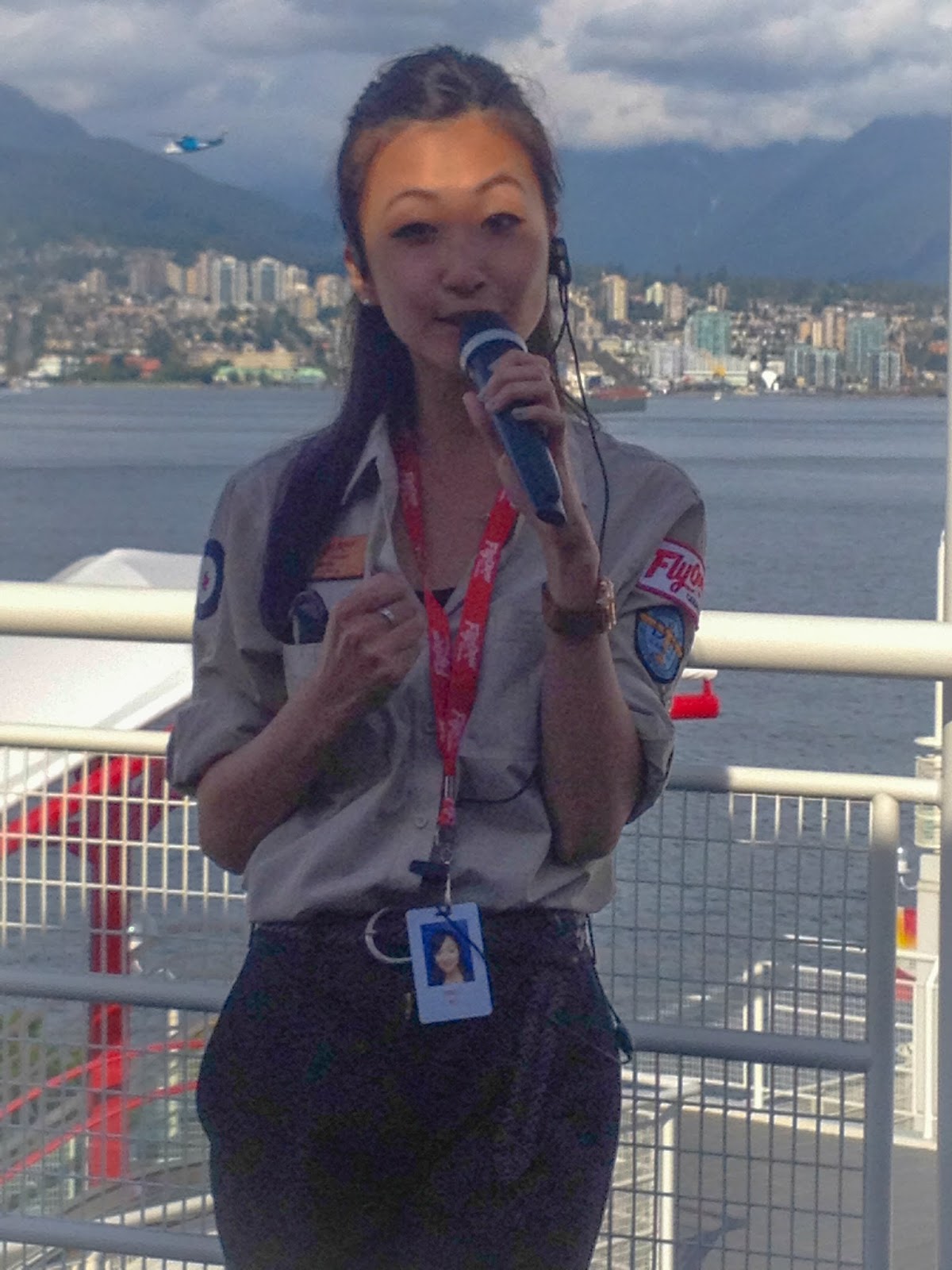
Our "flight crew" ready to serve us.
The seats bank and dive and climb as the camera pans around the vistas, which are from all over Canada, and took a year to film.

You even feel the mist from a cloud as you fly through it, the spray from rapids as you zoom down a river canyon. 

I'm not being poetic or colourful - there is a machine that is actually co-ordinated to spray you at the appropriate times throughout the film.

Up and down the mountains, across the prairies (where you can literally smell the flax seed), down rivers, past the CN Tower, along the seashore, flying above eagles soaring through mountain passes.


Hope I meet the height qualifications!
I felt myself grabbing the seat arms more than once during a steep climb or bank. At one point, the woman sitting next to me said, "Is it okay to scream?" I think she was only being semi-facetious.

All too soon, we're done our ride and the seats settle back into place as we prepare to disembark.

As we exit, I hear a horn blowing from one of the cruise ships docked at the Canada Place terminal, and for just a moment, I think, "I hope I my ship hasn't sailed without me..." before snapping back to reality and realizing I'm in a souvenir shop at the end of a virtual journey, not making an air-to-sea connection.

Before I even get a chance to look at the souvenirs available for purchase, my mind is already thinking:

Where do I get another "boarding pass...?"


Tuesday, September 10, 2013

Niagara Falls: slowly I turned ... and other great waterfall memories

John Muir wrote, "As long as I live, I’ll hear waterfalls and birds and winds sing."

There is definitely something magic about waterfalls - although usually if you're close to one, you'll be hard-pressed to hear birds or wind sing over the roar of the falls.

I've been extremely blessed in having seen waterfalls all over the world, some great gigantic falls of world renown, others very small but equally special natural places.

Here, in no particular order, are my top 10 favourite waterfalls, along with the memories and moments associated with each one.


Almost anyone who grew up watching the Three Stooges will remember the lines: "Niagara Falls - slowly I turned...step by step, inch by inch..." (If you don't, just search for it on YouTube).

I've been to Niagara Falls four times, three of those when I was 14 or younger. My first and last trips were the most memorable and meaningful to me, although all four had good memories.

The first one involved my very first road trip; I was seven, and my dad took a week off work so we could go to the falls, then spend a few days across the river in New York state. I still cherish that trip, I can still remember many details about it.

The last trip there I took in 2002, and during the trip, I visited the Niagara Falls Aviary. The falls were there, but they were secondary to my day spent with the free-flying birds.

Victoria Falls, on the Zimbabwe size.

2. Victoria Falls (Africa)

In visiting these spectacular falls, like Niagara Falls, I saw them from two different countries, as well: Zambia and Zimbabwe. They are spectacular; but what I most remember was the adventure I enjoyed below the falls, whitewater rafting through 20+ rapids on the Zambezi River. Just about drowned in a class 5 whirlpool, but I lived to tell the tale - and a great tale it is, especially when someone captures it on video!


I spent my first summer vacation as an Alberta resident exploring the central Rockies near Rocky Mountain House on horseback, in 1985. These falls presented one of the many scenic vistas during the three-day trip. We did not get really close to them; but watching them from horseback was pretty cool.

4. Cariboo Falls (B.C.)

These falls can only be accessed on foot, and only as a short hike from one of the lakes on the Bowron Lake canoe circuit. This was memorable, as it was the first canoe trip I ever took with Ann Kidston, the first summer we dated, in 1989. We survived and still paddle together today.

5. Grand Falls (New Brunswick).
The largest falls east of Niagara. That pretty much sums it up. If you follow the trail along the one side of the river below the falls, you will see some incredible vistas along the gorge.
Grand Falls, New Brunswick

6. Ragged Falls (Ontario)
Lots of memories associated with these falls, which are right outside Algonquin Park, just a short drive from the west entrance. Years ago on my very first canoe trip that did not involve an older adult supervising, me and a buddy decided to sleep up on top of the falls, under the stars. You are not really supposed to do that, but it was late when we got there, we decided it would be just as easy to sleep there, rather than getting back in the car, driving into the park and trying to find a campsite (that we were only going to use for sleep) in the dark. It was incredible, hearing the falls on either side of the rock we slept on, watching all the stars above. Very special.

7/8. Two different sets of falls in Belize.

Neither of these falls had names - but they are memorable for a couple of reasons. The first one was in the Cockscomb Basin Jaguar Sanctuary. It was our first jungle waterfall. And while we did not see any jaguars, we could hear parrots and other birds squawking while we slogged down the jungle trail to a small waterfall and pool which we all eagerly dove into, to help cool us down.

The second one was bigger, and was in the pine savanna forest of Belize; we had to ride horses to get there. It was also cool and refreshing, after our ride. We also had lunch there, prepared by our Mayan guides.
Plenty of gorgeous waterfalls - like Akaka - in Hawaii.

9. Akaka Falls (Hawaii).
It is in Hawaii. It is gorgeous, the first (of many, I hope) waterfalls I will see there. What more needs to be said?

10. Widgeon Falls (B.C.)
This also involved paddling: we canoed through Widgeon Slough from Grant Narrows on the Pitt River, an hour east of Vancouver. 

We camped overnight at the recreation area campsite, then hiked up to the falls the next morning, then returned home that day. Great trip!

Other honourable mentions: Athabasca Falls (Jasper), an unnamed waterfall in Ecuador, Sheep River Falls in Alberta, Elk Falls near Campbell River, B.C. Alexander Falls, south of Whistler, B.C. and Bijoux Falls along Highway 97 in B.C. 


Friday, May 6, 2011

All a-b-o-a-r-d!

In the movie, It's a Wonderful Life, George Bailey (played by the actor James Stewart) says: "You know what the three most exciting sounds in the world are? ... Anchor chains, plane motors, and train whistles."
As someone who has chosen travel writing as a vocation, I'm obviously in full agreement with all of those. But these days, you rarely hear the anchor of a ship going up (at least on most modern cruises), and plane motors are really the whine of jet engines - not quite as romantic.

However, you can still hear train whistles; whether traveling on a train or just sitting at home at night, hearing the lonely sound off in the distance, there is still something about that sound that seems to awaken the wanderlust in me, beckoning me to yet another destination, another adventure.

All aboard! (Photo courtesy of Via Rail)

In my daily perusing of the twitter-scape, I just learned today that there is actually a National Train Day in the U.S., to celebrate train travel.

Wow! What a cool idea! There are events in various cities across the U.S. to mark the occasion.

This brings back reminiscences of my most memorable train trip.

It took place back in 2007, and actually completed, in a loose sort of way, a dream I'd held for many years of traversing Canada by train, coast-to-coast.

I say "loosely" because the two legs of my journey were separated by about 30 years.

While attending the University of New Brunswick in my student days, on more than one occasion, I ended up taking the train from Toronto to Fredericton and back. I even went as far as Moncton once, due to a communication foul-up during a bus strike in the Maritimes back in 1975.

At the time I thought, "Wouldn't it be cool to go right across Canada by train, like people might have done back in the late 19th century?" when it was the only way to safely and quickly get from the east to the west.

Flash forward to 2007: The Travel Media Association of Canada's annual conference took place in London, Ontario.

One of the TMAC industry members, VIA Rail, offered writers attending the conference an "offer we couldn't refuse," and many of us took it. For me, that meant traveling by rail from Vancouver to Toronto, thus completing the circuit I began three decades earlier.

Moncton was as far east as I ever went by train, so I guess, technically, I haven't gone "coast-to-coast," but you know what? That's okay by me.

The two legs were quite different.

During my train trips between Toronto and Fredericton (the latter, by the way, is the host city for the 2012 TMAC conference), I often traveled "economy" class. That meant I spent an overnight trip sleeping in my chair. Not the greatest way to go, but certainly the cheapest.

On one or two occasions, I actually had a berth, meaning I could sleep lying down in a proper bed. Better than economy, but still not much privacy or flexibility.

However, on the 2007 trip, it was a stateroom, all the way! My own room, bed, bathroom and sink, as well as a closet for my luggage and a porter to look after me. Now that's the way to travel!

You know it's going to be a good trip when you're welcomed on board with a serving of complimentary champagne in the Dome Car.

Royal York Hotel
(Photo courtesy of Fairmont)
 The meals served on board in the dining car were exquisite; we were given a choice of wines with the meal and we could purchase other alcoholic beverages if we so desired.

Much of our free time was spent in the Dome Car, watching the mountain, then prairie, then Canadian shield scenery roll by. When not there, we could often be found socializing in the lounge car, where tea and nibblies were served every afternoon. We could also choose to stay in our rooms and read, nap, journal or just watch the countryside roll by - the ability to do the latter being one of the great assets of a train journey.

As with any journey worth making, there were some interesting and humorous situations that arose during our trip. Like when some of the water pipes froze, causing the water from my sink (and whiskers from shaving) to back up and rise into the sink of my neighbor's stateroom! Luckily, it turned out to be Andrew Renton , a long-time colleague and pal of mine, and we both had a laugh about it.

Trying to shower in a moving train always proved to be an interesting experience as well.

There were also some wistful remembrances for me as we passed through northern Ontario. It was in the dark of early morning, but I said a silent "Hello, old friend," as we passed the community of Gogama. I'd spent an entire summer based near there in 1973 when I worked in the province's junior forest ranger program. It was still arguably one of the best summers of my entire life. It later influenced me in a way I never could have guessed: a forest ranger there recommended I try UNB for forestry. I ended up going there, and it actually resulted in my career in the media, a result of being bit by the student radio/newspaper bug. But that's another story...

We rolled into Toronto's Union Station at about 3 o'clock in the morning, across the street from the beautiful Fairmont Royal York Hotel - alas, too late for our "Valentine's Night Drink" in the hotel lounge, but not too late to appreciate the splendour and majesty of my home for the night.

And while I may have been too tired to realize it then, later that morning, while enjoying a much needed hot bath, it did dawn on me that I had completed that cross-country journey wished for so many years ago. I'd linked the two chains together, finally, fulfilling that dream of my youth.

Thursday, April 28, 2011

Stepping through a portal to the past at Ottawa's Diefenbunker

Ghosts. I could swear there were ghosts, I just couldn't see them or hear them as I walked the halls of the Diefenbunker, a.k.a., Canada's Cold War Museum.

The facility is a huge four-storey bunker, buried deep under a hillside in the rural area outside Ottawa, Canada's capital city. It was originally built in the late 1950's and early 1960's, under the orders of the Prime Minister, John Diefenbaker, (hence its name) to house crucial elements of the Canadian government in the event a nuclear war broke out.

Thankfully, that never happened. However, it was only recently - 1994 to be exact - that the facility was de-commissioned and eventually turned into a museum.
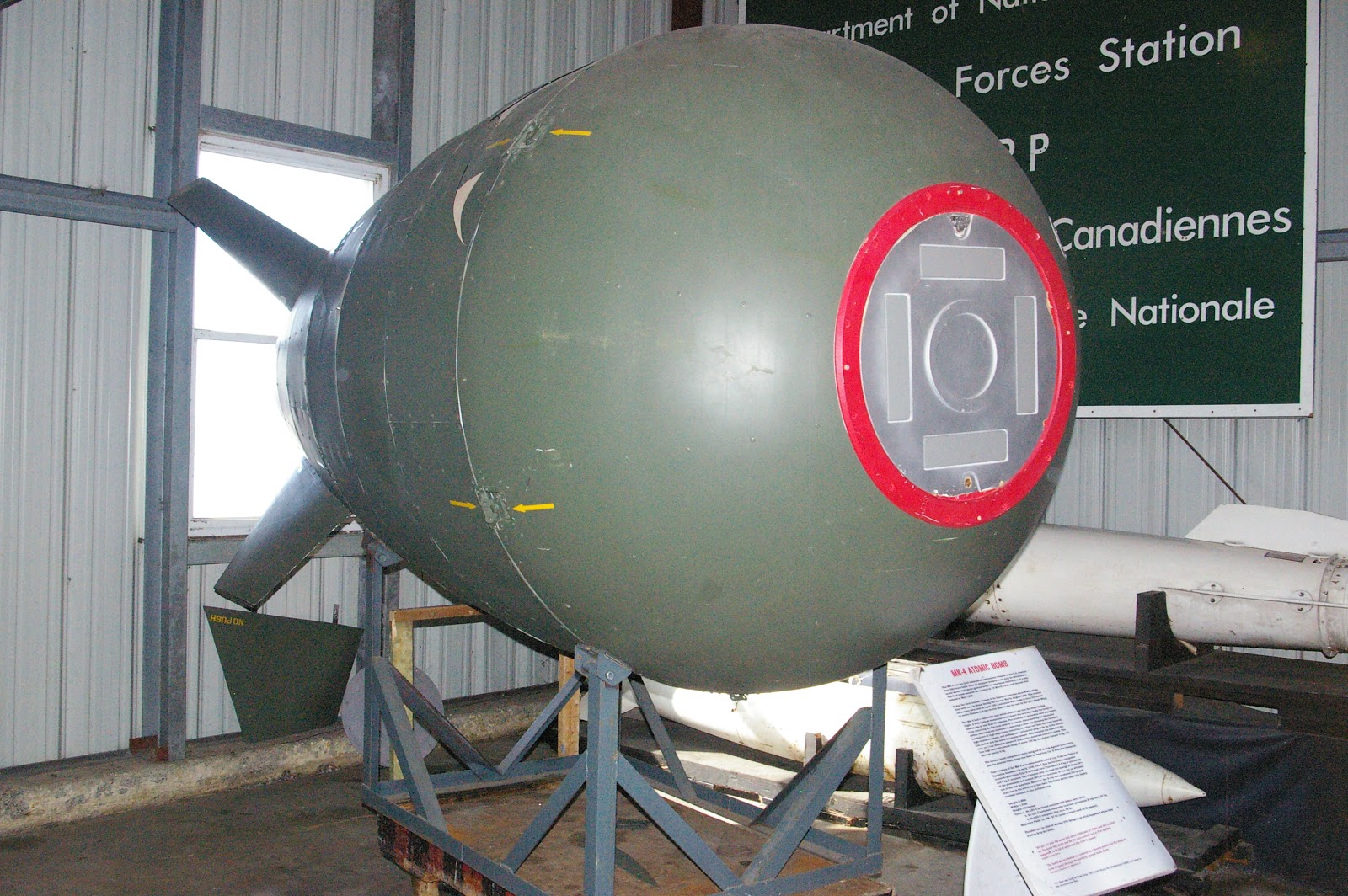
Fatboy Atomic Bomb.

Walking through the long tunnel leading into a hillside and down into the four levels gave me a bit of a chill, and not just because it was a cold, damp March day. It made me think how seriously people feared an actual Atomic Armageddon back then. Not that we don't live in trying times today, but walking past the empty shells of atomic "Fat Boy" and hydrogen bombs in the entrance way is bound to give anyone pause for thought, I would venture.

The museum features some of the original equipment along with much newer replica equipment sent down to replace the materials removed when the armed forces pulled out of it back in the mid-90's.


Making the long trek down the tunnel.
You have to pass through the decontamination chambers as you come into the building, rooms where people showered then got Geiger-countered before being allowed to pass in. We visited the surgery, the war room (where the P-M and all the heads of the government dept.'s and military) would convene to plan the future of a war-torn continent. Shades of the movie Dr. Strangelove...

The entire facility is very institutional, right down to the pale green paint on the walls and the durable, functional furniture on display.

The cafeteria is still there, and while you can't get a meal there, you can sample modern-day K-rations, the food armies travel on.

Supposedly, Canadian rations are among the best in the world. The chili and beans weren't bad (better if you're camping out, I suppose) but if this is the best, I'd sure hate to see the worst ...

Of course, there is a gift shop where you can purchase several kitsch-y items as well as some less tacky souvenirs.


K-rations, anyone?

Although it is a bit sombre, it's heritage is a part of our past - our recent past - and all sombreness aside, it's kind of a cool place to visit.

And although you might feel like they're there, I doubt if will find any ghosts lurking about, even though there is a bit of a haunting, haunted quality about the place.

And as you leave, you might want to say a prayer of thanks that it never actually had to be used ...