A blog about my travels around the world, in search of wild parrots, great paddling opportunities and incredibly eclectic travel experiences, I try to make a difference by connecting people with nature, people with other cultures, and people with themselves by sharing my stories.
The past few years, there's been a new sort of travel niche forming.
While "literary travel" has been around for quite some time - the practice of visiting real world places where literary events and stories have occurred - the 21st century has seen the rise of what, for lack of a better word, could be called "fantasy travel."
You can take a pre-scheduled, all-arranged tour, or just buy a book and use it as a guide, as there are several books that will offer readers a chance to follow in Holmes' footsteps.
This book helps you create your own Holmes tour.
On a wider scale, you can take similar tours with a King Arthur/Camelot theme. You can set them up with a tour company or even design your own, with stops at places like Glastonbury Tor, Tintagel, or Stonehenge, to name but a few.
I was following in the footsteps of the real-life author, though, not one of his books.
While there are many tours designed around visiting the haunts of historical or fictional figures, and plenty of books written to help guide would-be travellers around from place to place, ever since the start of the 21st century it seems people are interested in visiting not only real world places in imaginary stories, they want to go to the real-world locations of fictional places.
Once that first movie came out, tourism and travel interest in New Zealand exploded, with hordes of would-be elves, hobbits, and other fans of the movie descending upon that country located in the southern reaches of the planet to see the places where their beloved movies had actually been shot.
Now that's taken an even bigger step forward since Game of Thrones hit the airwaves on HBO.
That series, now in it's sixth season, has spawned an incredible array of tours and activities all built around the fictional kingdom of Westeros. They are far too numerous to list them here; but there are bus tours and beer tours and trips to Ireland and Iceland, Croatia and Dubrovnik. The possibilities are as endless as Tyrion Lannister's taste for wine and wenches.
The closest I've ever come to experiencing anything like that was the Medieval Times Dinner & Tournament. But it's just a one-night activity, and if you're in a place like Toronto, it's right there.
On a bit different scale, there are all kinds of James Bond experiences to be had, as well. You can learn to drive like Bond, drink like Bond, there's even a seven-day world tour ultimate James Bond experience. Given the nature of the films, and their penchant for settings all over the world, this too is ripe with possibilities.
I go to a great many symposiums and workshops that contain elements of professional development included in their schedules.
These workshops can vary quite a bit in terms of content, from topics like pitching editors, photography, business planning... I've even been to one that included a session on fitness for writers, both on the road and while at home.
And in reference to this post's title, yes, yoga can be a great boon for travel writers - or for that matter, travellers of any ilk.
But the physical malleability required for something like yoga is only one aspect of flexibility.
Emotional-mental flexibility is a quality often overlooked, but vital to develop if you spend any time travelling, especially out of the country, or for that matter, any great distance even within your country, particularly countries as large as Canada or the U.S.
It's overlooked, which is probably why I've never seen a workshop session about the importance of keeping an open mind and not being fazed by unexpected circumstances or detours while travelling.
I was recently reminded of the importance of being flexible with respect to a day-trip I had planned.
My "partner-in-crime," the indefatigable Divine Ms. K. and I planned to go to the Sea-to-Sky Gondola at Squamish, B.C. We'd bought tickets back in December, but hadn't had an opportunity to use them. They expired in April, and we planned to go on/around the 16th of that month. However, the morning of the 13th, she realized she had to make plans to fly out of town for business the very next day.
Rather than wring our hands and bemoan the fact we'd lose the tickets, we just spent an hour or two re-arranging our day and by noon we were off on our local outdoor adventure.
Now while it may seem not that big a deal, when you run several businesses as a self-employed couple, it's not always easy to change plans on a moment's notice. But we did it, partially because we've developed the ability to go with the flow and be flexible.
That same attitude can help on more distant, more lengthy journeys, as well. I've had to do it twice in South America, a couple of times in Africa, and on many trips in Canada.
While it may seem like a waste of time to try to teach "travel flexibility" in a workshop setting, as so many take something like that for granted, there are books and other resources that address general flexibility that teach techniques which can be applied to travel.
So, there's really no excuse. Being flexible mentally will not only help you be a better traveller, you'll probably handle life a whole lot better, too.
Just keep in mind the words of from "Cowboy in the Jungle," a Jimmy Buffet tune.
"We've gotta roll with the punches,
Learn to play all of our hunches,
Make the best of whatever comes our way..."
Usually, I write about travel in this space, although that does encompass a broad spectrum of sub-genres.
Today, I'm reviewing a book. Tuco is not a travel book, although the author, Brian Brett, does describe some of his travels in places like British Columbia, Mexico, Thailand, and other destinations in the book.
At some point, paddling is mentioned in the book, although not in a big way.
It's also not a book about the third of the three protagonists in the Sergio Leone 1967 spaghetti western, "The Good, the Bad, and the Ugly," played with panache by Eli Wallach. (Although as the author reveals, there is a connection with the movie.)
The book is about the author's relationship with his African grey parrot. It
is an excellent read, and you don't have to have lived with a parrot to appreciate it. While Brett's
relationship with his African grey is an important part of the book, it's also a springboard for much deeper conversations about the
world we live in and the way we relate to it.
Subtitled, The Parrot, the Others and a Scattershot World, A Life with Birds, Brett delves into his relationship not just with Tuco, but with other birds and the world at large. The book actually is a third version of a three-set volume that is a memoir of his life and its struggles, paralleled by the struggles humankind has in the world, struggles to accept others as they are, struggles to prosper without destroying the world - a "scattershot" world as Brett views it - and how they are both reflected in this out-of-place bird's life. I say out of place, because Brett views Tuco as an "other" of sorts. He himself was an "other," an outsider growing up, because of being born with Kallman syndrome (a condition that causes a form of androgyny) that created huge issues for him as he entered puberty and grew into young adulthood. "Othering" is what we all do to various degrees to anything we see as strange or different. It's othering that often mutates into bullying, something Brett put up with frequently while growing up in British Columbia.
We "other" birds, animals, people of different religions, races, sexual orientations - the list is almost endless.
The theme of othering crops up many times in the narrative as Brett weaves his way through a tapestry of topics that include science, environmentalism, animal cruelty, bird-watching, travel, small-town politics, his early experiences with pet birds, and life with an African grey parrot.
It's all enjoyable to read, but as someone who has spent close to a quarter-century living with African grey parrots, those anecdotes about Tuco's antics were the most enjoyable, the parts I re-read over and over again, sometimes aloud to anyone who would listen (or anyone who would read the passages I posted on my Facebook page regularly while reading the book.) And there were so many of them that reflect and almost eerily parallel the experiences I've had with my greys. For example:
"When a joke is told in our house, Tuco is always the first to laugh,
chiming in milliseconds before anyone else. Does he get the joke?
Probably not. What he does is even smarter. ... For Tuco, the
crucial factor in a joke is not the joke but the way it makes us behave.
He measures the speaker's tone and recognizes it's a joke, not a drama
or narration of events. Then, if he is in the room, assessing the
speaker's inflections and body language, he can anticipate the timing of
the punchline faster than any person can, and that's why he always
beats us to the laugh."
That happens all the time in our house with my 15-year-old grey, Coco.
The book is full of passages like that, stories that will have anyone who lives with parrots smiling, and perhaps even chuckling out loud. Even those who do not live with parrots will find them humorous - and perhaps a bit hard to believe. But believe me, all the stuff he describes in the book about Tuco's behaviour is real. Most parrot keepers have experienced even more bizarre or outrageous behaviours by their feathered companions.
Tuco is one of the rare books that both entertains and informs. It also stimulates thought and introspection about how we view life, how we might deal with some of the issues described in the book.
The author does reach some conclusions, of sorts, and while I won't tell you what they are, some of what I read still percolates around my coffeepot of a brain, occasionally seeping out through its filters into my conscious.
If you want to read a book that is just silly parrot stories, you might be disappointed. However, if you want to read a book full of those that also deals with some much more serious life issues - like bullying, environmentalism, or dealing with death - then this is a read for you.
If you have to fly in December, you might as well fly a biplane.
Christmas travel and I are old friends.
From the time I went to university, until the time I graduated, every Christmas would involve travelling from UNB in Fredericton, New Brunswick, home to Toronto, then back again two weeks later.
That didn't change a whole lot when I graduated and moved out west to Alberta. Every other year, I'd fly home to Toronto to spend time with family. When I moved to Fort St. John, B.C. that continued, in fact, it increased. It seemed every third year I'd go to Fort Nelson to visit Ann's family, followed the next year by a Toronto trip, then one year at home.
I'm really glad I don't travel too much at Christmas, any more. The last time I went anywhere in December was 2004, when I spent a wonderful week in the Titusville area, paddling among alligators, riding in bi-planes, visiting the Kennedy Space Centre and birding.
I love spending Christmas at home with my human-parrot flock (Ann, Coco, Einstein, until this year, Nikki, and now newcomer Congo).
I really enjoy watching many of the Christmas movies that come out every year. It dawned on me just recently that many of them involve travel - including five of my favourites.
Here they are in a countdown...
5. It's a Wonderful Life.At first glance you might say, "Where's the travel?" It's hinted at, more than actually done. Jimmy Stewart's "George Bailey" wants to travel, buys a big suitcase to go - but can never leave, because of family commitments coming up every time he's about to catch a train. His honeymoon is spent in a rundown house festooned with travel posters. And then there's those classic quotes: "Do you know the three most exciting sounds in the world? ...
Anchor chains, plane motors, and train whistles," and, "I'm gonna see the world. Italy, Greece, the Parthenon, the
Colosseum." So yeah, there is a strong element of travel in the story.
George Bailey would've used a suitcase like this. (morguefile.com)
4. Christmas in Connecticut. A romantic comedy featuring Barbara Stanwyck as a magazine food columnist who is not what she appears to be. It revolves around a trip from New York to Connecticut to convince the publisher she is a married woman on a farm - not a writer in Manhattan. Lots of gags and funny lines, great watch for couples and families.
3. Christmas with the Kranks.A daughter travelling to South America (then back), a Christmas cruise - it has travel written all over it. Hilarious physical comedy scenes with Tim Allen and Jamie Lee Curtis (especially the restaurant scene!), and Dan Akroyd as well as some very heart-warming moments make it a funny flick as well as good holiday fare. Good fun for all.
2. Home Alone/Home Alone 2. A trip to Paris. A trip to Florida. A trip to New York. Yeah, it's all based around holiday travel. But that's not why I watch them yearly. It's the incredible physical comedy by Macaulay Culkin, Daniel Stern and Joe Pesci, reminiscent of the Three Stooges shorts. Some great supporting actors pitch in, as well, like John Candy and Tim Curry. And when you watch it, don't forget to order the cheese pizza...
And the Number 1 Christmas movie that involves travel is...
1. A Christmas Carol (1951). There are at least 15 different movie versions of this Dickens story, and that's not counting cartoons or those flicks based loosely on this story. The Alister Sims version is the best in my opinion.
While the travel consists mainly of visiting locations in England, it ALSO involves time travel, back into the past as well as into the future.
And that would make it "king" in terms of travel in any Christmas movie.
Merry Christmas!
Who can forget some of the classic airport scenes in Home Alone and Home Alone 2?
Travel writers often desire to write about our own special memories of a place when that place is in the news like Paris has been the past week, particularly if it involves tragedy.
Unfortunately, the only memory I have of Paris involves running through Orly International Airport, trying to make a connecting flight to Madrid, Spain.
I was en route to Tenerife in the Canary Islands to attend an international parrot symposium at Loro Parque; I'd flown into Heathrow early that morning and my flight through the Netherlands had been cancelled, and re-routed through France.
Someone from Air France had me de-plane ahead of everyone else and led me on a run through a series of back doors and empty hallways to get me to the plane on time. I distinctly felt like I was stuck in a Home Alone movie, and I kept waiting for the theme music or "Run, Rudolph, Run" to begin playing.
Nothing to do with Paris - plenty to do with parrots in the Canary Islands.
I did make it. But I had no chance to even think about soaking up anything vaguely French in the airport. I haven't been back, since.
Now, some of my favourite movies of all time revolve around, or are set in, Paris. Movies like...
Casablanca ("We'll always have Paris!")
The Three Musketeers ("One for all, and all for one!")
The Hunchback of Notre Dame ("Sanctuary! Sanctuary!")
Irma La Douce ("But that's another story...")
But, those films and a few others, along with my quick run through Orly are all I have to draw on in terms of memories of Paris.
Sadly, with the kind of event that took place on Friday, Nov. 13, 2015, there is a great deal of backlash that is unfortunate and undeserved.
I'm talking about reactions like burning mosques in Peterborough, Ontario...attacking a Muslim mother in Toronto as she went to pick up her children at school...those are just a few examples of the wrong types of knee-jerk reactions - the key word there being "jerk." As in the people doing that.
I won't spend much more time on that, as this is largely a travel blog, and others have written ad infinitum about that in political columns, on op-ed pages of newspapers, and so on.
With the anger, there is also an aura of fear.
No one wants to travel to Paris - or many other places right now.
What I will suggest is the one thing we CANNOT do is to stop travelling. To Paris - or anywhere. That way the terrorists win. It shrinks the world, it puts up more walls, burns more bridges, when we should be tearing down walls and building bridges.
Travel can help do that.
Travel helps us connect to others, to people around
the world, it helps us to understand we are just like them, and they
like us.
For as Mark Twain said...
“Travel is fatal to prejudice, bigotry, and
narrow-mindedness, and many of our people need it sorely on these accounts.
Broad, wholesome, charitable views of men and things cannot be acquired by
vegetating in one little corner of the earth all one's lifetime.”
People need
to let go of the fear and let go of the perception that Muslims are different and that all Muslims are terrorists. And we need to travel. Hell, travel to a Muslim country (make sure it's a moderate one, mind you.)
Azlina, our Muslim guide in Malaysia: a very warm and knowledgeable hostess.
I've
travelled in a Muslim country - Malaysia - and I did not really feel any different
than I did travelling anywhere else in the world.
There may be a
few dress codes that seem a bit more conservative than in our own North
American or European cities - but that's also true in the very Christian African country of Malawi (more so, in fact, as I can attest to, having been there myself).
I
found Malaysia actually had a very tolerant attitude toward all
religious faiths.
In one city street, in the course of a few blocks,
there were Mosques, Christian churches, Hindu and Buddhist temples. I
wonder if the same can be said of other places in the world?
We need to keep travelling, to meet others, to build bridges, not burn them...tear down walls, not build them up - and the process, build friendships the world over.
For as another great writer, Robert Louis Stevenson (who visited Paris while paddling around France) said...
"We are all travelers in the wilderness of this world, and
the best we can find in our travels is an honest friend."
So go, travel, find an honest friend.
Now to leave you with a song about Paris, from another writer, balladeer Jimmy Buffet...
"I'll gladly pay you Tuesday, for a hamburger today." - J. Wellington Wimpy
Those who really known me know I love burgers. I'm always on the lookout for a good burger and in Vancouver I'm always looking for new burger joints.
In the past month, I've found two new ones, one just last week.
That lunch last week got me thinking about my quest for burgers. I travel a lot, so I obviously got to thinking of all the places in the world where I've enjoyed a burger outside of Vancouver. While it is a North American dish, it is sold internationally - although you wouldn't expect the best burgers would be easily found in other countries.
The site of my first international burger, outside Belmopan.
However, I have enjoyed my share of burgers internationally as well as around Canada and the United States.
My first "out-of-country" burger was in Belize, my first out-of-country trip (aside from the U.S., which I'd been travelling in and out of, since I was seven)
We'd been kayaking, caving, exploring ruins and horseback riding in the jungles and highlands of that country for close to two weeks - all on a diet of seafood, chicken, rice-and-beans, and vegetarian fare.
So we were C-R-A-V-I-N-G some burgers in the worst possible way. Luckily, on our last day of the trip we were able to feed that craving, and feed it twice: once at the Belize Rodeo, and once at JB's Watering Hole, near the capital of Belmopan. They probably weren't the best burgers, but sitting in JB's, quaffing a cool one and munching on a burger was like heaven.
After Belize, the trips began to pile up, but I don't remember eating burgers in Africa, Ecuador, or any place else, until I went to the Rainforest Music Festival on Borneo, in Malaysia. And I have to confess, I didn't eat a "Malaysian burger."
A burger at BK in Bangkok.
I ate at Burger King.
After 17 days of really good local food, I was craving a burger. So, at the airport in Kuala Lumpur, the day I was leaving, I purchased a burger. I never eat at BK at home, but there it seemed like burger heaven (nothing like the place in New Westminster, B.C. though!)
I tried to do it earlier this year when exiting from Mexico, but there was no BK to be found in the Puerto Vallarta airport. So I ate at Johnny Rocket's. Probably better than BK, but the next time I exit from another foreign airport, I will try to find a BK (tradition, you know?)
I've enjoyed many, many burgers in the U.S. A few memorable ones include the signature burger at The Saltwater Cowboy on St. Simon's Island, Georgia; the signature burger at A Cheeseburger in Parrotdise in the Little Torch Key, Florida (both since closed, unfortunately) - not to mention the burger named after Jimmy Buffet's classic song at his restaurant in Key West; and the Market Square Burger at Winghart's in Pittsburgh.
As far as Canada goes...
Who's up for a poutine burger?
Since this is where I've live, this is obviously we're I've enjoyed the most burgers. I've had my share of burgers from fast food outlets in almost every province I've lived in and visited: the Yukon, B.C., Alberta, Saskatchewan, Manitoba, Ontario, Quebec, New Brunswick, and Nova Scotia- but not PEI or Newfoundland. (I've been to PEI, but not long enough for a burger, and I have yet to see Newfoundland.)
I've visited so many burger joints, I can't really recall them all.
I was going through some boxes, sorting through some old photographs the other day, reminders of what photography was like in the pre-digital days.
While sifting through the piles of old prints, I stumbled upon some items I'd almost forgotten I had. I found postcards sent to me from vacationing friends during my elementary school days. One was from Jamaica, with a picture of a map of the island on the front. Another showed a man dressed in a native costume in front of a tepee from Keswick, Ontario.
Digging further, I found postcards my mom sent me from Hawaii, Florida, Arizona, Colombia, and several other places from around the Western Hemisphere.
I also discovered several unused postcards purchased during my very first trip to Algonquin Park in Ontario. We used to buy them to be sure to have some really good print images to go along with the ones we shot with our Kodak Instamatics and Duaflex's because back then, the odds of getting a good shot of deer or a bear with those kinds of cameras were slim-to-none. In fact, I remember when starting out on our very first hike, my dad told me, "Now if you see a bear, don't stop to take its picture!"
So I have postcards of bears, deer, wolves, skunks, and raccoons from Algonquin.
Not only had I forgotten about those postcards, I'd almost forgotten that postcards existed, period. I mean, the last time I sent postcards from anywhere was from Africa back in the 90's.
In this age of Skype and I-M, Google Talk and Face Time, texting and email, postcards seem like a quaint reminder of yesteryear, something vacationers used to use to share their trip with their loved ones.
From what I can ascertain, the production of postcards began, at least in North America, in the mid-19th century, about the same time the science of photography took off and transportation advances made postal service more reliable.
As leisure time increased, the postcard industry took off. Pretty soon, any gift shop at any kind of tourist facility sold them. They became a regular part of any travel routine that lasted more than a few days. Some would go into photo albums, as even today deltiology - the collection of postcards - is quite a popular hobby.
Others would end up in the mail. People took address books with them when they travelled so they could send a quick note back to their friends and families via the postal service. Kind of a pre-Internet version of Twitter or Instagram.
Unlike the Internet though, and depending on how long one vacationed, the postcards often arrived to their desired destination after you'd already returned home. Rather than annoy people though, that became part of a running joke.
Postcards for a collection.
Once the Internet arrived, and I started travelling professionally, I stopped taking vacation snapshots and I certainly didn't have time to send postcards. I basically stopped being aware of them. They might be there at the counter as I was paying for pack of gum or a bottle of water, but I wouldn't even notice them.
I only know they still exist, because someone actually gave me a postcard this past June. It was kind of a cool idea: a fellow travel blogger, Fabiano Maciel, ironically enough, purchased postcards for all the participants in a travel blogging press trip in Ontario, writing little notes on the back of each card.
I thought that was a really nice gesture, and it really speaks to what postcards are all about.
Reading those written thoughts from the past from childhood friends on the back of the postcards I'd re-discovered instantly transported me back to those days. They brought back many warm memories, those short notes freezing those moments in time. They wielded a power that no email or text message could ever hope to invoke. Does anyone save emails or text messages? Very, very rarely I would wager - and then the emails have to be printed out.
On the other hand, I'd saved those postcards, those messages and images from the past because they meant something to me emotionally. The images actually didn't mean much, but the messages certainly did.
Especially the cards from my mom, since she passed away several years ago.
Saved postcards are like instant time machines that depend on no technology, whisking us back in time - something no electronic tweet or post can do a decade down the road.
So maybe the next time you go on holidays, buy a postcard or two, send it to the people you care about.
You might be giving them a time machine of their own, one they ride some day in the future and recall the warm memories of your relationship.
When I was a kid growing up in Newmarket, Ontario, I never spent any time in or around Peterborough. My relationship with the city consisted of turning on CHEX-TV to watch a hockey game not on the regular CBC stations or a football game that was blacked out in the immediate Toronto area.
Peterborough was always that place that I was in a hurry to get through or past or around to get to Algonquin Provincial Park and later, Outlet Beach (now Sandbanks) Provincial Park.
My dad and I almost stayed at a fishing marina outside Peterborough one summer trip, but neither of us was much of a fisherman, it wasn't really set up for camping (although there was a place to pitch a tent) so I voted to go to Algonquin instead and off we went.
Learning to carve a canoe paddle with Russ Parker.
Later on, it was that place that Roger Neilson coached (the OHL's Petes) before beginning his NHL career in Toronto with the Maple Leafs. (A street in Peterborough is named after the late icon).
Of course, all of that was before a group of far-sighted individuals established the Canadian Canoe Museum. It also pre-dated the establishment of many of the great provincial parks like Kawarthas Highlands and Petroglyphs Provicinal Parks in the area.
And it was probably before the local dining scene, craft beer industry, wide diversity of independent coffee shops and many of the other aspects of current life that made Peterborough the thriving but very liveable community it is today.
I'm now finally getting the chance to explore the area and everything it has to offer.
Brewmaster Doug Warren serves up some craft beer.
So far, I've spent two days carving a canoe paddle at the canoe museum, followed by a paddle across Little Lake (which boasts its own huge fountain in the middle of the lake). I also enjoyed several fine meals and sampled some of the craft beers mentioned above.
I expect that to continue over the next few days with another visit to the canoe museum (yeah, I'm a canoehead!) a possible river cruise along the Trent River, and more fine dining (Peterborough actually has more restaurants per capita than Toronto).
So in many ways, I'm getting the best of Peterborough, arguably a better experience than I might have had all those years ago as a youngster.
I can certainly appreciate these kinds of enjoyments better than I would have back then.
So from my perspective, I waited until just the perfect time.
Good things really do come to those who wait...
View of the river from the balcony of my hotel room at Best Western Otonabbee Inn.
Dad fixes the tent, our first ever camping trip in Ontario. He passed away while we were both on camping weekends.
A couple of weeks ago, I blogged about odd travel traditions. Many of us have them, and we look foward to practising them every time we leave for a trip.
However, there is one rather odd and somewhat sobering travel tradition that seems to pop up in my life with some disturbing frequency.
It seems people in my immediate family often choose to die when I am away on a trip of some kind.
That's not to say every time I travel, somebody close to me passes away. If that really was the case, I might stop travelling. Or at least give it some strong consideration.
I guess it could be seen as just one of those weird quirks that happens because I'm a travel writer, and I'm probably away travelling more than the average person.
However, this disturbing trend developed before I started travel writing seriously.
In 1992, my father passed away while I was on a weekend camping trip, at Bear Mountain, near Dawson Creek, B.C (yes, there is a real place by that name - not "Dawson's Creek' - and it's been around for a long time). It happened on a Saturday night, the night before Father's Day. We didn't have cellphones then, so no one could get in touch with me until I returned home Sunday afternoon.
Close to 10 years later, my father-in-law passed away just as we were heading out to enter Lakeland Provincial Park, Alberta, for a four-day canoe trip. If we had been a few hours earlier heading out, we might not have known for four days.
That one was particularly tough. Mom had been ill for quite a while with Myelodysplastic syndrome and had gone into the hospital in Toronto a few weeks before. She never got out.
It was tough for many reasons. An only child, it meant I had no immediate family left - no parents, no siblings - in some ways, I'd never felt more alone, even though I had other family members to help me get through my grief period.
An egret wading in the 10,000 Islands. I shot this image the morning my mother passed away.
What made it more difficult was the fact I was so far away - and I was only halfway through the trip, as I'd made plans to spend a week in the Florida Keys following the paddling trip with Crystal Seas Kayaking. I had interviews lined up with some parrot sanctuaries and tourist facilities, lodging arranged for, and flights booked. And I had to complete the second half of my journey with a heavy heart.
I know many people would have returned home as soon as they found out. However, the life of a freelance travel writer sometimes demands that you make sacrifices, make choices, that people who are just vacationing, do not have to make.
That's one of the things the average person probably does not consider when they imagine what a travel writer does for a living. Once a schedule of accomodations, meals, and other elements of a trip have been set up with tourism boards, a travel writer has an obligation to fulfill those, particularly when the rooms have been set aside, and usually paid for by the boards - and they won't be getting a refund for them.
Also, if a story has been already promised to a publication, the writer needs to try to meet that committment. Leaving a destination, then trying to return later, rarely works out. While most editors and most tourism boards will understand in the event of a death in the family, they may still hesitate to work with you going forward.
I certainly would never judge or criticize anyone in a situation like this, no matter what their choice. It is their life, their decision.
However, that kind of decision is never easy to make. I struggled, and in the end I chose to stay and try to meet my commitments. I know that's what my mother would have wanted me to do, had she been given the choice, and knowing that, the choice was wee bit easier than it might have been.
It certainly does bring a different feel, a different perspective to a trip, though.
This odd trend happened again, just recently.
Margaret and David, on their wedding day.
On the second day of my recent trip to Mexico the first week of May, I received a text message from an aunt in New Westminster, B.C. My uncle had passed away in a hospice, the victim of colon cancer. I hadn't actually had any contact with him much since 1971. My dad's younger brother, he moved out west suddenly back then, and shunned contact from the family.
When I moved to Vancouver in 2003, I did try to connect with him, actually spoke on the phone once, but he made it clear he really didn't want any contact. I repeatedly sent him Christmas cards with notes about meeting for coffee, but never got a response.
Then just after Easter, I got a call from his wife, Margaret, telling me he'd been hospitalized. I had a chance to finally visit with him then, for an hour or so, and I was grateful for it. A few days later, he was placed in a hospice.
Three days before I left for Mexico, a phone call came, telling me he would do well if he made it to his birthday, May 8.
Off I went to Mexico, and then came the news he had passed away two days before his birthday.
Again, that odd travel tradition had reared its head.
As it turns out, the memorial service is scheduled for the day I leave for Ontario for three weeks, so it's like a double whammy. I won't be able to attend that service.
My memories of David go back to when I was a four-year-old spending most of my days at my Grandmother Geary's house, as both my parents worked. Three memories stand out specifically.
David (who was still living at home then) had a pet bird named Joey, a budgie. So I guess my fascination with birds (like parrots) began at a very early age. That was the first pet of any kind I ever encountered. I used to sit there talking to Joey every day.
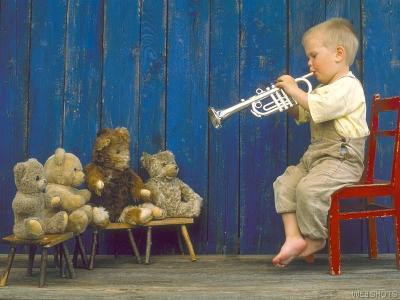
Not me - but it could easily be. But I'd be marching. (Photo via Webshots.com)
The second memory that springs to mind involves music.
When I was four, I always used to watch the old black-and-white Popeye cartoons; he was the first "super-hero" I cheered on. In many of the old 'toons, whenever Popeye would eat his spinach and get ready to beat the crap out of Bluto or some other deserving bad guy, the John Philip Sousa march, "The Stars and Stripes Forever," would start to play. So I just loved that song.
Turns out David had a copy of it in his collection of marching music. He would play it for me often, and I would march around the room in time to the music, later on adding a toy trumpet to my performance, which became a regular occurrence, at least once or twice a week.
Robin Hood blows his horn. (Image from http://benito-cereno.tumblr.com/)
The third memory includes some physical mementoes.
When David married Margaret (at the age of eight, the first wedding I ever went to, and I remember stuffing myself with sausage rolls at the reception!) and they went on their honeymoon, they brought me back several pennants from their travels in the Williamsburg, Va. area.
They also brought back a cow horn, hollowed out and complete with a mouthpiece to blow on.
It became a go-to prop for when I played Robin Hood, and later a "powder horn" for playing Daniel Boone/Davey Crockett/Hawkeye.
I still have it, and I still have the pennants.
I'll never forget any of those memories. Just like I'll never forget David.
So, what's the point of all this, in a blog that is supposed to be about travel?
It's this: Make sure the people in your life that you care about - family, friends, partners - KNOW that you care about them. Especially, try not to leave to go on any trip on bad terms with the important people in your life. God forbid, but they may not be there when you get back.
Life is a journey, but it's the people we meet along our path during that journey that help to make it so rich and rewarding. When one of them leaves, that journey seems a bit less rich.
While you're pondering that, remember this: You never know when someone you care about will be taken from you.
You have to be wary of peacocks lurking around the pool...
PUERTO VALLARTA, Mexico - I'd like to report that all is well and I've felt no threat to my safety in the four days I've been in Mexico. The only real danger threatening me was a wicked hangover from too much beer, wine and rum punch my first full day here. Oh, and maybe those pesky peacocks that hang around the resort pool, shaking their tails.
It was very interesting the various reactions prompted by the news of gang-related issues the night before I left Vancouver to fly to Mexico for the 2015 North American Travel Journalists Association conference.
A friend of mine posted a CBC link detailing the news about violence on his Facebook feed. Another friend later posted the same link as a comment in one of my posts about heading to Mexico.
All I can say is, "Now hold on there, Baba Louie..."
Let's not get carried away here.
Before getting all worked up and cancelling plans for any trip, you have to stop and assess the situation logically and with a bit of perspective.
The following headlines might certainly make you want to cancel plans to go somewhere:
"Children kept indoors after outbreak of drug-linked shootings"
"Mounties investigate drive-by shootings"
Pretty scary stuff, eh?
Except those headlines are from recent news stories in Surrey, B.C. CANADA.
No tourists were harmed in the making of this video.
I'm not making those up; they're real headlines. I'm not going to bother posting those links here - but go Google them if you don't believe me.
Does that mean you'll never go to Surrey? Or Vancouver for that matter? What if you live there?
A peck on the cheek is quite continental, a parrot is this guy's new friend...
As one friend put it, regarding danger in Mexico, "You're more likely to be shot in Surrey these days than in Mexico!"
Granted, we travel writers do live in a bit of a bubble at these kinds of events. But then so do most tourists on vacation.
I've been too busy enjoying myself, eating great food, meeting wonderful people (and even a few new parrot pals!), enjoying sunset cruises and marvelling at swimming with horses on horseback riding trips to worry much. Friday, I'll be sailing off on a pirate ship and (hopeully) doing some kayaking and/or snorkeling.
Now I'm not saying there is no danger in travelling. Common sense has to play a role in any decision. But here's the thing:
LIFE involves danger. Just going to the corner store involves an element of risk.
To dance the dance of life, you have to overcome fear.
So you can sit at home, lock your doors, and "live" a safe life, and someday you'll still die. Maybe a little more comfortably, maybe not.
But you'll die not having really lived.
As Franklin D. Roosevelt stated eloquently, "The only thing we have to fear is fear itself." So put down your fears, go out and live life.
I was 17 at the time, and it was not a large commercial jet liner I'd climbed into. It was a Turbo Beaver, a six-seat bush plane, often used for fighting forest fires, one that took from from water, not a runway Makes sense. I was in the bush, working as a junior forest ranger in Gogama, Ontario for the summer, and as a treat, they took us up for rides in a Turbo Beaver.
It was quite a ride - even after some of us were "water-bombed" during one of the takeoffs from Lake Minisinakwa (hey, it was used for fighting fires, remember?)
To quote from my (very first "travel") journal:
"In every direction we looked, nothing met our eyes but lakes and forests. It was far out!"
Actually, that was not the first time I'd flown; it was the first time I remember flying. Apparently in moving from Ottawa to Winnipeg when I was two years old, our family flew. But, of course, I don't remember that flight.
Fast forward two years from my junior forest ranger days, and I'm climbing onto an Air Canada jet in Fredericton, New Brunswick. I've just finished my first term at the University of New Brunswick, and I was flying home to Toronto for Christmas.
That became a familiar routine over the next several years, and the pattern continued, although not as often, when I graduated and moved out west.
But flying really became part of my life when I started working as a travel writer. There's no getting around. It's part of the job.
Since then, I've pretty much seen the "best of times, and the worst of times" with respect to the different airlines and the services they offer travellers.
Some of the best airlines I've flown on include Cathay Pacific (to Thailand via Hong Kong), Eva Air (to Malaysia via Taipei) and British Airways (to Africa via London). I won't get into a list of my worst flying experiences here (that's a story for another time, perhaps); but, suffice it to say, I have experienced my share of missing luggage, broken baggage, and connection SNAFUS (I remember running through the Orly Airport in Paris trying to make a connection once - I kept waiting for the Home Alone music to start playing).
When I began flying regularly in my university days, in-flight meals were almost guaranteed for any flight longer than two hours. We all know that's not the case, these days, when you're lucky to get free pretzels or cookies. But now we also have to pay for checking baggage, for not checking baggage, to get a blanket or pillow - the things we always used to take for granted.
Mind you, we do have state-of-the-art technology to get us from Point A to Point B these days; however, I sure would have liked to experience flying in the so-called Golden Age of Flying.
Economy airlines are the norm, these days. (John Geary clip)
Having experienced major muscle cramps and knots after flying economy class halfway across the Western Hemisphere, I certainly like the idea of wider seats with more leg room. And the idea of large lounges or stand-up bars in plane also appeals to me. (India's Kingfisher Airlines did have stand-up bars in some of its planes - what would you expect from an airline owned by a brewery? - but that didn't save it from bankruptcy.)
As well, I think the idea of flying on a plane with curtained berths for sleeping at night would be cool.
And back then, there was virtually no security like we have to go through today to board a plane.
I think flying in a large flying boat (think, Indiana Jones) would be a great experience to enjoy, at least once, anyway.
However, flying back then may not have been all it was cracked up to be. There is a certain romance associated with flying in the 1940s, '50s and early '60s that all nostalgia tends to stimulate - and like most nostalgia, perhaps colours the situation a bit more favourably than how it really was.
Who wouldn't be enticed to fly south by this poster?
While paying baggage fees and having to purchase mostly bad meals may be a pain-in-the-butt, and lining up for security checkpoints is tedious and tiring, there are many things we do not have to put up with these days:
Smoking. It used to be common, more people smoked, and not just cigarettes - cigars and pipes were not uncommon. Welcome to the Smoky Skies.
Lack of entertainment. We have music, movies, and on some airlines, singing flight attendants. Back in the day, you could write postcards. By hand. Then post them when you landed.
Drunks.Back in the day, booze was mostly free. Knock yourself (and many did). But boozy seat-mates are not always the best of company. (To be fair, on the Asian-based airlines I've used, it's still free. "Erica, just give me two cokes and four of those mini-bottles of rum, please!" But of course, Yours Truly is a pleasant drunk...)
Really expensive flights.During the Golden Age, only the really well-off could fly.
Danger.While several high-profile crashes have been in the news these days, it's still much safer to fly now than it was 50 years ago, when the chance of crashing was five times greater than it is today.
The more I think about, the more I think I'll put up with some of the negatives we have on today's commercial flights. (Either that, or finally break down and fly first class - just once! - to see how the other half lives.)
In past blog posts, I've written about some of the classic books of travel literature. There are posts all over the Internet featuring lists of the best of this genre, which is really all subjective, of course.
Now hold on, Baba Louie - before you click to another page, this is NOT a list of my favourite travel books. In fact, I won't be going on about travel writing at all in this post - at least not about travel writing in its written form.
I go to a great many professional development symposiums, conferences, workshops, etc. during the course of a year. There's no doubt that the landscape of travel writing has changed dramatically in the last few decades, first with the entrance of the world wide web into the area traditionally dominated by print media, with a bit of television and radio programming thrown into the mix. Then came social media. So it's crucial travel media people stay on top of the game.
Now, social media is seen to be a very new aspect of travel media coverage. But there is one aspect of it that perhaps is not really new - it's just, well, different.
I'm talking about video.
At most of the pro-d sessions I've been to in the last few years, one of the common themes that seems to stand out, almost like a mantra, is "Video is king."
We truly are a video-oriented society.
Choose your weapon: video cam or DSLR?
That's one of the reasons I've started putting my energy into producing some travel videos for my own YouTube channel as well as for the site TripFilms (some of which have been picked up by USA Today and MSN for their sites).
However, although it seems to be the "latest-and-greatest" way to share travel adventures and experiences. video presentation of travel stories is not new - it's just much more accessible to the average person than it was when travel films first began, almost as early as movies themselves.
You don't need a huge camera crew, expensive equipment, and almost unlimited funds to make travel videos these days. There are inexpensive video cams, DSLR cameras with video capabilities, relatively inexpensive software editing programs with which to produce films/videos, and a greater ability to travel the world than ever before.
It's certainly come a long way since the days of Nanook of the North, a 1922 documentary made by Robert J. Flaherty, a professional prospector and amateur film-maker. (No, it was NOT Frank Zappa who first used Nanook.) Flaherty made this film during two years of living in an Inuit village on the shores of Hudson Bay in northern Quebec. He didn't have a lot of other films to pattern after, so he was a pioneer - and some of the techniques he developed are still in use today. It may have also been the very first video featuring someone paddling a kayak. You can watch the movie in its entirety on YouTube.
That was made and distributed while films were still in the silent era. (For a real treat, I've embedded the full-length version of this film at the bottom of this post. Enjoy!)
Once the "talkies" came into vogue, it didn't take long for filmmakers to introduce that into what was becoming a popular topic for the "shorts" shown in theatres between the cartoon and the feature attraction. One of the first to jump on the bandwagon was James Fitzpatrick,who produced a series of TravelTalks for MGM. You can still see some of them online, or as fillers on TCM (that's where I stumbled across them).
Just like reading the old travel literature in books and magazines from previous decades, it is enjoyable as well as instructive to watch some of these old films, and get a sense of where we've come from.
Some of them were interesting, and - judging by today's standards - not all that great. But it was an evolving art, just as the videos produced today are also an evolving art.
So as you're watching - or perhaps, producing - another modern-day travel video, take time to think back to the past and realize that what was old is new again.
Nanook goes kayaking: the first-ever paddling video?