Showing posts with label food. Show all posts

Wednesday, February 10, 2016

New Year's traditions vary from country to country, culture to culture

Feasting: a part of any good New Year celebration.
So we have now entered the Year of the Monkey, with the Chinese or Lunar New Year having taken place last weekend.

It's at a different time of the year from the standard North American New Year, which is set on January 1 of the Gregorian Calendar, and the traditions are also very different.

There are similarities, of course. Music, food - LOTS of food! - and dance seem to play large roles in most new year celebrations. However, while in Canada, New Year's Eve tends to involve partying and and New Year's Day a family dinner (often planned around football bowl games on TV!) Chinese New Year's celebration even in Vancouver is very much more a family event. Traditional Chinese foods and family gatherings are still a big part of the day in many Chinese families in Vancouver. Of course, there's also the big New Year's Day parade in the city's Chinatown district. I've attended that, and it's always very colourful and plenty of fun.

I'm usually at home that time of the year, so we usually mark the occasion by cooking an Asian meal of some sort, and watching a movie with some kind of Chinese/Asian theme, sometimes even a show that has the theme of whatever animal that year is (monkey, tiger, dragon, etc.)

However, I have also been fortunate enough to celebrate New Year in Thailand. There, it's called Songkran, and it takes place in the first half of April. Again, it involves feasting, music, dance, and general celebration.

One of the interesting "traditions" that has evolved there the last several years is the use of super-soaker squirt guns to soak revellers...or even those not partying.

It all started with the Buddhist practice of sprinkling a blessing of water on someone's head when they enter a home or other area that's engaged in Songkran celebration. Somewhere, one year, someone got the idea squirting people with super soaker water guns was quicker. Now during the days leading up to the celebration, you risk getting soaked by strangers wherever you venture. (If you're a traveller with expensive camera gear, you might want to leave it in your hotel room if you want to avoid getting it wet.) Harmless, but sometimes annoying.

When not eating at Songkran, I was busy watching traditional Thai dance.

While I was there, I spent some time wandering around Wat Pho, one of Bangkok's premier temples. In addition to it being famous for its reclining Buddha, this temple is also the go-to place to learn the techniques of Thai massage, and earn certification in the practice.

Within the temple grounds, there was a market with food stalls. I also spent some time in an outdoor area along the Bangkok waterfront, where there were more food stalls (well, I did say there was always plenty of food eaten at new year's celebrations), dance and other artistic and cultural displays.

That's right - more food! Thai fish balls at the temple.
That's the only time I've been out of Canada for a new year's celebration, so my experience is limited to three cultures: Canadian, Chinese (as practised in Canada), and Thai.

I have eaten some East Indian food at a Sikh temple while researching a magazine piece for food on Vaishaki or Baishaki Day, which is the East Indian New Year's Day which takes place in April. But the research was done in November for a spring publication, so that's the closest I've come to "celebrating" Vaishaki (which is also a harvest festival.)

There are many other Asian cultures in Vancouver aside from Chinese, Thai, and East Indian, including Vietnamese. The Vietnamese New Year or Tet Nguyen Dan (Tet for short) is very similar to the Chinese New Year, in that it is also a "lunar" new year.

While the food may be different, the aspect of celebrating by feasting with family is a strong thread in that country's culture - as is the case with Mongolian, Tibetan, Japanese, Korean new year's celebrations. All those cultures use the same basic lunar calendar.

Whatever culture you're in, however and whenever you like to celebrate a new year, I hope the Year of the Monkey is a good one for you.

Gung hay fat choy!

Wednesday, July 1, 2015

Happy Canada Day! Some great Canadian ideas for travellers

You can hike or canoe to Grey Owl's cabin in Saskatchewan.
So you want to experience an iconic Canadian moment, eh?

Well, if you're planning a trip to Canada, here are some of the really great experiences you should set your sights on if you're planning a trip to Canada.

I do admit a bit of bias, since I love getting outdoors and experiencing nature. Most of these are all experiences I've enjoyed myself and I've tried to include all parts of the country. It was really tough keeping it to 10, but I had to stop somewhere, or I'd be still be writing.

1. Paddle a canoe in Algonquin Provincial Park. For me, paddling in this park is the ultimate experience, although not everyone likes to "rough it." But even doing it just once should bring immense rewards. Gliding past scenery immortalized by artist Tom Thomson, you can see otters playing in a creek, herons winging overhead, raccoons and deer sauntering along the shore; you'll here the wild and iconic sound of a loon. There are plenty of ways to do it. You can rent canoes and do your own trip and supply your own meals; you can get the folks at the Portage Store to outfit you; you can even hire a guiding service if you're a neophyte wilderness paddler. If an overnight trip is too much, just take a canoe out for a few hours. Lodges like Killarney provide free canoes for their guests.

2. Take in an NHL game between the Toronto Maple Leafs and Montreal Canadiens. While the Leafs have been pretty bad lately, there's still something about the atmosphere in the arena when these two decades-old rivals meet. Despite the Leafs' recent woes, they are still #2 in total Stanley Cup wins - second only to Montreal. Plan well in advance, or be prepared to pay exorbitant scalpers' prices in either Toronto or Montreal. If you just can't get tickets, then take in a CFL game. It's a bit different from the NFL experience and much more affordable in any of the league's nine cities.


Be sure to paddle a canoe in Algonquin. 
You might even have time to fish.

3. Go polar bear or beluga whale watching in Manitoba. This is still on my "to-do" list. The province is world-renowned for getting visitors up close to the big white bruins in "bear-buggies." At certain times of the year (summer) it's possible to see bears from Zodiacs in the Churchill area. As for Belugas ... you can see them from rafts, or even snorkel alongside them.

4. Visit Grey Owl's cabin in Prince Albert National Park. A man ahead of his time in terms of espousing a conservation ethic, the man portrayed by Pierce Brosnan in the 1999 film worked as a warden in this central Saskatchewan park and his cabin on Lake Ajawaan is still there. You can hike in all the way, or you can combine a visit as part of a canoe trip in the park's back country. There are great wildlife and bird watching opportunities here.

You can get poutine burgers in Vancouver,
but for the best poutine, try Quebec.
5. Eat something Canadian. You want poutine? You can get it just about anywhere, but if you want the best, get it in Quebec, since this combination of French fries, cheese curds, and gravy originated in that province. What about butter tarts? There's actually butter tart trails and tours in Ontario. If you're in Ottawa, be sure to sample a beaver tail (it's a pastry, not an actual rodent appendage.) Ottawa also has a poutine-fest, if you can't get to Quebec.

6. Spend some time among the dinosaurs. Alberta's badlands offer a couple of great places to look into the past. Dinosaur Provincial Park, near Brooks, is a UNESCO World Heritage site. Guided hikes take you into places where you can see fossils. It also is home to the field station for the Royal Tyrell Museum. The museum proper is near Drumheller. The scenery in both places is spectacular, especially if you don't really associate deserts and hoodoos with Canada.

7. Hike to the Lake Agnes Teahouse. This sits above gorgeous Lake Louise, Alberta. Spend an afternoon hiking up the switchbacks of this trail and enjoy incredible views of the lake, then enjoy homemade soup, sandwiches, and cookies before heading back down to the trailhead.

It's hard to beat the beauty of a badlands sunset.
8. Visit Spirit Island. Sitting halfway down Jasper National Park's Maligne Lake, this spot may be one of the most photographed places in Canada. Tour boats take visitors down to this spot. You can also paddle there in a canoe or kayak, as there are a pair of backcountry campsites on the lake, halfway down and at the end of the lake.

9. Raft the Fraser River. Roaring through Hell's Gate on a motorized whitewater raft was one of my bucket list items I crossed off very early when I moved out west several years ago. I liked it so much, I did it again, three years later. After shooting through the rapids, take time to ride the gondola across the river which will give you a birds' eye view of what you've been through.

10. Go puffin-watching in Cape Breton. This Nova Scotia island offers much for visitors to enjoy, but if you like birds and wildlife, you won't want to miss out on the opportunity to see these cute-looking birds that look something like a cross between a penguin and a parrot. This is another one on my "to-do" list, which I hope to check off next year.

Wednesday, May 20, 2015

Mexican food: much more than just beans & tortillas

Anyone want to share my molcajente?
I love Mexican food.

I think I have always loved Mexican food, ever since I ate a bowl of chilli while watching The Good, the Bad, and the Ugly. The first dish I ever learned to cook from scratch - chilli con carne - was one that at least has its roots in Mexico.

(And it's still one of my go-to dishes after 40 years; a favourite to cook, to share - and to eat.)

It does seem at times, that at least part of my life is a constant quest to find a good, authentic Mexican restaurant in my home city (currently Vancouver). Not easy in a city that is dominated by Asian cuisine.

I have managed to find a few pretty good ones, and some not so great.

And when I say "Mexican restaurants," I'm NOT talking about Taco Time or Taco Bell - despite claims, fast food places like that do NOT take you "south of the border" or anyone near it, for that matter.

However, after a recent trip to Mexico - my first to that country - I may have to re-think how I define "Mexican cuisine."

Yes, I did enjoy some traditional hearty fare associated with Mexico: fajitas, refried beans, taquitos, that sort of thing.

But even within that class of food, I discovered something new, a breakfast staple served in most Mexican restaurants: chilaquiles.

This dish mainly consists of corn tortillas cut in triangles or totopos, lightly fried and covered with green or red salsa, then simmered until the totopos are soft. It's usually garnished with a form of sour cream, and may or may not include onion rings, avocado slices, and pulled chicken. They're often served with refried beans, eggs, and guacamole. You'll find them in almost any Mexican breakfast buffet.

That aside, for the most part, I enjoyed a very different, in some ways, entirely new level and style of exquisite dishes prepared by Mexican chefs, cuisine you would not normally associate with Mexico.

Part of the reason for that was because of where we were on the Pacific coast - in Puerto Vallarta; that location influences local chefs, who have easy access to a huge variety of fresh seafood available regularly.

It all began the first night at a special opening gala for the event I was attending, the North American Travel Journalists 2015 conference. We dined alfresco, feasting on escargots, lamb shanks, lobster ravioli, Chilean sea bass, and cheese empanadas.


Some fun with food, at the River Cafe.

The trend continued the next night, during a dine-around event. I ended up at an eatery called the River Cafe, where we enjoyed live music and a tasting menu that included smoked salmon crostini, Pacific jumbo shrimp, and Sonora beef tenderloin.

It just kept getting better. The next night, we were wined and dined at La Leche, a very uniquely decorated eatery which consisted of high ceilings, and shelves along all the walls that went up to the ceilings. The shelves contained tins and canisters, all done in white with the restaurant's logo/name emblazoned on them. There, I had the opportunity to try a variety of different dishes in their seven-course line-up. The menu changes nightly, and it's written on a chalkboard.


You really have to be inside La Leche to appreciate it.


About an hour's drive out of Puerto Vallarta lies Canopy River Adventures. We enjoyed our final meal of the conference there, on a covered patio. It was a bit more traditional, with an option for beef, chicken or fish entrees, accompanied by tortillas, guacamole, and roasted peppers.

As you can see by reading the above, the cuisine in this country is incredibly varied.

But wait, there's more...

As part of my stay in Mexico, I spent two days in Riviera Nayarit. Our first day's lunch was in El Brujo (obviously a very popular name for a restaurant in the village of Bucerias, as there were three different eateries going by that name). This one fronted on the beach.

That was quite a unique experience, in many ways.

Never expected to be eating "Asian" while in Mexico.
For one thing, there was a steady stream of peddlers trying to sell us their wares, everything from necklaces to hats, massages to music (we were serenaded by a pair of Mexican troubadours who wouldn't stop until we paid them!), cigars to postcards.

Then there was the Tim Horton's sign on the beach, offering fresh coffee, smoothies, beer and Caesars on the beach, each day. Hmmm....

The food provided me with something different, too. I opted for the "Mixed Molcajete" - a mixture of grilled chicken, shrimp, beef, guacamole, cheese and peppers served in a broth contained in a heated stone dish called a molcajete (as pictured at the top).

That night, it was back to fine dining at the Marival. Again, the food was matched only by the view from the balcony dining room. We were served a variety of dishes in "threes," including a dish of Asian delicacies that included spring rolls, a Mediterranean trio that included a lamb shank, and one with three different types of seafood.

La Palomas sent us home in style. Not only was the ambiance and decor distinctly Mexican, the food was all based on Mexican-derived dishes.

Not sure I'll be able to conquer this dish like Huitzilopochtli.
I enjoyed Aztec tortilla soup (chicken broth, corn chips, cheese, avocado and sour cream), Aztec salad (mushrooms in sage oil and honey with arugula and cottage cheese), and Huitzilopochtli's Conquest (essentially ground tenderloin beef, some fruits and vegetables and a creamy sauce served up in a roasted bell pepper).

All this incredible food made it really hard to go back to Vancouver and the standard Mexican fare prepared by even the best restaurants (or even my own Mexican menus!).

Yep...I've been kicked up to a "new bracket" of Mexican food. Nothing will ever be quite the same again.

So now I'm not really sure if I should be thankful for this - or maybe just a little bit ticked off at Puerto Vallarta...


A pair of Mexican troubadours on the beach at Bucerias,
to send you on your way.


Thursday, May 7, 2015

Put that fear down and enjoy life's ride

You have to be wary of peacocks lurking around the pool...
PUERTO VALLARTA, Mexico - I'd like to report that all is well and I've felt no threat to my safety in the four days I've been in Mexico. The only real danger threatening me was a wicked hangover from too much beer, wine and rum punch my first full day here. Oh, and maybe those pesky peacocks that hang around the resort pool, shaking their tails.

It was very interesting the various reactions prompted by the news of gang-related issues the night before I left Vancouver to fly to Mexico for the 2015 North American Travel Journalists Association conference.

A friend of mine posted a CBC link detailing the news about violence on his Facebook feed. Another friend later posted the same link as a comment in one of my posts about heading to Mexico.

All I can say is, "Now hold on there, Baba Louie..."

Let's not get carried away here.

Before getting all worked up and cancelling plans for any trip, you have to stop and assess the situation logically and with a bit of perspective.

The following headlines might certainly make you want to cancel plans to go somewhere:
  • "Children kept indoors after outbreak of drug-linked shootings"
  • "Mounties investigate drive-by shootings"
Pretty scary stuff, eh?

Except those headlines are from recent news stories in Surrey, B.C. CANADA.


No tourists were harmed in the making of this video.


I'm not making those up; they're real headlines. I'm not going to bother posting those links here - but go Google them if you don't believe me.

Does that mean you'll never go to Surrey? Or Vancouver for that matter? What if you live there?

A peck on the cheek is quite continental,
a parrot is this guy's new friend...
As one friend put it, regarding danger in Mexico, "You're more likely to be shot in Surrey these days than in Mexico!"

Granted, we travel writers do live in a bit of a bubble at these kinds of events. But then so do most tourists on vacation.

I've been too busy enjoying myself, eating great food, meeting wonderful people (and even a few new parrot pals!), enjoying sunset cruises and marvelling at swimming with horses on horseback riding trips to worry much. Friday, I'll be sailing off on a pirate ship and (hopeully) doing some kayaking and/or snorkeling.

Now I'm not saying there is no danger in travelling. Common sense has to play a role in any decision. But here's the thing:

LIFE involves danger. Just going to the corner store involves an element of risk.

To dance the dance of life, you have to overcome fear.
So you can sit at home, lock your doors, and "live" a safe life, and someday you'll still die. Maybe a little more comfortably, maybe not.

But you'll die not having really lived.

As Franklin D. Roosevelt stated eloquently, "The only thing we have to fear is fear itself." So put down your fears, go out and live life.

You're welcome.


Tuesday, December 10, 2013

Dining for Tanzanians: a different kind of 'safari'

Africa ... the word conjures up images of exotic wildlife, vast plains and jungles, deserts and mountains, adventures beyond what we can experience at home.

It can also create images of the continent's various cultures...the music, art and food of the people who live there, who call Africa "home."

While travelling around Africa, one of the things that struck me - in almost every one of the eight countries I've visited - is how happy the people seem to be, there.
The Serengeti plains, Tanzania, Africa

Keep in mind, these are people that have no TVs, iPhones, cars, desktop computers, fancy flush toilets (in fact, running water is a real luxury), electric ovens - none of the things we take for granted, things we count as given commodities in our western lifestyles.

Yet they seem to be happier than many North Americans.

That may make you think of the old adage, ignorance is bliss; yet, these people - many of them smart, young adults - are aware of the world. They have some education, so they are not really ignorant.

And despite not having these material items, despite their awareness, they are not envious - they are, for the most part, very friendly toward foreigners.

Example: while touring in southern Tanzania not far from the Malawi border, our tour group wanted to go back down the road to another set of outdoor shops; myself and Ann were embroiled in a major bartering transaction that Africans love so much. The guide made sure we felt comfortable being left alone in the middle of nowhere on a dirt road (we were, of course) and they took off.

When we'd concluded our deal (both sides feeling they had gotten the "best" of the transaction), a couple of young men asked us if they could buy us a soda pop in the cafe across the street.

That's right - they wanted to treat us. The well-off foreign visitors. They wanted to buy us a drink.

We took them up on it, and they insisted on paying for the colas we drank.

They were incredibly curious, hungry for real knowledge about us, our country, what we did for a living. (When I told the one fellow I was a sports writer, he told me what that was in Swahili: "michezo mwandishi.")
African cart, ready to load up.

A desire for that kind of knowledge really deserves to be fed.

However, even though by our standards, education there is not that expensive, many of them cannot afford to go to school. Many of them do not even have homes, and live on the streets.

Dan Budgell, a UBC biology grad discovered that same fact when he travelled in Tanzania a few years ago. Rather than just give money to street kids, he bought them meals. But he wanted to do more.

He found out how little (in western terms) it costs to send kids to school, there. So with some other friends, he set up a foundation called the Global Peace Network. Among its humanitarian projects: raising money to help street kids get access to information.

They raise money in various ways. One of those ways is through an event that takes place this Wednesday, Dec. 11 at Simba's Grill on Denman Street in Vancouver. From 7 to 9 p.m. that night, GPN is hosting an African dinner at the restaurant that specializes in East African fusion cuisine. I have eaten Simba's food before, and I'm looking forward to eating it once again.

But it's about much more than just eating...at this time of the year, when we celebrate and feast and give presents, it's nice to feel that by participating in this type event, we do more than just enjoy a nice meal - we help some youngster in Tanzania get an education, and quite possibly, a better life.

I can't think of any better way to celebrate this festive season than doing something like that.

Africa gave me a whole lot when I was there. It's only right I should give something back.


Kurshid Khan cooking up some African cuisine at Simba's in Vancouver.

Sunday, November 10, 2013

Eating well does not exclude eating sustainably

"If we can make the world sick, we can also heal it."

That was the message of hope that Chef Barton Seaver brought to a room full of travel media and industry professionals, Saturday.

Seaver, author, National Geographic Fellow, TED speaker and chef extraordinaire, is passionate about cooking and conservation - and he believes eating well and living sustainably are not mutually exclusive activities.
Smoked trout with greens.
During his presentation of  "Little Fish, Big Flavour," at the joint TMAC-SATW professional development weekend, he admitted humans have done a poor job of working with our planet's resources to feed ourselves. But, if we can be the problem, we can also be the solution.
Barton explained one of the ways we can do that is by eating lower down the food chain. When it comes to eating fish, for example, if we eat that way, we not only impact the environment less, we also eat healthier (toxins accumulate and multiply the higher up the chain we go) - and we also help create an economic system that is more sustainable.

Or as he put it, " If we put our demand in the right place, we create sustainable economic systems."

He pointed out that while the effect might not be felt immediately, it would pay dividends down the road.

In other words, while we can eat fish that are apex predators - tuna, shark, etc. - we should be choosing to eat fish lower down in the food chain - mackerel, sardines, and other species like that - more often, to create both economically and environmentally sustainable systems.

Barton does not just deliver the message - he lives it.

One time, a supplier delivered what was essentially bait - boxes full of flying fish - to his restaurant. Rather than throw it out, Barton created a dish from it that became the talk of the town.

He continues to try to source food that is more sustainable, and creates ways to cook and present that food for discerning consumers.


Smoked mackerel and cream cheese spread.
Barton did more than just talk, at the presentation, too. Working with Fairmont Whistler Chef Richard Samaniego, he created several dishes for the audience that included of anchovy pizza, smoked trout and greens salad and a delicious cream cheese dip made with cheese, spices and herbs and smoked mackerel.

The afternoon was both inspiring and entertaining.

As someone who grew up in a Washington, D.C. neighbourhood that was extremely diverse in terms of its cultural mix, and hence, its food, Barton learned that, "Food is how we understand culture."

After listening to him - and sampling some of his food - I understand a little more about our place on the planet.

And I feel a bit more "cultured," too.

Some words of wisdom from Chef Barton Seaver.

Tuesday, September 17, 2013

One man's snack is another man's...nightmare?

Say the word, "piranha."

Now what images does that conjure up in your mind?

If you're like a lot of people, you're probably envisioning a swarming frenzy of blood-thirsty, flesh-eating fish that will strip you to the bone in a matter of minutes.

The fact is, not all piranha are like the ones you see chew up the bad guys when they fall into a pool of them during a James Bond movie.

While some species can indeed strip larger animals to the bone, they are not always in "attack" mode.

And sometimes you even get to eat them.

That's right - to quote Judges, "Out of the eater came something to eat." (Sorry, Samson).

I've had piranha. We caught them off the dock at La Selva Jungle Lodge in Ecuador, using a bit of bacon as a bait.


The house of Cuy.
The chef cooked them up for us. They didn't taste bad, although they were a bit bony. You'd have to catch quite a few to really have a feast.

Piranha is just one of the weird or unusual foods I've eaten during the course of my life and travels. (And you're right - there is another list coming up!)

Here is a list of some of the weird foods I've eaten (and some I still refuse to eat) around the world.

1. Piranha (see above.)

2. Cuy. Otherwise known as guinea pig. That's right - those furry little rodents sold in pet stores as pets are considered delicacies in places like Peru and Ecuador. I've had it deep-fried at a place called Mama Clorinda's (think, EFC - Ecuador Fried Cuy), and also served as a "con fit" in a higher-end restaurant in Cuzco, Peru. The former was a bit dry and greasy (the legs and head came to the table, deep-fried in batter; the latter, you couldn't tell what it was, it was so well prepared).

3. Alpaca. Again, this was in Peru (it does seem that Andean cuisine serves up more than its share of odd foods, doesn't it?) I had an alpaca steak at a little roadside cafe in a small town near the larger centre of Aguas Calientes, during a trip with Mountain Lodges of Peru. It was quite good, very rustic and simple, but very tasty, a bit like veal. Again, I tried it prepared slightly differently at a higher end eatery in Cuzco, and it was superb.

4. Ants. Back to Ecuador. Ate a bunch of small ants from the "lemon-ant tree" in the jungle during a five-day kayak trip. Just licked my finger, wiped it down the small tree trunk and popped them into my mouth. They really did taste lemony - but they were not very filling. You'd have eat a LOT to be even close to filled up.

5. Eland. Okay, taking a break from South America. Eland is a deer-like animal found on the plains of Africa. I had it in a restaurant in Zimbabwe called Ramambo's, which specializes in African game (NOT endangered species) that is farmed for the purpose of food. It tasted very much like venison.

6. Warthog. Also in Africa. Very strong flavour, like ham, but much gamier. not my favourite.

7/7a. Guinea fowl. African bird, very tasty, much like chicken. Not as tough as ostrich (which I also tried).

8. Crocodile. I ate this at a restaurant in Victoria Falls, Zimbabwe. Deep-fried in batter, with a texture very much like fish - but it tasted more like chicken than fish.

9. Alligator. When people ask me what alligator tastes like, I say, "It tastes like ... (long pause)...crocodile." Of course, they're expecting me to say "chicken." I've had it in jerky form in Florida and cooked at Vancouver's Ouisi Bistro, a Cajun restaurant on Granville Street. I prefer the cooked version to the jerky.


The green stuff is mushy peas. "Brains" is Welsh beer.
10. Mushy peas. A traditional British side dish usually served alongside fish and chips in pubs around the UK. A friend of mine who had travelled in Wales suggested I try it when I went there, so, of course, I had to do so. The first time, it was awful. I don't know what they did to it, but an entire table of us could not eat more than one or two bites each. A few days later I had a chance to try it in another pub - much better, thank you!

11. Jellyfish. I ate this at a traditional Chinese restaurant in Richmond, B.C.'s Aberdeen Centre during a TMAC banquet. Never again. The taste and the texture were gross. Ugh!

12. Bear, grizzly and black.

13. Lynx/Cougar.

14. Beaver.

15. Deer/moose/elk.

I've lumped the last five together, sort of... Deer, moose and elk is not really odd or unusual if you have grown up or lived in rural areas for any length of time, particularly in the northern part of Canada. As for the bear, cat and beaver samplings: I ate them at the 1998 B.C. Wildlife Federation wild game banquet, held as part of their annual AGM in Fort St. John, B.C. It was actually the last event I covered for the Alaska Highway News before moving to Calgary.

Deer and elk, I like; moose, not so much (although my wife grew up eating it). Bear, wildcat and beaver - I can really live without.

16. Chicha - the good. It is supposed to be the equivalent of a traditional Peruvian beer, made from maize (corn). I had it in nice a restaurant in Quito, Ecuador, so it was not made traditionally (I hope). It was thick and sweet - more like a milk than a beer.

WEIRD NO-NO'S

There is plenty of food I have not tried - and probably never will:


1. Balut. A Philippine delicacy, a cooked fertilized egg with a partially developed fetus inside.

2. Durian. A very popular fruit in southeast Asia, it reportedly "smells like hell, tastes like heaven." The first part of that description is why you see signs in hotel lobbies all over SE Asia: "No durian allowed in the room." Someone told me if you can get past by the smell, you'll love it. No thanks.

3. Bird's Nest Soup. The "nest" in real bird's nest soup is made from bird spit. No thanks.


Thai market offering: can't eat it.

4. Eel. Can't wrap my head around it. Sorry.

5. Kim chi. I guess it's supposed to be good...and maybe the stuff they sell in stores and Vancouver-area eateries is not made in the traditional way - but I don't even like sauerkraut, so forget this.

6. Most Mongolian dishes that involve brains, eyes, stuff rotting in the ground, etc. I would not do well at the Temple of Doom.

7. Bugs, slugs or anything else I've seen at traditional Thai markets. Especially if it's still alive.

8. Chicha - the bad. Had the chance to drink this traditionally-made brew in a Huaorani village in Ecuador. "Traditionally" made means the maize is chewed up in people's mouths then spit into a container, allowing the saliva to help it ferment. No, thank you!

So I guess one man's food is another man's reason for ... reaching for a bottle of Pepto Bismol and a packet of gravol.

Thursday, December 22, 2011

'Tis The Season To Be Cooking (and taking culinary journeys)...

After reading an article all about cookbook gift ideas well written by Mia Stansby in the Vancouver Sun (Wednesday, Dec. 21 edition), I thought, they're nice books, but I don't think any of them would be books I'd want in my collection.

I do have quite a collection - an entire bookshelf of cookbooks, in fact.

However ...

They're NOT your grandmother's cookbooks, though...(in fact, they're probably not even your mother's cookbooks - unless she happened to be a headhunter, Moroccan refugee or operator of a bordello).

I collect some of the most eclectic cookbooks you would ever want to read.

Okay, I know you're probably thinking, "What does this have to do with travel?" (Or for that matter, paddling or parrots?)

The fact is, culinary travel - adventures with food, journeys revolving around experiencing the food eaten by other cultures, cooking tours, or whatever term you want to use - is a huge segment of the travel market, these days.


At some point in the future, I'll probably write a blog post about the weirdest foods I've eaten while travelling. But for now, here are a few of my favorite cookbooks that also involve travel - if not real travel, then at least travel of your taste buds to new and distant foods.

To the best of my knowledge, all of these books are available online at Amazon.whatever - if not new, then certainly used.

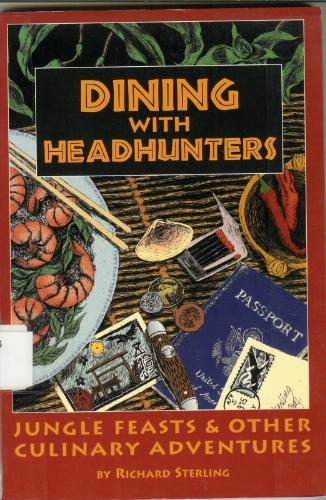
DINING WITH HEADHUNTERS: Jungle Feasts and Other Culinary Adventures by  Richard Sterling

This is much more than just a cookbook; it's a collection of stories about the author's adventures around southeast Asia, many experienced while he served in the U.S. Navy during the conflict in Vietnam, during the late 1960's and early '70's. Some stories are just plain funny, some poignant, some bawdy (hey, he was a sailor, after all!) and some a combination of all of the above.

Each story is followed by at least one, usually more than one, recipe. The recipes are all based on food or drink he actually experienced in the story with which they're linked.

A few of my fav's: Satay Malaya from "The Feasts of Fatima," a story about falling halfway in love with a lady of the evening; Mojo (a drink) from "Mojo Rising," a story about a retired madam (hmmm...mmm..., am I detecting a pattern here...?); and Madalay Mail Chicken, from "Train Fare" (nope, no working girls in that one!)

THE CASABLANCA COOKBOOK: Wining and Dining at Rick's by Sarah Key, Jennifer Newman Brazil and Vicki Wells

Being a huge fan of this movie, and the owner of several other books about Bogey (and a few Moroccan cookbooks, as well), I had to add this one to my collection several years ago. In addition to some excellent recipes for drinks (champagne cocktail, Senor Ferrari's iced almond coffee) and food (coriander shrimp kebabs, ground lamb kebabs) this little volume contains photos from the movie, games and quotes from the movie. A "must-have" if you're a fan of the movie, a fan of Moroccan food, or just a collector of eclectic cookbooks like Yours Truly.

I really do love Moroccan food, so I guess one of these days, I may even have to travel there...

THE ENCYCLOPEDIA OF ASIAN COOKING Edited by Jeni Wright

This book has been in our household, well, ever since we've had a household. I used it regularly for preparing foods from India, Malaysia, the Philippines, Vietnam, Burma and Thailand, to name but a few. It's not really eclectic, I guess, but it certainly is useful. It even offers suggestions for recipe substitutions if you can't find an ingredient needed for a particular dish (which can sometimes be a bit of a problem if you live in a community without much selection or variety of Asian ingredients.) It also provides measurements in both metric and imperial formats.


Cooking Thai Cashew Chicken, a recipe from Extending the Table

THE LAST DINNER ON THE TITANIC: Menus and Recipes from the Great Liner by Rick Archbold and Dana McCauley

This is an amazing book, if you're into history, culinary or otherwise. It gives you a glimpse of what it was like to travel on what was, in its day, the largest ocean liner in the world. It details how the ship was organized in terms of class structure (based on whether you were sailing first-class, second-class or third-class. The passengers were restricted, by class, where they could dine, or even have a drink - quite a difference from today's cruise ship industry.

It includes some old photos as well as artists' renderings and conversion charts (after all, these recipes were from Edwardian England, so some recipes do need adjusting).

It's a wonderful book, taking you back to the last days of the "Golden Age of Travel."

EXTENDING THE TABLE: Recipes and stories from Argentina to Zimbabwe by Joetta Handrich Schlabach

This collection of world recipes is another cooking tome that's well-thumbed in our household. It features recipes galore as well as stories from around the world. One of the features I really enjoy is the way the book includes proverbs and quotes about food, sprinkling them throughout the book like a good cook sprinkles herbs and spices throughout a culinary creation to create a tasty meal. Example: Egyptian proverb: "An onion offered by a true friend is like a whole lamb."

A wonderful book for anyone wanting to explore the cuisine of other cultures within the confines of their own kitchen.

WANAPITEI CANOE TRIPPERS' COOKBOOK by Carol Hodgins

You had to know, given the title of this blog, that at least one book would involve a cooking-paddling combination, right?

This book - which is designed in a way that you could take it canoeing with you - talks about nutrition in the wilderness - an entire section is devoted to it. There's also a section on water and environmental issues.

Then there are the recipes ... breakfasts, bannock and bread, meals, soups, salads, desserts - this book covers them all, and more. Say good-bye to those freeze-dried packs you buy at outdoor stores and say hello to some real cooking ...

Wednesday, August 10, 2011

The Pisco Sour: Peruvian - or Chilean?

Well I've never been to Spain, but I kinda like the music - hey, wait a minute - I have been to Spain. Doh! It's Chile I haven't been to. Spanish-speaking country, yes - but it's not Spain.

The Esmeralda
Not that I've actually been to Chile, mind you. My travels have taken me to three different South American countries: Ecuador, Peru and Bolivia. The closest I've come to being in Chile was aboard the tall ship Esmeralda, which was docked in North Vancouver, Monday. I was there by invitation of the Chile Board of Tourism to experience the event, "Flavors of Chile." 


There were certainly some good flavors aboard the tall ship ... asparagus spears wrapped in smoked salmon, salmon ceviche, some mini-pastry meat pies, empanadas and plenty of sweets for desert. Oh, I mustn't forget about the good cross-section of Chilean wines available for sampling.

But for me, when you're talking about Chile and alcohol, it all goes sour - Pisco Sour, that is.

Pisco Sours are considered by many to be the national drink of Chile. That's very interesting, because many Peruvians also call it their national drink.


When I visited Peru in 2008, I was told there is a big debate between the two countries as to which country actually invented the drink.

For those unfamiliar with the drink, it's a cocktail containing pisco, lemon lime juice, egg whites, simple syrup, and bitters. When I was in Peru, I had it made for me at Lucma Lodge, part of the Mountain Lodges of Peru. In Peru, they actually call limes "lemons," at least they look like what we call lemons in North America. Regardless, the Pisco sours there were the best I've had anywhere. And I've had them in restaurants in Lima, Cuzco and even Vancouver. And of course, on the Esmeralda in North Van.  

A Pisco Sour

I have to say, if taste is any indication, Peru would get my vote. Now I'm not sure if the ones we had on the Esmeralda used local Pisco or if it was brought all the way from South America. I do know that the quality of Pisco you can purchase at BCLC stores is not as good quality as the stuff you get in Peru, or probably, in Chile.

I guess the only way to settle this, at least in my mind, is to go to Chile and sample the local Pisco Sours there and then draw my conclusion by comparing them with what I had in Peru in 2008.

Of course, while I'm there, I'll probably manage to work in an excursion or two to see Patagonian conures in the wild, as there are some of those birds (also known as burrowing parrots) in that country. I've seen them in captivity here in North America, actually handled one quite regularly at the old facility for the Greyhaven Exotic Bird Sanctuary in Surrey, B.C. - Spook was a real sweetie! - but nothing beats seeing them in the wild.

And with the combination of parrots and Pisco, you really can't go wrong.

For more photos from this event, visit my photo album on Facebook:

Friday, June 3, 2011

Sunshine Coast trips: never enough...

One of the great gems of British Columbia is an area known as the "Sunshine Coast". And it is so close to the city of Vancouver, so accessible - yet it remains largely unexplored.

That's not such a bad thing ... part of its charm is the fact that it is only a few hours away but still maintains a remote feeling. As a travel writer, I almost feel a bit guilty encouraging people to visit it. From time to time, most travel writers struggle with the dilemma of sharing their special spots, their favorite destinations for fear of creating too much consumer interest - especially when you're dealing with areas that are special because they are not typically "tourist-y" areas.

Don't make a fuss,
just hop on the bus - er - ferry.

Getting there does involve a bit more than hopping in a car - but not much. You cannot just drive there - you do have to take a B.C. ferry or two, starting from Horseshoe Bay, then again from Earl's Cove, depending if you want to stay on the Lower Sunshine Coast or visit the Upper Sunshine Coast. But it takes less time to get there than it does to drive from downtown Vancouver to the ferry terminal at Tsawwassen and sail over to Vancouver Island. Still, it does seem more people plan trips to the island than they do the Sunshine Coast.

Frankly, I'm glad there is not too much traffic up and down the Sunshine Coast Highway. The highway is mainly a two-lane road, so it can be backed up at times, at least close to ferry arrivals/departures.

The drive itself is beautiful, once you get away from the ferry landing at Langdale.

I've made four trips there in the seven years I've lived in Vancouver, and I feel I haven't even scraped the surface on exploring the area. There are so many things to see and do there...

Want to go sea kayaking? It's not hard, because the Pacific Ocean is your constant companion on any journey up the coast. There are several companies based along the coast, including Half Moon Sea Kayaks on the lower coast, and Powell River Sea Kayak on the upper coast.

One of the stops along the way,
Desolation Sound Marine Park

If you're a hardcore hiker, there's always the Sunshine Coast Trail. While not as well known or publicized as its older, bigger brother, the West Coast Trail on Vancouver Island, it offers much to those who love spending time in the outdoors.

Looking for a great resort to stay at? Go to Rockwater Secret Cove Resort, where you can try your hand at "glamping" in their luxurious tenthouse suites. Along the upper coast, Desolation Sound Resort offers kayaking/dining packages when you stay in their chateaus.

If you're looking for something a bit more private, Moon Dance Cabin provides a secluded, bay front getaway that is still very close to any services you may require.

Moon Dance Cabin: secluded yet not isolated.


Just because you're outside the city, doesn't mean there's not good food. The Laughing Oyster offers some incredible meals; their beef wellington is second to none.

Looking for a spa experience, with a bit of other outdoor activity like kayaking or hiking? Painted Boat Spa and Resort can fill that bill.

As I'm looking back at what I've written here, I'm struck by the feeling that it reads like just another tourism ad, a case of a writer shilling for something. But quite frankly, most of this stuff I've experienced myself, on my own, booked by myself, paid for by moi - so it's not like I'm trying to be overly optimistic and positive to please or impress tourism reps. Also, I am not necessarily endorsing all of the companies with links listed here -  those are just included to give you an idea where to start.

Yes, even given that caveat, it still may sound like I'm promoting the area shamelessly. Fair enough, believe what you will. It's just that it is very hard not to write effusively about my travels there because they really have been magical.

When all is said and done, there really is some kind of mystic charm to the region that has to be experienced to understand. It has to be felt in person in order to appreciate what the Sunshine Coast is all about.

But don't take my word for it. Hop in your car, jump on a ferry and see for yourself. And don't be surprised if you find yourself coming back, again and again and again ...


Paddling the Sunshine Coast near Painted Boat Spa