A blog about my travels around the world, in search of wild parrots, great paddling opportunities and incredibly eclectic travel experiences, I try to make a difference by connecting people with nature, people with other cultures, and people with themselves by sharing my stories.
There it was again. We had no idea what was making
the noise 30 metres from our campsite, and we were not entirely certain we
wanted to find out.
"It's probably a bear hunting for frogs," I said,
hunkering down deeper in my sleeping bag.
"Bears don't eat frogs!" my companion replied from
deep in her own sleeping bag.
"Do too!"
"Do not! Might be a moose, though."
"This isn't moose habitat! It's probably a bear …
"
As it turned out, we were both right - sort of. Later research revealed that black bears do
indeed eat frogs. However, it was not a hungry bear on the prowl for the
delicacy of frogs' legs. It turned out to be a bird - probably an osprey -
diving for fish in Channel Lake's waters.
Channel Lake is part of a chain of waterways in the
northwest corner of Kejimkujik National Park. Located in south-central NovaScotia, "Keji" is the only national park in the Maritimes completely
surrounded by land, although there is a seaside adjunct apart from the park's
main body.
This 403-square kilometre island of wilderness is home to more than
100 species of birds; mammals such as deer, porcupine, moose - and yes, bear;
and a variety of tree species, including oak, maple, hemlock, spruce and pine.
Sunset on Channel Lake
One of the best ways to experience the park is by canoe, on
routes north or south of the large lake that gives the park its name. We paddled
north of Kejimkujik for five days - partially following the route paddled by Albert Bigelow Paine in his book, The Tent Dwellers - through Big Dam Lake, Frozen Ocean Lake and
Channel Lake before paddling back onto the main lake.
Because we paddled the park in early August - peak holiday
season - we were surprised that three days passed without sight of another
human.
The first people we did see were two park rangers, performing routine
backcountry campsite maintenance.
That's not to say we were lonely.
Prickly Porky on the move
Porcupines, barred owls,
deer and chipmunks visited our campsites.
Paddling down the quiet waters of
Still Brook, LittleRiver and West River, we encountered herons, a painted
turtle, frogs, a mother loon and her baby, and a merganser family.
The unexpected solitude was a true gift.
On our last night
on the big lake, a lone loon swam past our Moose Island campsite, wailing her
trademark cry, as if to say,"Farewell!" from the wilderness,
eliciting a prayer of thanks from my own mouth.
(This story was originally published in the Summer 2001 edition of Ski Canada's Outdoor Guide.)
Post script: There's much more to the park than canoeing. It's also a national historic site, as this video shows.
We've come a long way from the days when "cowboy"
coffee was a camper's only choice. While an occasional tin cup of that strong
but gritty brew is fine, today's coffee-quaffing campers have almost as many
choices on the trail as do city-dwelling caffeine hounds.
Cappuccinos up!
Cowboy coffee pots
While it might be considered "retro", you can
still use this old method of throwing grounds in boiling water, then drinking
(and often chewing!) the results. All you need are a black enamel pot, a campfire
and ground coffee
There are different schools of thought about the best way to
brew campfire or cowboy coffee. Add a handful of fresh grounds to a pot of cold
water and boil it; or, boil it then add the grounds (my preferred method). Some
campfire chefs throw in crushed eggshells - or even a whole egg! -to help the grounds settle, but I've never
subscribed to that.
Whichever method you choose, when the grounds sink, the
coffee is ready.
Coffee, percolator style
When my regular camping partner tired (very
quickly!) of my cowboy coffee on our early trips together, we switched to a
percolator to keep the grounds out of the water.
The coffee is a-brewin'...
I remember this as the preferred method on all our family
camping trips. Of course, my dad wasn't a cowboy and the cappuccino craze
hadn't hit North America, then. The first percolators were made in 1825, so it
is a tried-and-true method of coffee brewing.
The method is simple: fill the basket with coffee, the pot
with water, boil it then percolate it until the coffee is as strong as you like
it. You'll need to experiment to determine how long to percolate it to reach
the desired strength.
Campers can "espresso" themselves
These hit the market in the early 1990s. My partner still
wasn't crazy about my camp coffee, so I bought this little device for her
birthday one year. (She's never complained about my coffee since - or about any
birthday present, either.)
Brewing with this set-up is similar to using a percolator:
fill a basket with espresso-grind, fill the pot with water, then heat it until
the coffee is forced up through the upper chamber and nozzle into your waiting
cups. Once the brew is out, there is still enough steam coming from the nozzle
to froth milk if you want to turn your espresso into cappuccino.
Who's up for camp espresso?
This works best over a portable stove, or a Coleman stove, than a campfire. Place a cup (metal!) on the lid to catch the coffee
before it starts coming out, because when it is ready, it comes out very fast!
Press-ing on to new coffee frontiers
So-called "French presses" or plunger pots became
all the rage in homes about the same time campfire cappuccinos became
available. Now they are available for camping, either as plunger pots or
press/cup combinations, in which the press/plunger doubles as a lid.
The method is very simple: boil water, add it to grounds in
the pot/mug, steep to the desired strength, then press the plunger down. Pour
it into a mug, and voila! - a strong cup of java without grounds. Aficionados
claim it is closer to a "true" coffee taste, although having chewed a
few chocolate-covered coffee beans in my time, I can vouch it still doesn’t
compare to the taste (or kick!) of a few of those caffeine-packed goodies.
Whatever method you choose, a drop or two of Bailey's always seems to make it go down even better.
To put you in the mood, I'll leave you with this music video by Jerry Vandiver, dedicated to those of us who really appreciate their coffee in camp.
It's tough to beat the scenery and ambiance of coffee enjoyed in the outdoors.
(A slightly different version of this was originally published in Coast Magazine, July 2001, B.C. edition)
G.I. Joe, G.I. Joe, hiking fool from head to toe... Never actually got this pack.
If you spend anytime travelling - even if your biggest adventure involves a trip to a museum -
chances are, you've probably used a backpack of some kind.
Many of us have owned and used many different sizes and styles of backpacks over the years.
If you spend much time in the out of doors, you might be what consider to be a back pack expert.
I wouldn't call myself an expert, I feel a bit uncomfortable accepting that kind of term. I do know what works for me, and I can say what good and bad experiences I've had throughout the decades.
But thinking back to all the backpacks I've used over the years also brings back memories of the trips I've taken with them. And those memories are all pretty fond ones.
I first desired a backpack - or knapsack as we called it then - when I first went to Camp Richildaca near Kettleby, Ontario. We were going on a nature hike, and I wanted a pack to carry my lunch in, along with any other supplies I might need (which really weren't much, since it was only a two or three hour hiking adventure.)
I didn't get one that first summer. But the following summer I did, although not without some grief from my dad.
We'd visited relatives in Detroit for a week before I went to camp that year and spent one day getting a toy for me. My dad knew I wanted a knapsack for camp, and in the toy store, you could get an official "G.I. Joe knapsack and (plastic) entrenching shovel," it was part of the line of life-sized toys that complemented the popular boys' soldier-doll. (PC people like to call it "action figure," but hey, we knew it was a doll. Our answer to girls' Barbie. And he could kick Ken's ass. But I digress).
Anyway, he urged me to get that, but I chose the toy M-1 carbine instead (Hey, why get a knapsack when I can get another gun for my growing arsenal, eh?).
So, when I went to camp, at the end of the first week, I was bugging my dad for a knapsack. Even had one picked out that I liked. It was green, had "Trailblazer" written on the back. But my dad said, "You should have gotten the GI Joe pack!"
My official Boy Scout backpack.
It took a bit of cajoling, but eventually I got my pack. Looking back, it wasn't much, didn't even fasten with buckles, just a tie like a shoelace. But I loved it.
Then it was time to move up to a better model. And again I had a bit of a tussle with my dad over this issue. He thought to go to camp it would be much better if I just had some kind of big duffel bag, kind of like a hockey bag for all my clothing and gear.
But my dad was not that much of an outdoorsman; I knew there were going to be overnight canoe trips and overnight backpacking trips at this camp, and a duffel bag was not going to be very good for hauling gear through the woods on my back, so again I cajoled him and eventually got the pack I wanted.
It was a gray knapsack, an "official" Scouts Canada pack purchased at the local Jack Fraser store (the official supplier of Scouts Canada back then) It did not have any kind of frame with it, it was really more of a larger day pack rather than a multi-day pack, but it had one mean compartment, two side pockets, and a smaller outside pocket on the back ... it was just exactly what I wanted and it worked great on the canoe trip - my very first overnight canoe trip, to Drag Lake in the Haliburton Highlands! - and then on my very first overnight backpacking camping trip as well.
That particular backpack did me for several more years until I hit 18 and was planning my very first "no-adults" overnight canoe trip in Algonquin Park.
Now this was a big thing for me, because every other canoe trip I never been on was supervised by someone older - a scoutmaster, a junior forest ranger foreman - so this was a special rite of passage trip.
Time for a Taymor! Mine was blue not red, but same style.
I had my eye on a backpacking frame in Canadian Tire where I worked that summer. It was really cool, because it was essentially red with a white flap to cover everything - and it had a red maple leaf in the middle ... essentially it was a giant Canadian flag.
I bought it, and I loved that pack, using that for the next several years. For a few years, I stopped taking overnight camping trips just because I was in university and was often working and didn't have time to plan or carry out such trips.
Eventually I graduated moved out west and when it was time for me to go on a new outdoor adventure, it was time for a new backpack because the "flag-pack" had seen better days, it was 16 years old and hadn't been in any shape to take out west.
So off I went to my neighborhood sporting goods store and got a Taymor pack. My first trip with that was a three-day solo backpacking trip in Jasper National Park, to Jacques Lake. It did me for several more trips after that, canoeing the Bowron Lake circuit twice, and on some other camping trips. But as with all backpacks, when your travel style changes, often your pack has to change as well.
For my first international trip to Belize - a two-week trip that involved sea-kayaking, hiking, horseback riding, caving, and all kinds of great outdoor stuff - I needed a suitcase. But I also needed some kind of small day pack.
A friend of mine lent me a catalog from Mountain Equipment Co-op, which I'd never heard of at that point in time. But they had something which was perfect: a very rugged cross between a suitcase and a duffel bag but which also had a smaller day pack that fastened to the main bag with straps and became part of the whole unit.
The suitcase itself could be turned into a backpack for longer trips as it had an internal pack frame. The detachable day pack was great, because it could carry food, a change of clothes, a camera, water bottle, and any number of things you might need to access when you're kayaking in the Caribbean or hiking through the Central American jungle.
Still use my MEC pack today, 25 years later.
This one is lasted a long time - in fact, I still use it today for some travel, which means it's pretty darn durable. Since I bought it 1991,that means I've had it for almost 25 years in it still works. Yeah, here it comes... "They don't make much stuff like that any more."
Once I started doing freelance photography, which involved a lot of hiking in the mountains and other outdoor areas in and around Calgary and southern Alberta, I needed something sturdy and functional in which to carry my camera gear, since I wasn't using just a point-and-shoot any more.
It's still my favourite backpack for carrying camera gear. It's been vary durable, although I have had replaced the zippers on the one I currently use on a couple of occasion . But it's 15 years old, so it doesn't owe me anything.
It's helped me photograph parrots in the Caribbean, orangutans in Malaysia, temples in Thailand and the vista of Machu Picchu in Peru.
Let's see, did I bring my cards?
Everybody who knows me knows I love to paddle and when you're canoeing or kayaking it's always nice to have something to keep you clothing and gear dry.
I used to just pack the frames and backpacks into the canoe, but there was no guarantee, they would stay dry unless we put a tarp over them. And once we started kayaking, well, you can't fit a pack frame into a kayak storage compartment.
So we evolved to dry bags. They're very handy for paddling, even canoeing, if you don't have any long portages, but they are meant more for kayaking than canoeing. Some come with straps and some bags even have an apparatus that turns them into backpacks.
However they do not become the kind of backpacks you would take with you on a camping trip into the mountains.
Guaranteed to keep stuff dry.
I think back fondly to all the backpacks I've used...As we go forward in life, we of course have to make room in our lives by letting go of certain things, we can't keep every single thing (although sometimes I wish we could.)
But I get wistful every now and then when I think back to all those first trips I took - my first nature hike, first overnight canoe trip, first overnight camping trip, first overnight canoe trip planned on my own, and my first international trip. Most of the backpacks I took on most of those trips are long gone.
Some wore out, some were donated ... but they're all so old, they've probably all bitten the dust, I doubt if any of them are even around, never mind in use any more.
Although today's modern day, super light, multi-purpose materials may make lighter and more waterproof and more functional backpacks, there's no taking the place of the memories associated with those old packs.
Winter, spring, summer, or fall - when's your favourite season to travel?
A few weeks ago on my regular Wednesday photo survey on my Bear Lair Communications Facebook page, I asked readers what was their favourite season of the year to travel in.
That got me to thinking … Perhaps I should share the quintessential experiences I've enjoyed while traveling in each of the seasons.
Now I should say there are a couple qualifiers in this. First of all, if you forget about traveling, autumn is my favourite season of the year, period. I love the fall colours and everything else about the autumn - but that doesn't mean that I would travel to a destination just have a "seasonal" fall experience - although there are some really nice places to go in North America for that.
And if I had my choice, I would pretty much always spend any cold months travelling to warm, tropical or semi-tropical destinations so I could paddle and watch birds and other wildlife in comfort. But because some of the places I've loved to travel to don't really experience four seasons like we do in North America, I'm going to restrict this particular article to places where you can experience a real distinct season. No trips to Thailand in winter, no sojourns to Antarctica or Australia during our summer.
In other words, it's places I've travelled to in North America. Here we go.
SPRING: Ah, spring...when a young man's heart turns to ... baseball. Well, some young men's hearts. The rest turn to ... birding.
The snow geese have returned!
Spring is the time when hundreds of flocks of migratory birds make their way north from their wintering grounds, to build nests, mate, and raise new birds. There are many places to see the flocks migrating, but one of my favourite places is the Cape Tourmente National Wildlife Area in Quebec, just east of Quebec City.
SUMMER: This is a tough one. There are so many amazing places to go, experiences to enjoy in the summer, all over North America. I guess if pushed to pick one destination above all the others, I'd go with Algonquin Provincial Park in Ontario. I've visited there many times since the late 1960s, it's still one of my favourite places to go in the entire world.
It's tough to beat a misty morning on Algonquin's Lake of Two Rivers.
FALL: It seems like I'm falling back on Ontario again, but there's a reason for that: If you want to see autumn in all its splendour, Ontario - along with Quebec and the Maritimes - is the place to be.
This is just a very small hint of Ontario's autumn colours.
While autumns on the prairies have their moments, and B.C. falls are often like extended summers, the rich palette of colours created by the oaks, maples, birches, and other deciduous trees of Eastern Canada, the mix of reds and browns and yellows, cannot be rivalled.
I discovered this years ago, when I went on a family Thanksgiving weekend getaway to Deer Lodge in the Haliburton Highlands. At 14, I was really too young to appreciate for very long - I was a teen-ager stuck with adults, and upset I couldn't watch a CFL football game between Ottawa and Montreal - but looking back at some of the slides my dad took reminds me of how gorgeous early October is in the east. Ditto, when you drive through New Brunswick or Nova Scotia in mid-autumn.
Again, Algonquin is a great place to be in autumn; so is Gatineau Park in Canada's national capital region, just over the border into Quebec, outside of Ottawa. I've only been there in winter, but if photos are any indication, it is probably THE place to be, come October. (Just be ready for lots of traffic...)
WINTER: As previously mentioned, given my druthers, I'd ruther go someplace warm in the winter where I can paddle or watch birds and not have to put on five layers of clothing. However that's not really winter is it?
The trouble is, I'm not a skier, not a snowmobiler, I don't really snowshoe very much (although I've done all three) and it's really hard to paddle a canoe or kayak in the winter. But if you want to have an iconic winter travel experience, you have to try dog sledding.
Mushing through the mountains! (Photo courtesy of Snowy Owl Sled Dogs)
I've had the opportunity to enjoy it in northern B.C. as well as in K-Country - specifically, the Spray Lakes, in Alberta. Snowy Owl Sled Dog Tours run some wonderful programs in the provincial park that incorporate different elements of winter experiences into their packages.
You can do half day trips, day trips, overnight trips and experience some Aboriginal culture as part of those trips.
There really is nothing quite like the silence of the Rocky Mountains, as as you mush along the trail at high speed, being pulled by a trained dog team... all you hear is the sound of the dogs' feet crisply pattering over the snow and the rush of the wind in your own ears as you glide over the frozen white carpet.
Well, there you have my personal favourites for travel in the various seasons. What are yours?
A campfire always seems to be the perfect way to end a day
spent in the outdoors.
Nothing like a good campfire to warm the hands - and the soul.
Gathering around a campfire for stories and songs,
conversation and reflection, follows an old tradition that started eons ago in
the days when campfires provided much more than a place for a social gathering.
At one time in humankind's history, they were needed in order to cook, to stay
warm and to keep predators at bay. The evening fire was the focal point for a
gathering of the clan or tribe and developed into a social event as a secondary
function.
As man evolved over the centuries, the need for such fires
became less and less crucial, and in the final months of the 20th century, it
is largely symbolic. It is still a gathering place, but it takes its place
along side other social facilitators such as the office water cooler, the local
pub, the neighborhood coffee shop, the church picnic and countless other commonplace
gathering places. Like the evening fire, they all serve to bring people
together and provide opportunity to socialize.
There is one main difference, though. One thing separates
the fire from all the others.
All the rest are man-made functions. A fire, is, at its
heart, a natural element. Man does not create it, although man can produce
conditions under which this element can spring into life.
It is that elemental aspect, that magical difference about
an evening fire, whether it is a fire in a hearth shared by two old friends or
a roaring bonfire that brings together a whole group of people from different
backgrounds and beliefs, that makes it so special.
Can't beat campfire-roasted marshmallows.
Who has not sat in front of a fire in the woods at night,
listening to the cry of the loon, the howl of the wolf, the whistle of the
whippoorwill and not felt that primeval shiver, followed by a primeval comfort
to be found only in the light and heat emanating from the campfire? That
shiver, that comfort, they serve to remind us that we are human. And while we
have created a whole world of facilities and institutions to separate us from
Mother Nature, we are still part of Her, not above Her. As much as we may like to
think it, we are not invincible, not immune to Nature's whims.
The evening campfire restores to us that part of our
humanity that we have forgotten, or at least, neglected. It gives us back the
magic we have distanced ourselves from with our overrated technology. It helps
us touch the souls of our ancestors in a way that no faded photographs or crumbling
gravestones can.
Sometimes, a desire for a campfire is so great,
even a propane-fuelled fire works.
If you take time to stop talking and quiet the voices in your
head, if you listen - really listen! - to the crackle of the flames, the sound
of your breath, the pulse of the blood in your veins, you may feel a million
years of mankind's souls touching with your own, however briefly.
Treasure it, revel in it, soak it up like a thirsty coyote
laps up the water in a desert oasis. It is pure magic; not the kind provided by
flashy video showman or sly-handed carnival hucksters, but the real magic of
the Universal mind. It is the collective soul of humanity connecting with your
own being, connecting you with Eternity.
It is usually a fleeting moment, this connection. But in
that moment, we can attain the most profound peace we are liable to experience
on this planet, even in this second decade of our still-new third millennium.
Does one ever tire of a campfire?
All too soon, all too easily, we lose that connection. The
crackle and pop of the fire stirs us from our reverie, bringing us back to the
present moment, back to the physical reality of our being. But we need fret
not; for it is always there, always waiting for us in the flames of a campfire,
in the whisper of the wind through the trees, or in the billion stars that
shine down upon us, winking at us, as if to tell us they know something of the
Universal mind that we do not.
They wink, but there is no secret, really; it is always
there, waiting for us to reach out and connect.
We simply need to remember to
take time to acknowledge it, and it will come to us. The fire of the stars, or
the fire from our camp hearth, it is all the same: the light is the key that
connects us, gives us the power to reach back to what we were, and what we, in
essence, still are.
It is also a source of profound but simple wisdom, wisdom
with a message. We need to heed its message; because just as the fire dies if
not properly tended, our world will die, if not properly tended. We can choose
to let the earth expire. Or we can choose to be proper caretakers, and ensure
that it does not. The choice is ours to make, but if we find that connection,
it is an easy one to make.
When I was a kid growing up in Newmarket, Ontario, I never spent any time in or around Peterborough. My relationship with the city consisted of turning on CHEX-TV to watch a hockey game not on the regular CBC stations or a football game that was blacked out in the immediate Toronto area.
Peterborough was always that place that I was in a hurry to get through or past or around to get to Algonquin Provincial Park and later, Outlet Beach (now Sandbanks) Provincial Park.
My dad and I almost stayed at a fishing marina outside Peterborough one summer trip, but neither of us was much of a fisherman, it wasn't really set up for camping (although there was a place to pitch a tent) so I voted to go to Algonquin instead and off we went.
Learning to carve a canoe paddle with Russ Parker.
Later on, it was that place that Roger Neilson coached (the OHL's Petes) before beginning his NHL career in Toronto with the Maple Leafs. (A street in Peterborough is named after the late icon).
Of course, all of that was before a group of far-sighted individuals established the Canadian Canoe Museum. It also pre-dated the establishment of many of the great provincial parks like Kawarthas Highlands and Petroglyphs Provicinal Parks in the area.
And it was probably before the local dining scene, craft beer industry, wide diversity of independent coffee shops and many of the other aspects of current life that made Peterborough the thriving but very liveable community it is today.
I'm now finally getting the chance to explore the area and everything it has to offer.
Brewmaster Doug Warren serves up some craft beer.
So far, I've spent two days carving a canoe paddle at the canoe museum, followed by a paddle across Little Lake (which boasts its own huge fountain in the middle of the lake). I also enjoyed several fine meals and sampled some of the craft beers mentioned above.
I expect that to continue over the next few days with another visit to the canoe museum (yeah, I'm a canoehead!) a possible river cruise along the Trent River, and more fine dining (Peterborough actually has more restaurants per capita than Toronto).
So in many ways, I'm getting the best of Peterborough, arguably a better experience than I might have had all those years ago as a youngster.
I can certainly appreciate these kinds of enjoyments better than I would have back then.
So from my perspective, I waited until just the perfect time.
Good things really do come to those who wait...
View of the river from the balcony of my hotel room at Best Western Otonabbee Inn.
Dad fixes the tent, our first ever camping trip in Ontario. He passed away while we were both on camping weekends.
A couple of weeks ago, I blogged about odd travel traditions. Many of us have them, and we look foward to practising them every time we leave for a trip.
However, there is one rather odd and somewhat sobering travel tradition that seems to pop up in my life with some disturbing frequency.
It seems people in my immediate family often choose to die when I am away on a trip of some kind.
That's not to say every time I travel, somebody close to me passes away. If that really was the case, I might stop travelling. Or at least give it some strong consideration.
I guess it could be seen as just one of those weird quirks that happens because I'm a travel writer, and I'm probably away travelling more than the average person.
However, this disturbing trend developed before I started travel writing seriously.
In 1992, my father passed away while I was on a weekend camping trip, at Bear Mountain, near Dawson Creek, B.C (yes, there is a real place by that name - not "Dawson's Creek' - and it's been around for a long time). It happened on a Saturday night, the night before Father's Day. We didn't have cellphones then, so no one could get in touch with me until I returned home Sunday afternoon.
Close to 10 years later, my father-in-law passed away just as we were heading out to enter Lakeland Provincial Park, Alberta, for a four-day canoe trip. If we had been a few hours earlier heading out, we might not have known for four days.
That one was particularly tough. Mom had been ill for quite a while with Myelodysplastic syndrome and had gone into the hospital in Toronto a few weeks before. She never got out.
It was tough for many reasons. An only child, it meant I had no immediate family left - no parents, no siblings - in some ways, I'd never felt more alone, even though I had other family members to help me get through my grief period.
An egret wading in the 10,000 Islands. I shot this image the morning my mother passed away.
What made it more difficult was the fact I was so far away - and I was only halfway through the trip, as I'd made plans to spend a week in the Florida Keys following the paddling trip with Crystal Seas Kayaking. I had interviews lined up with some parrot sanctuaries and tourist facilities, lodging arranged for, and flights booked. And I had to complete the second half of my journey with a heavy heart.
I know many people would have returned home as soon as they found out. However, the life of a freelance travel writer sometimes demands that you make sacrifices, make choices, that people who are just vacationing, do not have to make.
That's one of the things the average person probably does not consider when they imagine what a travel writer does for a living. Once a schedule of accomodations, meals, and other elements of a trip have been set up with tourism boards, a travel writer has an obligation to fulfill those, particularly when the rooms have been set aside, and usually paid for by the boards - and they won't be getting a refund for them.
Also, if a story has been already promised to a publication, the writer needs to try to meet that committment. Leaving a destination, then trying to return later, rarely works out. While most editors and most tourism boards will understand in the event of a death in the family, they may still hesitate to work with you going forward.
I certainly would never judge or criticize anyone in a situation like this, no matter what their choice. It is their life, their decision.
However, that kind of decision is never easy to make. I struggled, and in the end I chose to stay and try to meet my commitments. I know that's what my mother would have wanted me to do, had she been given the choice, and knowing that, the choice was wee bit easier than it might have been.
It certainly does bring a different feel, a different perspective to a trip, though.
This odd trend happened again, just recently.
Margaret and David, on their wedding day.
On the second day of my recent trip to Mexico the first week of May, I received a text message from an aunt in New Westminster, B.C. My uncle had passed away in a hospice, the victim of colon cancer. I hadn't actually had any contact with him much since 1971. My dad's younger brother, he moved out west suddenly back then, and shunned contact from the family.
When I moved to Vancouver in 2003, I did try to connect with him, actually spoke on the phone once, but he made it clear he really didn't want any contact. I repeatedly sent him Christmas cards with notes about meeting for coffee, but never got a response.
Then just after Easter, I got a call from his wife, Margaret, telling me he'd been hospitalized. I had a chance to finally visit with him then, for an hour or so, and I was grateful for it. A few days later, he was placed in a hospice.
Three days before I left for Mexico, a phone call came, telling me he would do well if he made it to his birthday, May 8.
Off I went to Mexico, and then came the news he had passed away two days before his birthday.
Again, that odd travel tradition had reared its head.
As it turns out, the memorial service is scheduled for the day I leave for Ontario for three weeks, so it's like a double whammy. I won't be able to attend that service.
My memories of David go back to when I was a four-year-old spending most of my days at my Grandmother Geary's house, as both my parents worked. Three memories stand out specifically.
David (who was still living at home then) had a pet bird named Joey, a budgie. So I guess my fascination with birds (like parrots) began at a very early age. That was the first pet of any kind I ever encountered. I used to sit there talking to Joey every day.
Not me - but it could easily be. But I'd be marching. (Photo via Webshots.com)
The second memory that springs to mind involves music.
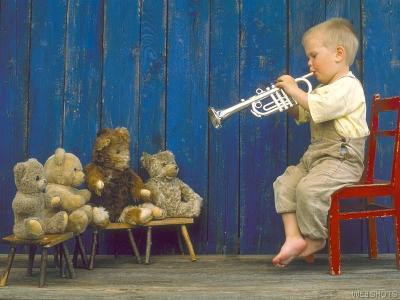
When I was four, I always used to watch the old black-and-white Popeye cartoons; he was the first "super-hero" I cheered on. In many of the old 'toons, whenever Popeye would eat his spinach and get ready to beat the crap out of Bluto or some other deserving bad guy, the John Philip Sousa march, "The Stars and Stripes Forever," would start to play. So I just loved that song.
Turns out David had a copy of it in his collection of marching music. He would play it for me often, and I would march around the room in time to the music, later on adding a toy trumpet to my performance, which became a regular occurrence, at least once or twice a week.
Robin Hood blows his horn. (Image from http://benito-cereno.tumblr.com/)
The third memory includes some physical mementoes.
When David married Margaret (at the age of eight, the first wedding I ever went to, and I remember stuffing myself with sausage rolls at the reception!) and they went on their honeymoon, they brought me back several pennants from their travels in the Williamsburg, Va. area.
They also brought back a cow horn, hollowed out and complete with a mouthpiece to blow on.
It became a go-to prop for when I played Robin Hood, and later a "powder horn" for playing Daniel Boone/Davey Crockett/Hawkeye.
I still have it, and I still have the pennants.
I'll never forget any of those memories. Just like I'll never forget David.
So, what's the point of all this, in a blog that is supposed to be about travel?
It's this: Make sure the people in your life that you care about - family, friends, partners - KNOW that you care about them. Especially, try not to leave to go on any trip on bad terms with the important people in your life. God forbid, but they may not be there when you get back.
Life is a journey, but it's the people we meet along our path during that journey that help to make it so rich and rewarding. When one of them leaves, that journey seems a bit less rich.
While you're pondering that, remember this: You never know when someone you care about will be taken from you.
Nothing beats cooking - and eating - in the outdoors.
The name of my blog pretty much gives away the fact I'm passionate about parrots and about paddling (if not, I've really goofed!). But if not truly passionate, I'm certainly very close to being passionate about food, as well. So...if you take a foodie who's also a canoehead, it can sometimes be a bit of a challenge to create an acceptable menu when I'm on a multi-day paddling trip. I will say I've had some marvellous eating experiences while travelling by canoe and kayak. There've been a few disappointments, too. While every trip has its highlights, and I've never really had a bad paddling trip, how and what you eat can often influence your impressions and memories of the trip. Obviously, while you're on a canoe or kayak trip, you are "on the road". However, unlike driving on a highway, there's no place to pull over and order a burger and fries (although those always seem to be my first go-to meal after finishing any paddling trip.) That means you have to plan and cook it yourself, if you're on a self-guided trip; if you're booked with an outfitter, they look after the meal planning and most of the prep for you. I've done plenty of both; and in both instances, I've experienced the good, the bad, and the ugly (even when there's no spaghetti involved.) I have created some incredible meals myself, as well as been a party to some bad ones (usually in the form of freeze-dried foods.) Although it may not qualify as gourmet fare, I remember the very first dish I ate, cooked over a campfire in the outdoors.
A nice heaping plate of Richildaca Stew.
I was eight years old, and I was a camper at Richildaca Day Camp, near Kettleby, Ontario, in the rural area just west of the Newmarket-Aurora area in southern Ontario, about 40 km north of Toronto. It was "cookout day." I was excited when I saw them open the ground beef. Then I saw cans of mushroom and vegetable soup. I HATED mushrooms and anything to do with them! And I wasn't keen about veggie soup, either, back then. But, it was eat that or starve. So I ate. And I ate it. And I ate it. Yeah, I loved it. So much that I've always tried to feature it on all my camping menus. Of course, it has changed over the years, as I've tweaked it a bit. And it wasn't called "Richildaca Stew" back then. But it's still easy, hearty, and every bite still brings back memories. If you want to see a real-life demonstration on how to make Richildaca Stew, you can watch the entire process on one of my YouTube videos. Then there are the bacon and eggs and hashbrowns that always taste so good cooked outdoors over a camp stove or an open fire. They always taste better than the ones cooked at home.
Breakfast is a sizzlin'...
Of course, not all my paddling recipes turn out well. Although I once impressed a young lady with my "canned goods shiskabob" (canned potatoes and spam, cooked on a stick over a fire - another Richildaca innovation), there have been some unpleasant memories involved with camp food. The most unpleasant involved two people sleeping in a small dome tent after gorging on freeze-dried bean-tortilla dinner. It was w-a-y worse than normal beans. Even the porcupines that hung around that campsite in numbers just up and disappeared.
Some go-to books for planning paddling meals.
Scratch that one off the list. If you want to plan your own trips and meals, there are several good books to help you. Two of my favourites are The Wanapitei Canoe Trippers Cookbook and The Paddling Chef. Outfitters have prepared some amazing meals on trips over the years. My first sea kayaking excursion in Belize, our guides prepared an amazing and simple rum punch, a delicious conch stew, and wonderful fresh-caught fish. Mind you, I wasn't crazy about the vegetarian chilli and vegetarian spaghetti sauce foisted upon us later in that EcoSummer trip by an overzealous "naturist" guide. But you take the good with the bad. The best chow I've had on a paddling trip? Two come to mind immediately: an Adventure-Life five-day kayak trip I took in the jungles of Ecuador and some great grub enjoyed with Okefenokee Adventures on a three-day canoe trip in the Georgia swamp. In the Amazon, we had three-course meals, with everything prepared by the guides. Each meal featured soup, salad, entree, dessert and wine. All eaten at a table, sitting on chairs underneath a forest canopy filled with parrots, toucans, and the occasional harpy eagle. In the Okefenokee, I remember eating some incredible jambalaya and equally good spaghetti with meat sauce.
Of course, everyone who knows me, knows how I love my coffee, in or out of camp. And without a good mug of brew (or two), you really cannot start the day properly - especially on a paddling trip. Paddler and singer-songwriter Jerry Vandiver knows this better than anyone - which is why he wrote a great song about camp coffee. I'll leave it here, with you. Maybe it'll inspire you to plan your next paddling trip - or even a trip menu. Or if nothing else, to go get another cup of coffee to sip while you enjoy it.
Want to see more of Jerry's videos? Check out his YouTube page.
As a travel writer, that's one of the questions constantly asked of me when I meet someone for the first time.
That's not what I'm writing about, though.
If you've ever wandered onto my Facebook personal page, you probably know how much I love coffee. And coffee culture. And trivia about coffee. Friends are constantly posting stuff about coffee onto my Timeline.
And, of course, people always like to know what my favourite coffee is, where is my favourite place to drink or purchase coffee, and - since I'm a travel writer - where is the best cup of coffee I've ever had.
That's easy.
The best cup of coffee I ever had was during my very first international trip (outside of Canada and the U.S.) in 1991.
It was our last day, we had an afternoon flight out of Belize City to LAX, then on to Vancouver.
For our last meal in the country, we decided to go for brunch at the Fort George Hotel.
From the first sip, we knew we'd stumbled on something exquisite. We were having coffee-gasms. Right there in the hotel dining room.
Several cups later, we finally came up for air, and asked our server what kind of coffee it was.
He smiled, and said, "Guatemalan chocolate coffee."
Even Nikki, our African grey parrot, loved Second Cup. We never feed our birds caffeine, though.
Now it was not "flavoured" coffee; I'm not a fan of that type of coffee (yeah, I'm a purist). The "chocolate" was simply what it was called. It was rich, sweet, fragrant, smooth - and that was just the aroma. It almost didn't need cream or sugar.
After I returned home, I was on a mission to find a coffee as close to that coffee as I could. None of the Guatemalan coffees I tried came close, though. Then, eight months later, at a mall in Edmonton, I decided to grab a coffee at a Second Cup.
Now I'd never tried their coffees, since, at the time, I lived in Fort St. John, B.C. and there were no Second Cups, not even a Tim Horton's there, at the time. I looked at the menu, saw "Guatemalan" beside something called "Huehuetenango." So, I tried it.
Bingo!
While it wasn't exactly what I'd had in Belize, it was the closest I'd ever come. Or ever would come: Sweet, rich, mellow, just about perfect. I liked it so much, I gave them my address and credit card info, and set up monthly shipments of a few pounds to Fort St. John so I could enjoy it all the time.
Slurping coffee aboard a Chilean ship docked in North Van.
Sadly, Second Cup - the only company licensed to sell it in Canada, then - stopped carrying the brand in 2008. I found a place in Ontario that now sells it, and will ship it, but it didn't taste as good as it had in the past, so I've resigned myself to life at Tim's. Cheaper, less hassle, but not as good.
Since that trip to Belize, I've sampled coffee all over the world. Ironically, because we import coffee from places like African and South America for consumption in North America, that often leaves lesser-quality coffee in those countries.
Travelling around Africa for six weeks, I gave up trying to enjoy a good cup of coffee, and opted for tea instead.
Ditto, in Ecuador. Although I didn't give up coffee for tea, it was not as good as the coffee I drank at home.
When I returned to South America six years later, Starbucks had infiltrated the consumer coffee market, so forget about enjoying an authentic native coffee.
Starbucks in Lima tastes the same as Starbucks in Taipei, which tastes the same as Starbucks in Vancouver, which tastes the same... you get the picture. And yeah, I'm not a Starbucks fan. If I want burnt coffee, I'll take a cup of Tim's and re-heat it in the microwave.
I have enjoyed good cups of coffee elsewhere.
The best iced cappuccino I've enjoyed was a Terri's Cappuccino Bar in Fort St. John. It was a regular daily indulgence there, winter and summer, for two years.
Don't forget to add the Bailey's!
And nothing beats a cup of "campfire cappuccino, brewed on a camp stove, served up with a healthy portion of Bailey's, during a camping or paddling trip.
Kona coffee from Hawaii is VASTLY overrated, in my opinion. I've sampled several cups on both Maui and the Big Island, including some at a coffee plantation.
Quite frankly, I couldn't figure out what the fuss was all about.
And while I've never sampled Jamaican Blue, I suspect my reaction would be much the same as it was to Kona.
That's not to say I'll never enjoy a cup of coffee on the road. But I feel like I've already found the Holy Grail of Coffee, so I'm resigned to the fact that even if I'm at Avalon, the coffee they serve there probably will not match the cup I enjoyed back on that April morning in Central America.
The sounds of nature and the outdoors are unmatched in their
beauty – and they also cannot compete against the raucous sounds of man-made
noise.
Earlier this summer, I spent two days camping in nearby
Golden Ears Provincial Park, just about an hour’s drive east from Vancouver.
Let me say we’re very fortunate to have such a beautiful park, such natural
beauty and wilderness so close to one of Canada’s largest three cities. I
thoroughly enjoyed hiking on its trails, canoeing on Alouette Lake, just
getting out-of-doors, away from the city.
Let's go camping! Just watch out for weird species...
Unfortunately, some people cannot bear to leave the city
behind. And some choose to ignore rules that are implemented for everyone’s
safety and comfort.
Rather than rail against humanity in general, I thought it
would be interesting to identify the types of odd and often contrary beings one
sees when visiting provincial parks like Golden Ears.
If you see any of these weird and inconsiderate species,
avoid them if at all possible (and if possible, report them to a park ranger).
Caninus releasus. These creatures let their dogs run loose,
off-leash, without any care for the rules. In just about every national and provincial
park, dogs are supposed to be leashed. This is for the protection of the park,
and the creatures that live there. It’s also for protection of dogs and their
people. Dogs can hurt the smaller animals like birds and small mammals that
live in the park. And if they happen to disturb a bear, it could cause dire
consequences for the dog, even for the human, and unfortunately, often the
ultimate demise of the bear.
Although It’s very clearly spelled out on signs,
online, and in park literature, when I was hiking on two different trails and
even in the campsite areas, there were far more dogs off-leash than on. Too
many of these C. releasus types think
they have control of their dog with their voices – but they don’t!! It may only
take a second or two for disaster to occur, before a dog responds to its
owner’s voice (and often they are out of sight on a trail). I for one, don’t
feel comfortable walking on a trail where a big Rottweiler or similar dog is
running free.
Cyclistes ignoramusi. Like the C. releasus creatures, these types feel free to ignore signs that
say “NO CYCLING ON THIS TRAIL.” There are specific trails for cyclists in the
park, yet members of this particular specie choose to blatantly ignore such
postings and cycle merrily down the path that is obviously NOT supposed to be
used for cycling. Wonder how they’d feel if I rode a motorcycle down their city
cycling paths?
These are the ONLY kinds of dogs that should be off-leash in a provincial park.
Flamus controllus. With all the dry weather and recent fires in
B.C., not just this summer, but in past summers, you’d think people would be a
little careful about campfires – particularly when there is a ban on in the
park. Yet while hiking on one of the trails, I smelled wood smoke from a fire
burning somewhere nearby, which tells me a member of the F. controllus species was
in the area.
A sub-species of this animal is F. controllus gassy-goofus;
this sub-species brings portable gas-powered “fireplaces” to the great north
woods to enjoy its cozy glow at night – which is allowed. However, they turn it
up higher than allowed by park rules, turning it down low when they know a
ranger is patrolling the area, then turning it back up when the coast is clear.
Loudus inconsideratus. This species demonstrates a variety of
behaviours, but they’re all consistent in two respects: they are loud and they
don’t care if they bother others in surrounding campsites. Sometimes it’s a
loud radio (why go to the woods to escape the city – then blare your music?),
other times its loud talking well after midnight, sometimes it’s just banging
around, doing stuff that makes noise louder than necessary that prevents others
from sleeping or just enjoying the quiet of the outdoors.
Pinheaded powerboatians. These are the types that zoom up and
down a lake in their powerboats, creating wakes with no regard for people in
canoes or kayaks and the potential danger created by the unstable movement of
their craft due to the unexpected waves from the motorboats. Their motors also
sound annoying.
Despite signs indicating "No cycling," we encountered cyclists on this trail.
Clueless camerus shutterbuggus. You’re trying to line up a shot
of a rare animal or bird, you patiently, quietly, and slowly approach it,
trying to get the best angle and not frighten it away, sitting, waiting for
that perfect moment when you can press the shutter to capture an image … then
this species – hailing from the city and with no clue as to how to approach wildlife
– stomps right over toward the subject on a direct line, and invariably in
front of your camera trying to get a shot, scaring the critter away before you
can get your shot.
They’re characterized by their use of a camera phone or
cheap point-and-shoot and loud, colourful clothing that brands them as being
from the city as well as brand new to any kind of nature photography.
They are
often also accompanied by one or more Screaming spoiledrottenoids, smaller
versions of themselves who also do everything they can to ruin the shot and the
moment.
REMEMBER: If you
do see any of these weird species, try your best not to shoot them, stab them,
or otherwise kill them, because unfortunately, they are never in season.
Although it sure would be nice if they did declare even one
weekend to be open-season on any of these annoying animals…