Showing posts with label wildlife. Show all posts

Thursday, February 2, 2017

World Wetlands Day: time to save a duck, a gator, your drinking water...

Another busy day at Reifel.
"When I would recreate myself, I seek the darkest wood, the thickest and most impenetrable and to the citizen, most dismal, swamp. I enter a swamp as a sacred place, a sanctum sanctorum…"
- Henry David Thoreau

Today is World Wetlands Day. (Yeah, it's Groundhog Day too - but he already gets enough publicity.)

In case you're not quite sure what a wetland is, according to the US EPA, it is: "... areas where water covers the soil, or is present either at or near the surface of the soil all year or for varying periods of time during the year, including during the growing season."

Still not sure about the value of wetlands? Well, they:
  • act as natural sponges
  • filter pollutants, helping provide clean drinking water
  • absorb rainfall, reducing floods and droughts
  • reduce the speed and height of storm surges
  • provide food and habitat for huge variety of birds and wildlife
  • provide a lace for recreation and reflection

I've visited a number of wetlands around North America. Three of my favourites are located in three very different environments.


One of my favourite places to hang out near my Vancouver home is the George C. Reifel Migratory Bird Sanctuary just outside Ladner, B.C. It's part of a coastal wetland jutting onto the ocean in places, and just a half-hour's drive from the Vancouver International Airport. There you'll find yourself in a wetland paradise full of ducks, geese, cranes, and herons - not to mention songbirds like red-winged blackbirds or raptors like bald eagles or marsh hawks (a.k.a. northern harriers).
 
Black crowned night heron.
 
 I won't go into too much detail about the sanctuary itself, its history and its functions; that can all be gleaned from the sanctuary website .
I will say that although it is a stopping place for birds migrating north and south in the spring and fall, respectively - an avian "motel" of sorts - it is also a year-round home for many other birds.
 
Reifel is one of those rare spots you can visit again and again, and never tire of going there. It's a special place where you can get close to nature without having to drive too far from your front step, if you live in the Greater Vancouver area. 
 
The experiences there are pretty much the same every time, but for me, there's always one gem of an experience I have that's a bit different each time, something that sets that visit apart from others.  
 
Once I saw a great blue heron fly across a pond and alight on a log right in front of me. It then proceeded to spend several minutes grooming itself while I shot videos and images of the bird.
 
Another time, I was able to watch and record a pair of sandhill cranes strolling along the edge of the marsh. You won't see these large, rare and beautiful birds every time you go to Reifel, but I have seen them on more than one occasion.
 
 
A blue heron grooms at Reifel.
 
I saw my first  black-crowned night heron there; also, my first northern shoveller, my first bufflehead, my first...well, you get the idea.
 
It's a great place to take kids, too, and get them to experience and enjoy nature.

OAK HAMMOCK MARSH


Oak Hammock is a prairie wetland located, in southern Manitoba near Winnipeg. I spent a day there several years ago and I was amazed at the variety and diversity of bird life there. Of course, it helped that I was paddling; there’s no better way to see birds – especially wetland species – than from a canoe.
 
The Coot family.
A total of  296 different bird species have been recorded there. While I certainly did not approach that number, I was not disappointed. Just minutes into our journey, we spotted an American coot with babies. 

During my day's paddle, I spied gulls, terns, blackbirds, and several other species. 
 
The highlight came as we paddled quietly toward a small island covered with American white pelicans. 
 
When we came too close for their comfort, it was as if someone pressed a button - they took off en masse, a white cloud of flapping feathers rising up into the sky.
 
OKEFENOKEE NATIONAL WILDLIFE REFUGE

Just north of the Florida panhandle in southern Georgia, in the middle of a wild, wet southern wilderness, sits this gem locals call simply, "The Swamp." 

I once spent three days canoeing and camping in this wonderful reserve with Okefenokee Adventures, the go-to adventure tour operator for the area. Our guide was very knowledgeable about the natural and cultural history of the area.

Like the other two spots described above, it's a great place for birds. While there exploring it, I saw a sandhill crane, several egrets and a green heron.
You'll see plenty of gators in "The Swamp."

Because it's so not as close to an urban centre as the other two, it boasts a far wider variety of wildlife in including deer, black bears and its iconic reptile: the American alligator.

I saw many of them, and a few deer, but no bears.
 
It's a wonderful place for a naturalist to hang out, and like Oak Hammock, it's only accessible by canoe. 

The point to all this? 

Without wetlands, none of these creatures would have homes. And surely that's reason enough to be concerned and to practice wetland conservation by supporting groups that focus on conserving wetlands, where it's a big national organization like Ducks Unlimited or a smaller local group like the Reifel Sanctuary or the Burns Bog Conservation Society. 

Then go out and enjoy a wetland.

Wednesday, October 12, 2016

National wildlife refuges offer cool travel experiences

Egrets are just one of the bird species found in Merritt Island.
One of the main reasons I travel is to see wildlife close up, to see wild animals in their native habitat.

I've been more than fortunate in my lifetime, that I've seen so many different wild animals in so many different countries: lions and gorillas in Africa, crocodiles and capybaras in South America, orangutans and gibbons in Borneo, to name but a few.

While there are still several on my list of "want-to's" (kangaroos and koalas in Oz, komodos in Indonesia to name but a few), I certainly feel extremely grateful that I've seen what I have.

Some of my best experiences have come right here in North America. And that's what the focus of this piece will be: wildlife at home. More specifically, wildlife found in the National Wildlife Refuges of the U.S., because it is National Wildlife Refuge Week.

NWR's are not the same as national parks, although some exist as part of a national park. In the U.S., National Parks are located in unique natural places and developed to serve a large number of visitors. Facilities for cars and walking are given priority.  

National wildlife refuges, on the other hand, come in all sizes, from tiny to enormous. On average there are more than 10 refuges per state (with 560 nationally). Their primary function is to help conserve wildlife, fish and plant resources and their habitats.

When I started looking at the number of parks I've visited in the U.S., compared with wildlife refuges, I was surprised. I've been to five NWR's but only a pair of NP's - and in one of those parks, I spent much of my time in the NWR.

Anyway, here, without further ado, are some thumbnail sketches of the refuges I've visited.

Merritt Island NWR. Located near Titusville, Florida, this place is a bird-watcher's paradise. I spotted my first roseate spoonbills here. It was also here I saw some of my first wild American alligators. Along with the wildlife there, the refuge is very unique, in that it sits in the shadow of NASA's Kennedy Space Center.

Florida Panther NWR. Just a short drive from Naples, Florida, this spot is set aside to try to conserve the highly-endangered Florida panther (the animal, not the NHL team!). The Florida panther is an endangered subspecies of Puma concolor, and is the only breeding population east of the Mississippi River. While hiking through the refuge, I didn't spy any panthers, just some deer and woodpeckers.
A woodpecker in the Key Deer NWR.

National Key Deer NWR. Located in the lower Florida Keys, it consists of about 9,200 acres of land comprised of pine rockland forests, tropical hardwood hammocks, freshwater wetlands, salt marsh wetlands, and mangrove forests. It's home to the tiny Key deer - the only place in the world they're found. Didn't see any during my tramp around the Jack C. Watson wildlife trail, but again saw a red-bellied woodpecker. 

Ten Thousand Islands NWR. Situated in Everglades National Park, this area is not typically what you might envision when someone says "everglades." 

It sits right on the Gulf of Mexico, and the islands are mainly mangrove islands. While paddling on a four day day kayak trip there, I managed to see dolphins, turtles, manatees, raccoons, and numerous types of birds, including a cardinal, two ospreys, herons, and several egrets.

Okefenokee NWR. Just north of the Florida panhandle in southern Georgia, I spent three days canoeing and camping in this wonderful reserve with Okefenokee Adventures, the go-to adventure tour operator for the area. Our guide was very knowledgeable about the natural and cultural history of the area.


Alligators: one of the apex predators in the Okefenokee.

We saw several alligators, some deer, a few snakes, and numerous birds - including a sandhill crane, green heron and some egrets. A wonderful place for a naturalist to hang out, it's only accessible by canoe.

These are just a few of the NWR's around the USA, so if you get a chance this week, check out one of the refuges in your neck of the woods. Some refuges offer activities to mark the week, or you can just go on your own and enjoy nature. Because as Henry David Thoreau remarked, "We need the tonic of wildness..."

Wednesday, June 15, 2016

Solitude among the woods and waters of Nova Scotia

Splash! 
Morning mist on Mersey River.

There it was again. We had no idea what was making the noise 30 metres from our campsite, and we were not entirely certain we wanted to find out.

"It's probably a bear hunting for frogs," I said, hunkering down deeper in my sleeping bag.

"Bears don't eat frogs!" my companion replied from deep in her own sleeping bag.

"Do too!"

"Do not! Might be a moose, though."

"This isn't moose habitat! It's probably a bear … "

As it turned out, we were both right - sort of.  Later research revealed that black bears do indeed eat frogs. However, it was not a hungry bear on the prowl for the delicacy of frogs' legs. It turned out to be a bird - probably an osprey - diving for fish in Channel Lake's waters.

Channel Lake is part of a chain of waterways in the northwest corner of Kejimkujik National Park. Located in south-central NovaScotia, "Keji" is the only national park in the Maritimes completely surrounded by land, although there is a seaside adjunct apart from the park's main body. 

This 403-square kilometre island of wilderness is home to more than 100 species of birds; mammals such as deer, porcupine, moose - and yes, bear; and a variety of tree species, including oak, maple, hemlock, spruce and pine.
Sunset on Channel Lake

One of the best ways to experience the park is by canoe, on routes north or south of the large lake that gives the park its name. We paddled north of Kejimkujik for five days - partially following the route paddled by Albert Bigelow Paine in his book, The Tent Dwellers - through Big Dam Lake, Frozen Ocean Lake and Channel Lake before paddling back onto the main lake.

Because we paddled the park in early August - peak holiday season - we were surprised that three days passed without sight of another human. 

The first people we did see were two park rangers, performing routine backcountry campsite maintenance.

That's not to say we were lonely. 
Prickly Porky on the move
Porcupines, barred owls, deer and chipmunks visited our campsites. 

Paddling down the quiet waters of Still Brook, LittleRiver and West River, we encountered herons, a painted turtle, frogs, a mother loon and her baby, and a merganser family.

The unexpected solitude was a true gift. 

On our last night on the big lake, a lone loon swam past our Moose Island campsite, wailing her trademark cry, as if to say,"Farewell!" from the wilderness, eliciting a prayer of thanks from my own mouth.

(This story was originally published in the Summer 2001 edition of Ski Canada's Outdoor Guide.)

Post script: There's much more to the park than canoeing. It's also a national historic site, as this video shows.

Wednesday, October 7, 2015

Like walking in the rain, writing can require overcoming intertia


Thoreau by the fire: why would I want to leave?
I stare out the window as the autumn rain pours down, washing yesterday's slate clean.

I am thankful for the needed rain.

However, the deluge is enough to discourage all but the most dedicated walker.

I love the rain; its sound always seems to comfort me. 

Further comfort arises from the crackling fireplace. I am in a cozy cocoon, from which I do not want to stir. 

Nevertheless, as I sit reading, like a larva whose time has come to metamorphose into a butterfly, I struggle against the boundaries of my unseen prison, unconsciously at first, then more attentively

I am reading Thoreau's "The Maine Woods," and more than once he tells of trekking in the rain. Finally I put the book down, my mind made up.

Why leave this...


...for this?


Rain or no rain, I will walk.

Motivating myself to walk in the rain is much like motivating myself to write. There is an inertia that chains me to my comfortable chair, preventing me from acting on my conscious thoughts. Yet, in either case, once I shed those chains, there is little that brings me greater pleasure.

As I pull out my rain pancho, I think this trek through the torrents will transcend a stroll in the sunshine. There will be fewer people in the park where I walk, so I may see more wildlife.

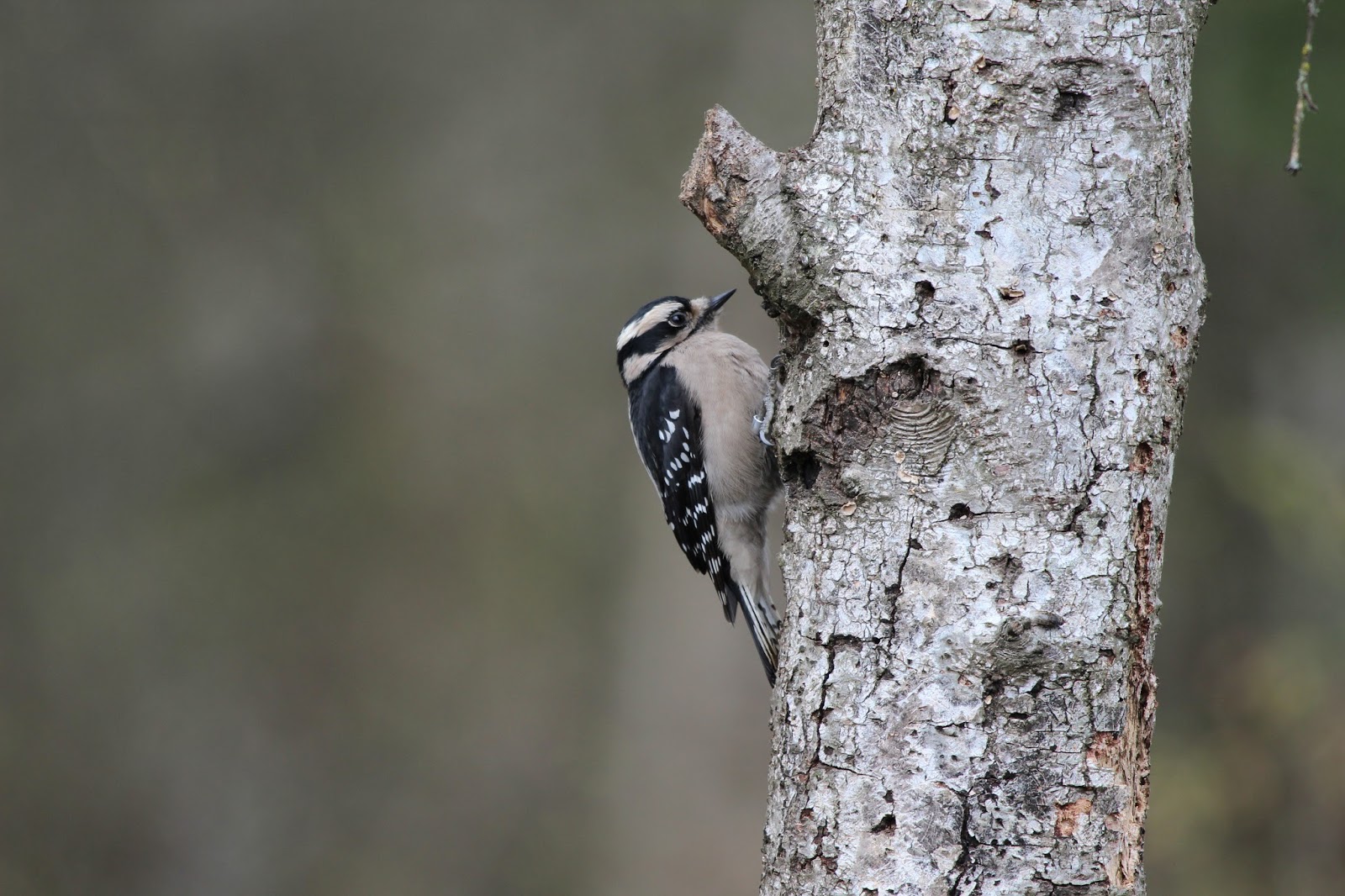
I am not disappointed. As the rain slackens, the wildlife stirs from its mid-day meditations. It seems I have the entire park to myself. I am Adam, alone in the world with no one but the animals for company. I spy a pair of deer, then a pair of ducks. Two geese wing their way overhead. I hear, then see, a downy woodpecker going about his business on a tree trunk.

Nature's magic is not limited to chance wildlife encounters. Each time I inhale, my senses revel in the fresh, clean scent of rain-covered forest.

Pecking away, despite the rain.
Half an hour into my jaunt, the rain ceases and I find myself missing the very element that kept me chair-bound earlier. The sun wakens from his mid-day slumber. 

As he wipes the vanishing clouds of sleep from his face, I awake also, to the fact others are walking the park's pathways. 

With that realization, twinges of regret begin to coalesce inside my rain-hungry soul. After hiding inside from it for much of the day, I now want the rain to return, and with it the solitude and serenity of a wet, wild world.
 
But I realize that for today, the winds of Aeolus have banished the rainclouds of Zeus from the skies.

I do not dwell on this realization for too long, for I know the rains will return. And that happy knowledge stays with me, adding a spring to my step as I wend my way home, ready to shatter those other chains, ready to sit down and write.

As I conquered the rain that kept me inside, so have I conquered the inertia that kept me from writing.

Thursday, August 6, 2015

Wildlife vacations: it's tough to pick a top 5 - what are yours?

There are numerous reasons for travel.
A silverback gorilla climbs down from
a tree in Kahuzi Biega.

Sometimes, travel takes you to a new job. Other times, we travel just to get away for a while from our jobs, or our routines, to get out of a rut.

Then there are the dream vacations, travel to be pampered in luxury, to de-stress while others look after your every need.

Sometimes we travel to explore - a new place, a new activity, or even to explore ourselves.

I've travelled for all these reasons and more. One of my favourite reasons, my main focus to travel, is see and experience wildlife in its natural settings.

I've been very lucky, I've enjoyed some incredible wildlife experiences around the world. And some, right here in my backyard, in B.C., Alberta, and other parts of Canada.

So in trying to come up with a "top five" out of all my experiences, I was really hard-pressed to keep it to that number. But, here goes, in no particular order (if you think limiting myself to five was hard, try to pick the best of the best!)


  • Looking for the "Big Five" on Africa's Serengeti plains. In Serengeti National Park, you may be lucky enough to see a leopard in a tree or listen to the roaring of lions in the bush at night while sleeping in your camp tent. In the Ngorongoro Crater, you'll probably get much closer to some of the wildlife - maybe too close if a rhino charges your jeep or if a lion saunters past and bumps it while you're popped up through the sunroof taking photos. They're only half a day's drive apart, so you'll want to see both when visiting Tanzania. Oh, the other members of the "big five" can also be seen there: Cape buffalo and elephants.
  • Gorilla viewing in Central Africa. Hiking through the Congo rainforest, tracking gorillas, avoiding columns of soldier ants, fighting off hordes of disease-carrying Tsetse flies and mosquitoes, keeping your eyes peeled for poisonous snakes, to say nothing of the leopards and other creatures that would like to eat you, stomp you or just plain obliterate you, - if this is your idea of fun, then  you'll be right at home in Kahuzi Biega National Park, a UNESCO World Heritage site in the Democratic Republic of the Congo.  But it'll all be worth it when you get your first glimpse of the silverback patriarch, or see a mother gorilla nursing a baby in the middle of the jungle. (If you've been to the Serengeti, and you're all "Africa'ed-Out," you can enjoy a similar and also incredible wild primate experience viewing orangutans in Borneo.)


It's definitely gator country in the Okefenokee.
  • Paddling with alligators in the Okefenokee. Otherwise known as "the swamp," the Okefenokee National Wildlife Reserve in Georgia, U.S.A. offers a wilderness opportunity unlike most others. The reserve is mostly water, so you can only access the heart of it by canoe or kayak. Although you can do it on your own, you're probably safer to hire a licensed outfitter to make sure you don't get lost between the camping platforms placed along the water trails. You do get really close to gators; it's also a great place for birders.
A Grand Cayman parrot, perched in a tree on the Mastic Trail.
  • Snorkeling with wild dolphins in Hawaii. I'm not talking about going to see tame dolphins like some of the resorts offer; this experience involves going out onto the ocean several miles offshore, with a reputable tour operator, locating a resident wild pod and then jumping in the ocean and going for a snorkel. You never approach them - they come to you. And when you can hear them echo locating underwater then one comes up to you and looks you over, it's an incredible feeling.
  • Gazing at wild parrots in Latin America. I've had the opportunity to experience on several occasions, but my two favourite trips took me to the Heath River Wildlife Centre on the Peru-Bolivia border and on the Mastic Trail on Grand Cayman Island. At Heath River, you sit in a floating blind on the river to watch scores of parrots and macaws congregating on a jungle clay lick. In the Caymans, they're tougher to see, as there is no lick - you have to hike through the jungle and hope you get lucky. In either case, you'll hear them long before you see them.

Monday, November 24, 2014

When you go looking for parrot photos, the birds don't always co-operate

As we approached the landing that would allow us to penetrate the jungle shore of the Rio Napo, two parrots winged their way overhead, en route to the same clay lick where we were headed, the same spot where we could hear hundreds of other squawking parrots congregating as part of their morning
Dawn along the Rio Shiripuno.
We heard parrots - we just couldn't see them.
routine.

I hoped this journey would help me realize an ambition I’d failed to realize the previous week, when I’d paddled down the Rio Shiripuno through Ecuador’s Amazon rainforest.

As stated elsewhere in this space, I have two main passions in my life: paddling and parrots. I live with two African grey parrots, and I have spent many summers canoeing or kayaking since I dipped my first paddle into a pond at a summer youth camp, 40 years ago.

I took this trip to combine the two of them: I’d be able to paddle a section of a remote river in the wild Amazon rainforest to see – and hopefully photograph – parrots in their natural habitat.

The paddling trip covered a section of the river that cut through the territory of the Huaorani, one of the last indigenous Amazon tribes to encounter western civilization. Their first contact came with North American missionaries in 1956.

I spent five days kayaking on the river, traveling with guides from EcoAdventour, a local outfit that worked with U.S.-based Adventure Life  as well as the Huaorani chief, Moi. Two hours onto the river, we saw some macaws fly overhead, so my hopes were high that we would see plenty of parrots – and take plenty of photos.

We saw numerous other wild birds during our river trip, including military macaws, blue-headed parrots, and Amazons. We also saw various other species of birds: toucans perched overhead in treetops; kingfishers zipping up and down the river; a pair of nightjars in their nest, right near our second night’s campsite, herons at various points along the river; and a solitary harpy eagle sitting high above the river in the crown of a tree.

However, paddling a kayak - even a touring kayak on a relatively placid river - and trying to get in position to take good photos of birds proved to be mutually exclusive activities most of the time, so I did not capture any good bird shots, and had very few good “parrot photo ops” during the expedition.

INTO THE CLOUD FOREST, THEN BACK TO THE JUNGLE

Following the river trip, I’d spent a day exploring the cloud forest of the country’s transitional zone between the high Andes and the lowland jungle. Cloud forest vegetation is sparser, and more sturdy than lush, but still much thicker than what we would see at a similar elevation in Canada

This transitional zone is home to numerous bird species, including the Andean cock of the rock, many hummingbird species, and in some areas, parrots.

However, I was still not able to get close enough to take any pictures of parrots on my trip through the cloud forest. A slight change in our travel plans arose, resulting in an opportunity to go back into the rainforest and visit a parrot lick. Yeah, I jumped at it.

A half-hour plane trip, two-hour bus ride and three-hour river excursion via motorized dugout canoe brought us to a jungle trail on Ecuador’s Rio Napo. A 15-minute hike followed by a half-hour paddle in a small dugout canoe across the jungle lake Laguna Garzacocha (literally, “Heron Lake” in the native Quechua language) landed us at La Selva Jungle Lodge, located on a bluff overlooking the lake.

We spent that evening exploring the area around the lodge during a night hike through the jungle. We spotted a small caiman (a cousin to the crocodile), and a nine-banded armadillo. But, I was here to see (and photograph) parrots. Take me to the birds!

This caiman was about three feet long.
Some grow up to 12 feet.
The next day came early enough, with a 5 a.m. wake-up call. I traveled with my own personal guide, Omar, paddling and hiking back to the Rio Napo, then headed upriver by motorized dugout for 15 minutes to the parrot lick. As I walked the short path between the river and the lick, the sound of hundreds of parrots squawking grew louder, as my excitement mounted.

I quickly reached the blind and after setting up quickly, I sat and watched them flit around through the treetops, squawking and whistling, interacting with other birds.

Omar identified four parrot species: Mealy amazons (Amazona farinosa), yellow-crowned amazons (A. ochrocephala), blue-headed parrots (Pionus menstruus) and dusky-headed parakeets (Aratinga weddellii).

I watched a pair groom each other on a branch; on another tree, one parrot chased a second one away from what was obviously, a favored perch; elsewhere, a lone parrot groomed himself, then shook his tail, reminding me of my own companion African grey parrots’ behavior back home.

Two hours later, the flock winged away to new adventures, leaving the trees empty and silent. The birds never did land on the lick, so I still did not have the good close-up shots of wild parrots I desired.

As we headed back to the lodge, a pair of macaws glided high overhead, teasingly out of camera range, and the thought struck me that perhaps the enjoyment of simply watching wild parrots interact in their natural environment was enough, perhaps the pictures did not seem to matter so much … .

Besides, since I didn’t get the shots I wanted, I have a good excuse to go back ….


This is what a busy parrot lick looks like - not my experience at Yasuni.

 (This trip, taken a few years ago, was the first time I combined parrots with paddling - in some ways, the inspiration for this blog's title. Different versions of this adventure have appeared previously in different magazines, including the Georgia Straight and Parrots magazine.)

Tuesday, September 9, 2014

Beware of these dastardly denizens while camping in provincial parks

The sounds of nature and the outdoors are unmatched in their beauty – and they also cannot compete against the raucous sounds of man-made noise.
Earlier this summer, I spent two days camping in nearby Golden Ears Provincial Park, just about an hour’s drive east from Vancouver.

Let me say we’re very fortunate to have such a beautiful park, such natural beauty and wilderness so close to one of Canada’s largest three cities. I thoroughly enjoyed hiking on its trails, canoeing on Alouette Lake, just getting out-of-doors, away from the city.
Let's go camping! Just watch out for weird species...

Unfortunately, some people cannot bear to leave the city behind. And some choose to ignore rules that are implemented for everyone’s safety and comfort.

Rather than rail against humanity in general, I thought it would be interesting to identify the types of odd and often contrary beings one sees when visiting provincial parks like Golden Ears.

If you see any of these weird and inconsiderate species, avoid them if at all possible (and if possible, report them to a park ranger).

Caninus releasus. These creatures let their dogs run loose, off-leash, without any care for the rules. In just about every national and provincial park, dogs are supposed to be leashed. This is for the protection of the park, and the creatures that live there. It’s also for protection of dogs and their people. Dogs can hurt the smaller animals like birds and small mammals that live in the park. And if they happen to disturb a bear, it could cause dire consequences for the dog, even for the human, and unfortunately, often the ultimate demise of the bear. 

Although It’s very clearly spelled out on signs, online, and in park literature, when I was hiking on two different trails and even in the campsite areas, there were far more dogs off-leash than on. Too many of these C. releasus types think they have control of their dog with their voices – but they don’t!! It may only take a second or two for disaster to occur, before a dog responds to its owner’s voice (and often they are out of sight on a trail). I for one, don’t feel comfortable walking on a trail where a big Rottweiler or similar dog is running free.

Cyclistes ignoramusi. Like the C. releasus creatures, these types feel free to ignore signs that say “NO CYCLING ON THIS TRAIL.” There are specific trails for cyclists in the park, yet members of this particular specie choose to blatantly ignore such postings and cycle merrily down the path that is obviously NOT supposed to be used for cycling. Wonder how they’d feel if I rode a motorcycle down their city cycling paths?


These are the ONLY kinds of dogs that should be off-leash in a provincial park.

Flamus controllus. With all the dry weather and recent fires in B.C., not just this summer, but in past summers, you’d think people would be a little careful about campfires – particularly when there is a ban on in the park. Yet while hiking on one of the trails, I smelled wood smoke from a fire burning somewhere nearby, which tells me a member of the F. controllus species was in the area. 

A sub-species of this animal is F. controllus gassy-goofus; this sub-species brings portable gas-powered “fireplaces” to the great north woods to enjoy its cozy glow at night – which is allowed. However, they turn it up higher than allowed by park rules, turning it down low when they know a ranger is patrolling the area, then turning it back up when the coast is clear.

Loudus inconsideratus. This species demonstrates a variety of behaviours, but they’re all consistent in two respects: they are loud and they don’t care if they bother others in surrounding campsites. Sometimes it’s a loud radio (why go to the woods to escape the city – then blare your music?), other times its loud talking well after midnight, sometimes it’s just banging around, doing stuff that makes noise louder than necessary that prevents others from sleeping or just enjoying the quiet of the outdoors.

Pinheaded powerboatians. These are the types that zoom up and down a lake in their powerboats, creating wakes with no regard for people in canoes or kayaks and the potential danger created by the unstable movement of their craft due to the unexpected waves from the motorboats. Their motors also sound annoying.

Despite signs indicating "No cycling,"
we encountered cyclists on this trail.
Clueless camerus shutterbuggus. You’re trying to line up a shot of a rare animal or bird, you patiently, quietly, and slowly approach it, trying to get the best angle and not frighten it away, sitting, waiting for that perfect moment when you can press the shutter to capture an image … then this species – hailing from the city and with no clue as to how to approach wildlife – stomps right over toward the subject on a direct line, and invariably in front of your camera trying to get a shot, scaring the critter away before you can get your shot. 

They’re characterized by their use of a camera phone or cheap point-and-shoot and loud, colourful clothing that brands them as being from the city as well as brand new to any kind of nature photography. 

They are often also accompanied by one or more Screaming spoiledrottenoids, smaller versions of themselves who also do everything they can to ruin the shot and the moment.

REMEMBER: If you do see any of these weird species, try your best not to shoot them, stab them, or otherwise kill them, because unfortunately, they are never in season.


Although it sure would be nice if they did declare even one weekend to be open-season on any of these annoying animals…