Showing posts with label writing. Show all posts

Wednesday, October 7, 2015

Like walking in the rain, writing can require overcoming intertia


Thoreau by the fire: why would I want to leave?
I stare out the window as the autumn rain pours down, washing yesterday's slate clean.

I am thankful for the needed rain.

However, the deluge is enough to discourage all but the most dedicated walker.

I love the rain; its sound always seems to comfort me. 

Further comfort arises from the crackling fireplace. I am in a cozy cocoon, from which I do not want to stir. 

Nevertheless, as I sit reading, like a larva whose time has come to metamorphose into a butterfly, I struggle against the boundaries of my unseen prison, unconsciously at first, then more attentively

I am reading Thoreau's "The Maine Woods," and more than once he tells of trekking in the rain. Finally I put the book down, my mind made up.

Why leave this...


...for this?


Rain or no rain, I will walk.

Motivating myself to walk in the rain is much like motivating myself to write. There is an inertia that chains me to my comfortable chair, preventing me from acting on my conscious thoughts. Yet, in either case, once I shed those chains, there is little that brings me greater pleasure.

As I pull out my rain pancho, I think this trek through the torrents will transcend a stroll in the sunshine. There will be fewer people in the park where I walk, so I may see more wildlife.

I am not disappointed. As the rain slackens, the wildlife stirs from its mid-day meditations. It seems I have the entire park to myself. I am Adam, alone in the world with no one but the animals for company. I spy a pair of deer, then a pair of ducks. Two geese wing their way overhead. I hear, then see, a downy woodpecker going about his business on a tree trunk.

Nature's magic is not limited to chance wildlife encounters. Each time I inhale, my senses revel in the fresh, clean scent of rain-covered forest.
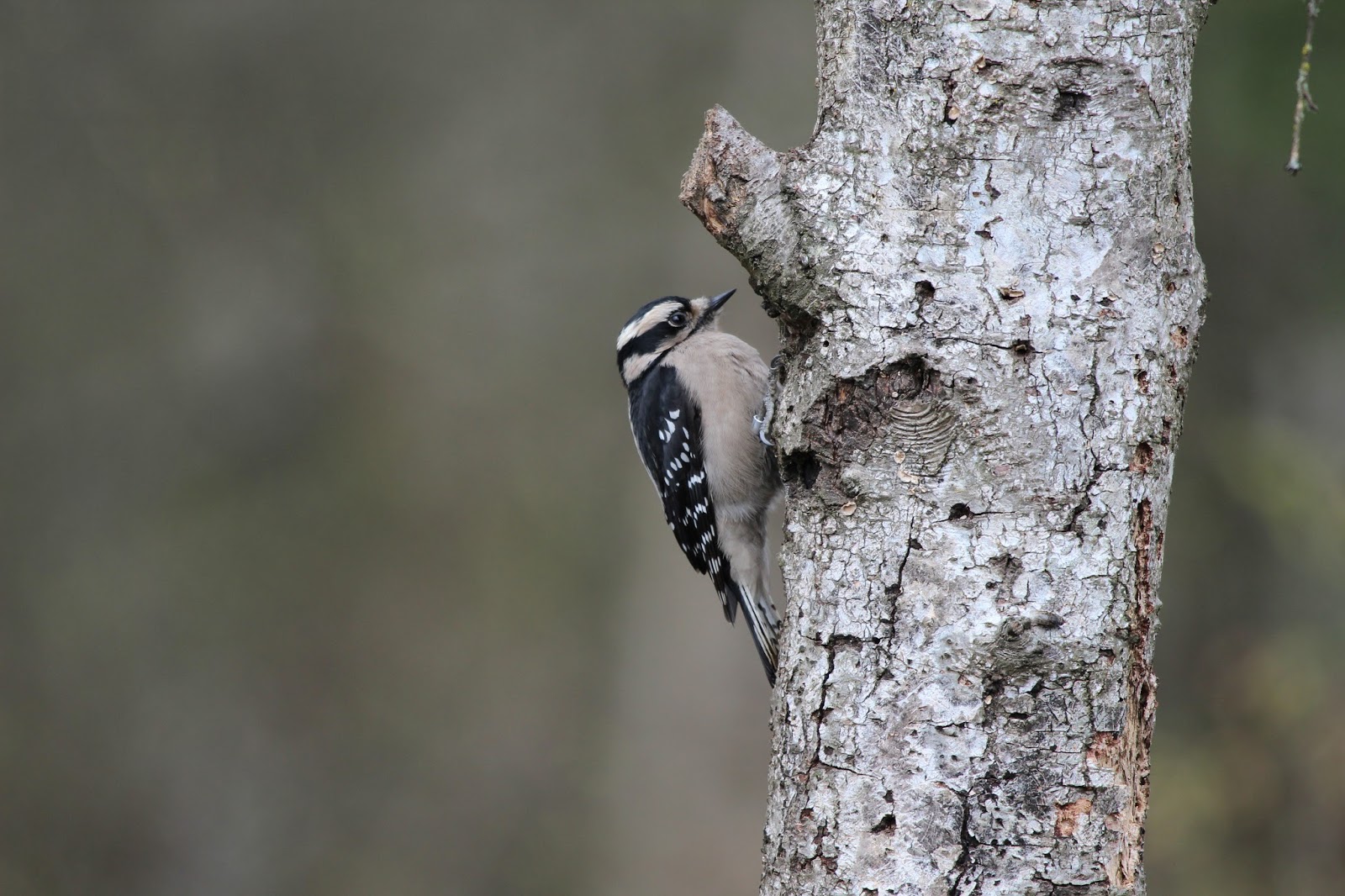
Pecking away, despite the rain.
Half an hour into my jaunt, the rain ceases and I find myself missing the very element that kept me chair-bound earlier. The sun wakens from his mid-day slumber. 

As he wipes the vanishing clouds of sleep from his face, I awake also, to the fact others are walking the park's pathways. 

With that realization, twinges of regret begin to coalesce inside my rain-hungry soul. After hiding inside from it for much of the day, I now want the rain to return, and with it the solitude and serenity of a wet, wild world.
 
But I realize that for today, the winds of Aeolus have banished the rainclouds of Zeus from the skies.

I do not dwell on this realization for too long, for I know the rains will return. And that happy knowledge stays with me, adding a spring to my step as I wend my way home, ready to shatter those other chains, ready to sit down and write.

As I conquered the rain that kept me inside, so have I conquered the inertia that kept me from writing.

Wednesday, April 23, 2014

Hi-Diddle-Dee-Dee, a travel writers' life for me...

Sooner or later, friends, family, casual acquaintances, just about anyone I meet actually, all get around to asking me one question when they find out I'm a travel writer.

"How did you get to be a travel writer?"

It sometimes takes the form of, "What school did you attend to learn journalism?" Other times, it takes the form of, "Boy, I'd sure like to find out how you got that job!" Sometimes it even comes disguised as a not-so-subtly-veiled hint, "Do you ever need anyone to come along with you on one of your trips?" (the latter because travel writers are often hosted on press tours where the expenses are minimal.)

First of all, I don't think anyone ever sets out to become a travel writer. A writer, yes; a travel and tourism industry professional, of course; a travel agent, maybe. But I don't remember anyone I ever knew in high school or university who set out with the career goal of becoming a travel writer upon graduation. Most of us just fall into it.

And as far as "tagging along" with a travel writer on assignment goes...it's not all pina coladas on the beach and free massages at the spa (although there is a bit of that). A working travel writer often has a tough schedule in order to get to all the destinations, see all the sights that need to be seen in order to meet the demands of the trip itinerary/assignment.

Ready to launch our kayaks and paddle to the cays in Belize.
A travel writer is usually up early, going all day long, and even after the schedule is done for the day, there is often work to do at night - especially these days with social media becoming more and more a part of the picture. That means that not only do you stay up late, going over the days' notes, organizing photos and preparing equipment for the next day's activities, and perhaps journalling about the day's events...now, a writer may also end up writing a blogpost or posting photos and videos on social media.

Opting out of scheduled events is NOT really an option, as it is on a family vacation. If you're on the trip, you have to attend everything. The schedules can be very demanding.

That being said, I cannot imagine myself enjoying any other career as much as this one.

So ... How did I become a travel writer?

First you have to understand how I became a writer. I went to the University of New Brunswick enrolled in a Bachelor of Science-Forestry program. Ever since I was 12, I'd wanted to help conserve our natural resources - forests, lakes, wildlife - and made up my mind to go into forestry. While working as a junior forest ranger in Gogama, Ontario in the summer of 1973, the head foreman told me about UNB. I decided to go there rather than one of the Ontario universities because I wanted to see another part of the country - I wanted an adventure.

The first week at UNB, I made very good friends with Dan Arsenault...he had joined CHSR 700, the on-campus AM student radio station and eventually convinced me to join, too.

I might as well have said good-bye to a forestry career right then, but I tried to combine the two for another two years, eventually giving in to my passion for radio and switching to a degree program that would allow more leisure time for my broadcast interests. Eventually, I worked my way up through the station as program director, then station manager before moving into my true broadcasting love: sports. After leading the station's sports department into the era of FM broadcasting, I got work as a professional freelance sports reporter first at CFNB then CBC Radio in Fredericton while finishing my business degree.

I also began writing sports for the student newspaper, which led to my first full-time in Barrhead, Alberta, after graduating. For the next 15 years, I bounced back and forth between broadcasting and newspaper jobs in Alberta and B.C.

While still working as sports editor for the Alaska Highway News, I took my first international vacation, an ecotour in Belize. It involved paddling sea kayaks for a week, then touring around the jungle in caves, on horseback and at Mayan temples for a week, swimming in underground rivers, seeing wild parrots, finding scorpions in one's shirt --- I loved it!

I went back and wrote up two articles about it for the paper, and I was hooked. This was even more fun than sports-writing.

Fast-forward to 1999: my SO and erstwhile companion the Divine Ms. K. got a killer job in Calgary, and I began my freelance career. Not focused strictly on travel, but a mix of the outdoors, conservation, adventure, food and travel.
Looking at parrots on Grand Cayman Island.

In essence, I'd come full-circle. In many of my articles, I was informing people about the importance of protecting the environment and by sharing many of my travel adventures, I hoped to connect them to nature.

Kind of a convoluted path, but a path none-the-less. And I've travelled on it now for 15 years.

It's helped me enjoy some incredible experiences... seen places in the world I might never have seen, otherwise... I've met some wonderful people that I am still friends with - and I've even made a few bucks along the way.

And it's something I intend to do until they pull the camera and keyboard from my cold, dead fingers.

Your takeaway from this?

No matter what path you're on, no matter what background you come from, no matter what your education background is, if you can write well, or take good photos (better if you can do both) you can be a travel writer.

And remember what T.S. Eliot said: "The journey, not the arrival, matters."

Enjoy your journey.


On assignment: Playing with sharks and rays at the Maui Ocean Centre

Thursday, April 17, 2014

Itching to be a travel writer? Read these books first

When talking to people about what I do for a living, I often get asked, "Gee, what would it take for me to become a travel writer?"

(This usually comes right after, "Boy, I'd sure love to have your job!" when you've regaled the person with tales of your latest adventures.

Before you can travel, you have to be able to write; 
before you start writing, you should read the books below.

It's not easy being a travel writer, although many people do find they have a knack for creating good travel prose. Perhaps I should re-phrase that: it's not easy to be a successful travel writer.

However, if you are set in trying it out, you will need to invest in a bit of study, first.

To help, here are “Five Books Every Travel Writer Should Have.” 

Some of these books are very basic, and if you’re already an experienced freelance writer, they will seem rudimentary. Some of them do not deal with "travel-writing" at all. But if you're a newbie, you have to walk before you run. And if you're already running, even the best pros experience “slumps” from time to time - and like a slumping hockey player trying to get his game back on track, it sometimes helps to go back to the basics and remind ourselves about how we got there.

You may notice one thing that is absent from my list: any book dealing specifically with travel writing online or travel writing in social media. I don’t know of any that hard-copy books that deal specifically with travel writing, although there are several books about social media and blogging in general. Because these types of media change so quickly, you're probably better off borrowing e-books from your local library or digging up info online about writing for websites or social media platforms.
Once you've mastered freelance basics and
queries, you can move on to this book.


So here are the books:

  1. Beginning Writer’s Answer Book, edited by Kirk Polking. This is one of several books published by Writer’s Digest Books. It’s the first book I read about freelancing, and if you’re new to freelance writing, you really need to read it. It outlines how to get started, important terms to know, some of the really important “do’s” and “don’t’s” about working with editors and publishers. Even if you have been freelancing for a while, it’s not a bad book to have for reference.
  1. The Renegade Writer by Linda Formichelli and Diana Burrell. This is the second-most important book a freelance writer needs. Once you’ve learned the rules about freelancing from the book above, this one teaches you how to break them all – successfully. There are times and situations where it’s okay – in some instances it may even be imperative – to break the rules. This book helps you figure out when and where those are. It covers topics like simultaneous submissions and/or queries, calling editors on the telephone, etc. It’s written in a very entertaining style, as well.
  1. How to Writer Attention-Grabbing Query and Cover Letters by John Wood. This is another Writer’s Digest book. When it comes right down to it, there are two essential aspects of successful freelance writing: A) The ability to deliver good quality writing, on time and on target for an editor; and, B) The ability to get an assignment in the first place so you can deliver great articles. This book helps with the second item. It deals with soliciting work from periodical publications as well as books. In addition to query and cover letters, it also provides advice about how to handle other forms of correspondence with editors. As I mentioned in the intro, it’s not a bad idea every now and then to re-read some of this stuff and eliminate any less-than-desirable habits we may have picked up without even being aware.
  1. Writing Travel Books and Articles by Richard Cropp, Barbara Braidwood and Susan M. Boyce. Okay. The first three books I’ve listed here are not travel-specific; however, if you’re not a good freelance writer to begin with, these last two – or any book dealing with just travel writing - won’t help you at all. (Besides, how many “how to be a travel writer” books do you really need?) This book was my bible when I became interested in concentrating more on freelance travel writing. It covers some of the same basics as the books above, but without as much detail. Then it goes on to provide many more details about all the different aspects of travel writing, including the importance of images. Which leads us to …
    Basic photography skills are
    a must for any travel writer.
  1. Digital Travel Photography – Digital Field Guide by David D. Busch. If you want to be a successful freelance travel writer, you have to be able to take good photographs. Not great - but good. This book briefly covers the basics that are essential to any kind of good digital photography, and then spends most of its pages focusing on how to produce successful digital travel photos. It goes into a great deal of detail about the different elements as well as the different types of travel photography. It also offers a list of online resources at the back. Best of all, it’s really small enough to travel with, in the event you need to refresh your memory with some forgotten detail, while on the road. It does not really delve into getting your travel photos published, but if you’ve read the first four books listed here, you’re good to go.
If those five are not enough …

Five more books you, as a travel writer, may want to read, or have for reference or inspiration (in no particular order): 

  • The 10 Best of Everything, by Nathaniel and Andrew Lande
  • Travel Yoga, by Darrin Zeer
  • 1000 Places to See Before You Die, by Patricia Schultz
  • A Sense of Place, by Michael Shapiro
  • Writing to Change the World by Mary Pipher. 
Travel Yoga is not about writing - but if you do pursue the life of a travel writer, it may come in handy. And while the last book is not about travel or travel writing, as travel writers, each one of us has the power to change the world - something we should always bear in mind when we put words to paper or into cyberspace.

Wednesday, November 6, 2013

Why join a writers' association?

I recently read a blog post written by another travel writer focused on the benefits of membership in a professional travel writing association, the International Travel Writers and Photographers Alliance.

The writer stressed that through this association,  she obtained much easier access to fam tours, a.k.a. press trips.

Press trips are an important aspect of travel-writing, particularly if you happen to be a freelance writer, and no one is paying you a salary with benefits.

But there are many other benefits of belonging to writing associations - and not just for travel writers.

I guess I should stop here and clarify when I say, "writers associations" I'm talking about professional writers - journalists, copywriters, speech creators, movie script writers - anyone who actually makes a living as a writer. While some novelists are fortunate enough to be able to live off their writing income, most are not.

So I am not including in this group writers' groups that get together over coffee and cake to critique each other's prose and poetry. Anyone can sit in on those; for professional associations, you need to meet some kind of minimal qualification standards to join, just like any profession such as law, medicine, accounting, etc.

If you're a professional writer, it may benefit you to belong to more than one writers association - particularly if it has a different emphasis. They all have different benefits.

I began my professional freelance career by joining the Professional Writers Association of Canada (PWAC) in 2000. That followed by membership in the North American Travel Journalists Association, the B.C. Association of Travel Writers and the Travel Media Association of Canada. They have all turned out to be beneficial for me in many different ways.

1. Industry contacts. As previously mentioned, contacts with travel industry people is, of course, a huge benefit of being a travel writer in an association, since without those contacts, it is difficult to obtain hosted trips. But networking can provide much more than knowing who to contact for subsidized travel. These professionals can also help you with story research; with sourcing images for a website or magazine/newspaper; they can put you in touch with others who may be able to help you complete your story. If you develop a good relationship with them, some of them may even be able to help you connect with editors for a story you're working on or interested in telling.

2. Professional development. Every profession requires this, but while many employers provide this for their staff, freelancers, by nature, do not have this option. Pro D sessions at conferences and monthly meetings can really help you stay on top of your game, both from a standpoint of being educated and up-to-date with respect to trends and practices in the writing profession - as well as from a motivational standpoint, encouraging you to continue writing. It can also help you develop different but related means to add income to your career.


Yours Truly (middle), John Masters (left) and John Lee
socialize at a 2013 TMAC event.
3. Writer advocacy. Not every association does this. Most travel writing associations do not; however, many other writing associations do.

Example: Several years ago, I submitted a story with about 60 colour slides (it was pre-digital) to a magazine and was paid on acceptance for the material. More than a year later, the story was still not published and I wanted the slides back to use for other stories/resales. The editor would not return them. 

After much back-and-forth with no success, I finally asked PWAC to contact him and he finally relented and returned my slides. The story never was published, but at least I was paid.

Conversely, PWAC will also advocate on your behalf for work that has been published but not paid for.

4. Increased exposure. PWAC members are included in an online writers database, accessible to anyone in the world. So if an editor in Hong Kong needs a travel story about Vancouver, the editor can search the database by keywords to find a writer to fill the need. This has happened to me on several occasions, netting me good assignments each time.

5. Collateral benefits. These are almost always unforeseen, unexpected bonuses. During a Pro D session at a travel writers conference, a presenter mentioned about a non-travel martial arts publication looking for writers. That same presentation, she also mentioned about some of the trade mags (again, non-travel) she had worked for. That spurred me to contact the martial arts publication, and for the next five years, I wrote for them regularly. Ditto, trade mags: I contacted a company that publishes several trade magazines and again, wrote for them regularly for about three years. (Both gigs ended when the editors left those mags). But I got a lot of work for several years by going to that travel writers conference.
Christine Potter leads discussion during a 2010
BCATW professional development event.

6. Benefits packages. While freelancing for various publications means you will not get the same benefits from a publication that a staff writer does, many professional writing associations offer benefits packages in the form of health insurance, and in some cases, travel insurance plans. It varies from group to group, but it is certainly worth looking into.

7. Professional feedback. Since we work alone so much, it's nice to compare notes. Maybe we don't realize one particular editor is really hard to work with; another likes to see "this" in a story; another is a very good editor to work for. Tips about the best way to pitch certain editors. These are the kinds of things you only find out by word of mouth.

8. Social benefits. Kind of an extension of #5. We work alone; we often never get out of the house. It's nice to get out once a month or so, have a few drinks with your peers, let your hair down and enjoy the camaraderie among people who completely get where you're coming from. You may even develop life-long friendships with some of them.

In summation, I have to point out that an association is only as good as the effort you put into being an active part of it. I do not mean you have to volunteer in some capacity - they are almost all non-profit organizations - although that helps. As with anything else, you need to take an active hand and participate in events, discussions and conferences. Just joining and sitting back will net you next to nothing, other than a line in your email signature. The more you put into it, the more you will get out of it.


Keep on writing!

Friday, August 3, 2012

There is magic in kids' camps

This time of year - the mid-way point of the two-month summer school break - I almost always find myself reminiscing about summers past, and in particular, going to camp as a kid.

You may be wondering, well, fine - but what does that have to do with travel?

In my case, plenty. 

In fact, it would not be too big a stretch to say going to camp as a kid is one of the key factors that propelled me into a career of travel writing.

Bear in mind, much of the travel I write about involves getting out-of-doors, into nature, seeking adventure - and often doing so by canoe or kayak or occasionally, whitewater raft. There is also often a conservation angle or aspect to it. There is good reason for that...

It really all does go back to that first summer at Camp Richildaca in southern Ontario, where I learned to paddle a canoe on a small pond on the day camp's property.

Richildaca Canoe Pond (Photo by Alexandra Heilbron)
Of such things, careers are made...

I also learned the sport of archery, rode my first horse, went on my first nature hike, cooked my first meal over an open fire and slept in a tent for the first time at Richildaca.

Oh, yeah - I learned to swim there, too - kind of an important skill to develop if you plan on spending a lot of time paddling on lakes, rivers and oceans around the world.

Yes, it would be not to big a stretch to say the two-week periods I spent there over three successive summers made a big impact on who and what I became as an adult. Ditto, the successive two camp periods I spent at the Haliburton Scout Reserve.

Without the love of the outdoors, that desire to hike and paddle and seek adventure in the wilderness, I just might be another old sports writer (I did it for 15 years before turning to travel writing), or, worse still - (shudder!) a history teacher.

Chow time! at Haliburton Scout Reserve
Nothing wrong with history teachers, by the way - I'd probably make a good one - but my interest in elementary school North American colonial history (and its associated adventure) combined with my love of the outdoors really did send me down a path that involved a fairly l-o-n-g detour into the University of New Brunswick's Bachelor of Science Forestry program, the eventual earning of a business degree - and a career in radio and print sports journalism for 15 years. 

My move into journalism really is the result of some encouragement from a first-year friend at UNB, Dan Arsenault, someone I'm still friends with today. He coaxed me into joining CHSR, the campus radio station. I did; eventually I also began writing for the Brunswickan, UNB's student newspaper.


Even going to UNB, the launching pad for my journalism career, was actually another case of Richildaca synchronicity: when I worked as a junior forest ranger in Gogama, Ontario during the summer of 1973, the head foreman recommended UNB as a good place to go for forestry if I didn't want to stay in Ontario.

Paddling on Azure Lake, as a junior forest ranger
The entire time I worked as a sports journalist, I still loved camping, canoeing, getting out-of-doors. Eventually, my sense of adventure took me paddling in Belize (where I encountered my first wild parrots!), and it was not long after that I started down the path of becoming a travel writer.

I don't know that any of that would have gone quite that way if I hadn't gone to Camp Richildaca when I was eight years old, and picked up a canoe paddle for the very first time.

I had no clue then that I was essentially beginning to paddle down a path that would make me one of those fortunate souls who gets to "work" by wandering the world in search of stories to write and photos to take. My inclinations and career have taken me to Africa, South America, the Caribbean, Malaysia, Thailand, Hawaii, the Canary Islands...


Zipping down Thailand's River Kwai in a canoe

Richildaca is gone now, the original owners passed away. New ownership and management have developed a new camp on the same site, the Kettleby Valley Camp, and it continues to offer outdoor experiences for children and young teens, helping them develop new skills and interests, helping them make new memories.

So if you're thinking about sending your kids to camp, and you're not quite sure whether to do it or not, why not just let the kids decide? Let them try it, at least for one summer. If they don't like it, they won't want a repeat.

Even if it does not lead to a career, chances are, they'll build some pretty good memories.

And, really there's no telling where that experience may lead them in life...