Thursday, May 28, 2015

When death becomes part of a travel tradition

Dad fixes the tent, our first ever camping trip in Ontario.
He passed away while we were both on camping weekends.
A couple of weeks ago, I blogged about odd travel traditions. Many of us have them, and we look foward to practising them every time we leave for a trip.

However, there is one rather odd and somewhat sobering travel tradition that seems to pop up in my life with some disturbing frequency.

It seems people in my immediate family often choose to die when I am away on a trip of some kind.

That's not to say every time I travel, somebody close to me passes away. If that really was the case, I might stop travelling. Or at least give it some strong consideration.

I guess it could be seen as just one of those weird quirks that happens because I'm a travel writer, and I'm probably away travelling more than the average person.

However, this disturbing trend developed before I started travel writing seriously.

In 1992, my father passed away while I was on a weekend camping trip, at Bear Mountain, near Dawson Creek, B.C (yes, there is a real place by that name - not "Dawson's Creek' - and it's been around for a long time). It happened on a Saturday night, the night before Father's Day. We didn't have cellphones then, so no one could get in touch with me until I returned home Sunday afternoon.

Close to 10 years later, my father-in-law passed away just as we were heading out to enter Lakeland Provincial Park, Alberta, for a four-day canoe trip. If we had been a few hours earlier heading out, we might not have known for four days.

Then, in 2007, while on a four-day kayak trip in the 10,000 Islands region of Everglades National Park, my mother passed away. Again, no one could reach me until I returned from that trip.

That one was particularly tough. Mom had been ill for quite a while with Myelodysplastic syndrome and had gone into the hospital in Toronto a few weeks before. She never got out.

It was tough for many reasons. An only child, it meant I had no immediate family left - no parents, no siblings - in some ways, I'd never felt more alone, even though I had other family members to help me get through my grief period.

An egret wading in the 10,000 Islands.
I shot this image the morning my mother passed away.
What made it more difficult was the fact I was so far away - and I was only halfway through the trip, as I'd made plans to spend a week in the Florida Keys following the paddling trip with Crystal Seas Kayaking. I had interviews lined up with some parrot sanctuaries and tourist facilities, lodging arranged for, and flights booked. And I had to complete the second half of my journey with a heavy heart.

I know many people would have returned home as soon as they found out. However, the life of a freelance travel writer sometimes demands that you make sacrifices, make choices, that people who are just vacationing, do not have to make.

That's one of the things the average person probably does not consider when they imagine what a travel writer does for a living. Once a schedule of accomodations, meals, and other elements of a trip have been set up with tourism boards, a travel writer has an obligation to fulfill those, particularly when the rooms have been set aside, and usually paid for by the boards - and they won't be getting a refund for them.

Also, if a story has been already promised to a publication, the writer needs to try to meet that committment. Leaving a destination, then trying to return later, rarely works out. While most editors and most tourism boards will understand in the event of a death in the family, they may still hesitate to work with you going forward.

I certainly would never judge or criticize anyone in a situation like this, no matter what their choice. It is their life, their decision.

However, that kind of decision is never easy to make. I struggled, and in the end I chose to stay and try to meet my commitments. I know that's what my mother would have wanted me to do, had she been given the choice, and knowing that, the choice was wee bit easier than it might have been.

It certainly does bring a different feel, a different perspective to a trip, though.

This odd trend happened again, just recently.

Margaret and David, on their wedding day.
On the second day of my recent trip to Mexico the first week of May, I received a text message from an aunt in New Westminster, B.C. My uncle had passed away in a hospice, the victim of colon cancer. I hadn't actually had any contact with him much since 1971. My dad's younger brother, he moved out west suddenly back then, and shunned contact from the family.

When I moved to Vancouver in 2003, I did try to connect with him, actually spoke on the phone once, but he made it clear he really didn't want any contact. I repeatedly sent him Christmas cards with notes about meeting for coffee, but never got a response.

Then just after Easter, I got a call from his wife, Margaret, telling me he'd been hospitalized. I had a chance to finally visit with him then, for an hour or so, and I was grateful for it. A few days later, he was placed in a hospice.

Three days before I left for Mexico, a phone call came, telling me he would do well if he made it to his birthday, May 8.

Off I went to Mexico, and then came the news he had passed away two days before his birthday.

Again, that odd travel tradition had reared its head.

As it turns out, the memorial service is scheduled for the day I leave for Ontario for three weeks, so it's like a double whammy. I won't be able to attend that service.

My memories of David go back to when I was a four-year-old spending most of my days at my Grandmother Geary's house, as both my parents worked. Three memories stand out specifically.

David (who was still living at home then) had a pet bird named Joey, a budgie. So I guess my fascination with birds (like parrots) began at a very early age. That was the first pet of any kind I ever encountered. I used to sit there talking to Joey every day.
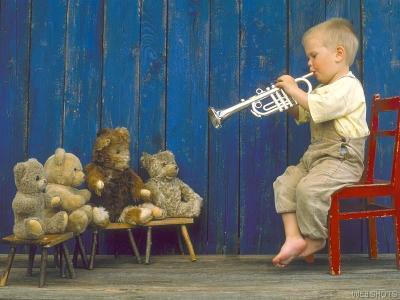
Not me - but it could easily be. But I'd be marching.
(Photo via Webshots.com)
The second memory that springs to mind involves music.

When I was four, I always used to watch the old black-and-white Popeye cartoons; he was the first "super-hero" I cheered on. In many of the old 'toons, whenever Popeye would eat his spinach and get ready to beat the crap out of Bluto or some other deserving bad guy, the John Philip Sousa march, "The Stars and Stripes Forever," would start to play. So I just loved that song.

Turns out David had a copy of it in his collection of marching music. He would play it for me often, and I would march around the room in time to the music, later on adding a toy trumpet to my performance, which became a regular occurrence, at least once or twice a week.

Robin Hood blows his horn.
 (Image from http://benito-cereno.tumblr.com/)
The third memory includes some physical mementoes.

When David married Margaret (at the age of eight, the first wedding I ever went to, and I remember stuffing myself with sausage rolls at the reception!) and they went on their honeymoon, they brought me back several pennants from their travels in the Williamsburg, Va. area.

They also brought back a cow horn, hollowed out and complete with a mouthpiece to blow on.

It became a go-to prop for when I played Robin Hood, and later a "powder horn" for playing Daniel Boone/Davey Crockett/Hawkeye.

I still have it, and I still have the pennants.

I'll never forget any of those memories. Just like I'll never forget David.

So, what's the point of all this, in a blog that is supposed to be about travel?

It's this: Make sure the people in your life that you care about - family, friends, partners - KNOW that you care about them. Especially, try not to leave to go on any trip on bad terms with the important people in your life. God forbid, but they may not be there when you get back.

Life is a journey, but it's the people we meet along our path during that journey that help to make it so rich and rewarding. When one of them leaves, that journey seems a bit less rich.

While you're pondering that, remember this: You never know when someone you care about will be taken from you.


Playing this one for you, David.

Wednesday, May 20, 2015

Mexican food: much more than just beans & tortillas

Anyone want to share my molcajente?
I love Mexican food.

I think I have always loved Mexican food, ever since I ate a bowl of chilli while watching The Good, the Bad, and the Ugly. The first dish I ever learned to cook from scratch - chilli con carne - was one that at least has its roots in Mexico.

(And it's still one of my go-to dishes after 40 years; a favourite to cook, to share - and to eat.)

It does seem at times, that at least part of my life is a constant quest to find a good, authentic Mexican restaurant in my home city (currently Vancouver). Not easy in a city that is dominated by Asian cuisine.

I have managed to find a few pretty good ones, and some not so great.

And when I say "Mexican restaurants," I'm NOT talking about Taco Time or Taco Bell - despite claims, fast food places like that do NOT take you "south of the border" or anyone near it, for that matter.

However, after a recent trip to Mexico - my first to that country - I may have to re-think how I define "Mexican cuisine."

Yes, I did enjoy some traditional hearty fare associated with Mexico: fajitas, refried beans, taquitos, that sort of thing.

But even within that class of food, I discovered something new, a breakfast staple served in most Mexican restaurants: chilaquiles.

This dish mainly consists of corn tortillas cut in triangles or totopos, lightly fried and covered with green or red salsa, then simmered until the totopos are soft. It's usually garnished with a form of sour cream, and may or may not include onion rings, avocado slices, and pulled chicken. They're often served with refried beans, eggs, and guacamole. You'll find them in almost any Mexican breakfast buffet.

That aside, for the most part, I enjoyed a very different, in some ways, entirely new level and style of exquisite dishes prepared by Mexican chefs, cuisine you would not normally associate with Mexico.

Part of the reason for that was because of where we were on the Pacific coast - in Puerto Vallarta; that location influences local chefs, who have easy access to a huge variety of fresh seafood available regularly.

It all began the first night at a special opening gala for the event I was attending, the North American Travel Journalists 2015 conference. We dined alfresco, feasting on escargots, lamb shanks, lobster ravioli, Chilean sea bass, and cheese empanadas.


Some fun with food, at the River Cafe.

The trend continued the next night, during a dine-around event. I ended up at an eatery called the River Cafe, where we enjoyed live music and a tasting menu that included smoked salmon crostini, Pacific jumbo shrimp, and Sonora beef tenderloin.

It just kept getting better. The next night, we were wined and dined at La Leche, a very uniquely decorated eatery which consisted of high ceilings, and shelves along all the walls that went up to the ceilings. The shelves contained tins and canisters, all done in white with the restaurant's logo/name emblazoned on them. There, I had the opportunity to try a variety of different dishes in their seven-course line-up. The menu changes nightly, and it's written on a chalkboard.


You really have to be inside La Leche to appreciate it.


About an hour's drive out of Puerto Vallarta lies Canopy River Adventures. We enjoyed our final meal of the conference there, on a covered patio. It was a bit more traditional, with an option for beef, chicken or fish entrees, accompanied by tortillas, guacamole, and roasted peppers.

As you can see by reading the above, the cuisine in this country is incredibly varied.

But wait, there's more...

As part of my stay in Mexico, I spent two days in Riviera Nayarit. Our first day's lunch was in El Brujo (obviously a very popular name for a restaurant in the village of Bucerias, as there were three different eateries going by that name). This one fronted on the beach.

That was quite a unique experience, in many ways.

Never expected to be eating "Asian" while in Mexico.
For one thing, there was a steady stream of peddlers trying to sell us their wares, everything from necklaces to hats, massages to music (we were serenaded by a pair of Mexican troubadours who wouldn't stop until we paid them!), cigars to postcards.

Then there was the Tim Horton's sign on the beach, offering fresh coffee, smoothies, beer and Caesars on the beach, each day. Hmmm....

The food provided me with something different, too. I opted for the "Mixed Molcajete" - a mixture of grilled chicken, shrimp, beef, guacamole, cheese and peppers served in a broth contained in a heated stone dish called a molcajete (as pictured at the top).

That night, it was back to fine dining at the Marival. Again, the food was matched only by the view from the balcony dining room. We were served a variety of dishes in "threes," including a dish of Asian delicacies that included spring rolls, a Mediterranean trio that included a lamb shank, and one with three different types of seafood.

La Palomas sent us home in style. Not only was the ambiance and decor distinctly Mexican, the food was all based on Mexican-derived dishes.

Not sure I'll be able to conquer this dish like Huitzilopochtli.
I enjoyed Aztec tortilla soup (chicken broth, corn chips, cheese, avocado and sour cream), Aztec salad (mushrooms in sage oil and honey with arugula and cottage cheese), and Huitzilopochtli's Conquest (essentially ground tenderloin beef, some fruits and vegetables and a creamy sauce served up in a roasted bell pepper).

All this incredible food made it really hard to go back to Vancouver and the standard Mexican fare prepared by even the best restaurants (or even my own Mexican menus!).

Yep...I've been kicked up to a "new bracket" of Mexican food. Nothing will ever be quite the same again.

So now I'm not really sure if I should be thankful for this - or maybe just a little bit ticked off at Puerto Vallarta...


A pair of Mexican troubadours on the beach at Bucerias,
to send you on your way.


Thursday, May 14, 2015

Feeling travel bored? Start your own weird travel tradition

"It's become sort of a McCallister family travel tradition ... funnily enough, we never lose our luggage!"
- from Home Alone 2: Lost in New York

A whopper and a coke for the road, in Bangkok.
Many families - and for that matter, many individuals - have created and practised their own unique travel traditions over the years.

I'm no different.
Except my personal tradition might be considered a bit weirder than most.

I didn't plan it - it just sort of evolved as a result of being hungry and bored, with time to spare in an airport.

It all began several years ago, at the end of a long press trip to Malaysia.


A group of Canadian travel writers, including Yours Truly, were wrapping a two-week long tour through the country, guests of Tourism Malaysia. We'd spent most of our time on the island of Borneo,  but a few days at the beginning and end of the trip took place in the capital, Kuala Lumpur, which is located on the mainland.

We got to the airport in plenty of time. We were looking at a long flight back to Vancouver via Taipei, Taiwan, flying on Eva Air.

I spent a bit of time wandering around, thinking back over the past fortnight's adventures and looking forward to getting back home to hang out with my parrots - Nikki, Coco, and Einstein - and do a bit of paddling - which I'd not had the chance to do while in Malaysia (although we did make use of motorized canoes to visit an Iban village in the Sarawak area, visiting and enjoying a meal with the former headhunters.)

Before I go any further, I should tell you one thing you may not realize about modern-day airports, is the fact that North American culture has pretty much taken over them, no matter where in the world you go. Want a Starbucks' latte in Lima, Peru? No problem. Craving something from the Colonel in Changi (Singapore)? You got it.

Anyway, we got through security and I had already done more shopping than I wanted to do on this trip, so I was bored. And a bit hungry. And although I love Asian food - especially some of the Malaysian dishes - after two weeks of nothing but that type of food, I was ready for something else.

And there, like an oasis on the desert, rising out of the horizon, appeared a Burger King.

Now, I'm not a huge BK fan; I really don't like the fact they bought Tim Horton's recently. But, it is what it is, and life goes on. Besides, this goes back a few years.

I thought to myself, "It would be kind of cool and bizarre to say I ate at a Burger King in Malaysia. And at least it's not McDonald's..."

So I went in, placed an order, sat down and ate.

It tasted pretty much like the BK food you'd get in Canada. I enjoyed it and didn't give it much thought afterward.

Fast forward a few years, and I'm wandering around the airport in Bangkok, waiting to catch a Cathay Pacific flight back home. And when what to my wandering eyes did appear - but a BK outlet, to my gate, very near.

Of course, I had to go in and have a burger. This time I even snapped a pic and posted it on my Facebook page.

And at that point, it officially became my very own eclectic travel tradition. Forthwith, from hereon in, whenever I exit a foreign land, I vow to eat a meal at a BK outlet before boarding the plane.

I had a chance to add to it recently - but I had to make an adjustment.

When you can't find BK, go for a JR.
If you're a Facebook friend, you may have seen it: I posted a photo of my burger-rings-milkshake lunch at the Puerto Vallarta airport en route from Mexico back to Canada earlier this week.

However, there was no BK there. So I had to make do with a Johnny Rocket's. That's okay - it was still good. Maybe even better than BK (which wouldn't really be that hard). But - the tradition continued.

So....

Do you have an odd travel tradition you follow regularly? I'd love to hear it in the comments below.

It doesn't have to involve food, or be weird (but if it is, GREAT!) or even be very elaborate. Just something you do every time you travel.

If you do NOT have one, why not think one up? It will at least give you something to do or think about it next time you're waiting for a flight home.


I didn't see any ninjas at the KL Airport BK - but then I didn't look very hard. 
And they're tough to spot (that's why they're ninjas.)

Thursday, May 7, 2015

Put that fear down and enjoy life's ride

You have to be wary of peacocks lurking around the pool...
PUERTO VALLARTA, Mexico - I'd like to report that all is well and I've felt no threat to my safety in the four days I've been in Mexico. The only real danger threatening me was a wicked hangover from too much beer, wine and rum punch my first full day here. Oh, and maybe those pesky peacocks that hang around the resort pool, shaking their tails.

It was very interesting the various reactions prompted by the news of gang-related issues the night before I left Vancouver to fly to Mexico for the 2015 North American Travel Journalists Association conference.

A friend of mine posted a CBC link detailing the news about violence on his Facebook feed. Another friend later posted the same link as a comment in one of my posts about heading to Mexico.

All I can say is, "Now hold on there, Baba Louie..."

Let's not get carried away here.

Before getting all worked up and cancelling plans for any trip, you have to stop and assess the situation logically and with a bit of perspective.

The following headlines might certainly make you want to cancel plans to go somewhere:
  • "Children kept indoors after outbreak of drug-linked shootings"
  • "Mounties investigate drive-by shootings"
Pretty scary stuff, eh?

Except those headlines are from recent news stories in Surrey, B.C. CANADA.


No tourists were harmed in the making of this video.


I'm not making those up; they're real headlines. I'm not going to bother posting those links here - but go Google them if you don't believe me.

Does that mean you'll never go to Surrey? Or Vancouver for that matter? What if you live there?

A peck on the cheek is quite continental,
a parrot is this guy's new friend...
As one friend put it, regarding danger in Mexico, "You're more likely to be shot in Surrey these days than in Mexico!"

Granted, we travel writers do live in a bit of a bubble at these kinds of events. But then so do most tourists on vacation.

I've been too busy enjoying myself, eating great food, meeting wonderful people (and even a few new parrot pals!), enjoying sunset cruises and marvelling at swimming with horses on horseback riding trips to worry much. Friday, I'll be sailing off on a pirate ship and (hopeully) doing some kayaking and/or snorkeling.

Now I'm not saying there is no danger in travelling. Common sense has to play a role in any decision. But here's the thing:

LIFE involves danger. Just going to the corner store involves an element of risk.

To dance the dance of life, you have to overcome fear.
So you can sit at home, lock your doors, and "live" a safe life, and someday you'll still die. Maybe a little more comfortably, maybe not.

But you'll die not having really lived.

As Franklin D. Roosevelt stated eloquently, "The only thing we have to fear is fear itself." So put down your fears, go out and live life.

You're welcome.


Wednesday, April 29, 2015

Commercial flying: changes for the better - or worse? Your call...

Where's the flight crew? Where are my peanuts?
(Photo by http://smg.photobucket.com/user/Thud/profile/)
I remember the first time I flew in a plane.

I was 17 at the time, and it was not a large commercial jet liner I'd climbed into. It was a Turbo Beaver, a six-seat bush plane, often used for fighting forest fires, one that took from from water, not a runway Makes sense. I was in the bush, working as a junior forest ranger in Gogama, Ontario for the summer, and as a treat, they took us up for rides in a Turbo Beaver.

It was quite a ride - even after some of us were "water-bombed" during one of the takeoffs from Lake Minisinakwa (hey, it was used for fighting fires, remember?)

To quote from my (very first "travel") journal:
"In every direction we looked, nothing met our eyes but lakes and forests. It was far out!"
Actually, that was not the first time I'd flown; it was the first time I remember flying. Apparently in moving from Ottawa to Winnipeg when I was two years old, our family flew. But, of course, I don't remember that flight.

Fast forward two years from my junior forest ranger days, and I'm climbing onto an Air Canada jet in Fredericton, New Brunswick. I've just finished my first term at the University of New Brunswick, and I was flying home to Toronto for Christmas.

That became a familiar routine over the next several years, and the pattern continued, although not as often, when I graduated and moved out west.

But flying really became part of my life when I started working as a travel writer. There's no getting around. It's part of the job.

Since then, I've pretty much seen the "best of times, and the worst of times" with respect to the different airlines and the services they offer travellers.

Some of the best airlines I've flown on include Cathay Pacific (to Thailand via Hong Kong), Eva Air (to Malaysia via Taipei) and British Airways (to Africa via London). I won't get into a list of my worst flying experiences here (that's a story for another time, perhaps); but, suffice it to say, I have experienced my share of missing luggage, broken baggage, and connection SNAFUS (I remember running through the Orly Airport in Paris trying to make a connection once - I kept waiting for the Home Alone music to start playing).

When I began flying regularly in my university days, in-flight meals were almost guaranteed for any flight longer than two hours. We all know that's not the case, these days, when you're lucky to get free pretzels or cookies. But now we also have to pay for checking baggage, for not checking baggage, to get a blanket or pillow - the things we always used to take for granted.

Mind you, we do have state-of-the-art technology to get us from Point A to Point B these days; however, I sure would have liked to experience flying in the so-called Golden Age of Flying.

Or at least, I'd like to have experienced it the way it was portrayed in movies like Back from Eternity or Five Came Back and on TV shows like Pan Am.


Economy airlines are the norm, these days. (John Geary clip)

Having experienced major muscle cramps and knots after flying economy class halfway across the Western Hemisphere, I certainly like the idea of wider seats with more leg room. And the idea of large lounges or stand-up bars in plane also appeals to me. (India's Kingfisher Airlines did have stand-up bars in some of its planes - what would you expect from an airline owned by a brewery? - but that didn't save it from bankruptcy.)

As well, I think the idea of flying on a plane with curtained berths for sleeping at night would be cool.

And back then, there was virtually no security like we have to go through today to board a plane.

I think flying in a large flying boat (think, Indiana Jones) would be a great experience to enjoy, at least once, anyway.

However, flying back then may not have been all it was cracked up to be. There is a certain romance associated with flying in the 1940s, '50s and early '60s that all nostalgia tends to stimulate - and like most nostalgia, perhaps colours the situation a bit more favourably than how it really was.
Who wouldn't be enticed to fly south
by this poster?

While paying baggage fees and having to purchase mostly bad meals may be a pain-in-the-butt, and lining up for security checkpoints is tedious and tiring, there are many things we do not have to put up with these days:

  • Smoking. It used to be common, more people smoked, and not just cigarettes - cigars and pipes were not uncommon. Welcome to the Smoky Skies. 
  • Lack of entertainment. We have music, movies, and on some airlines, singing flight attendants. Back in the day, you could write postcards. By hand. Then post them when you landed.
  • Drunks. Back in the day, booze was mostly free. Knock yourself (and many did). But boozy seat-mates are not always the best of company. (To be fair, on the Asian-based airlines I've used, it's still free. "Erica, just give me two cokes and four of those mini-bottles of rum, please!" But of course, Yours Truly is a pleasant drunk...)
  • Really expensive flights. During the Golden Age, only the really well-off could fly. 
  • Danger. While several high-profile crashes have been in the news these days, it's still much safer to fly now than it was 50 years ago, when the chance of crashing was five times greater than it is today.
The list goes on; more details are provided in a 2013 Fast Company article.

The more I think about, the more I think I'll put up with some of the negatives we have on today's commercial flights. (Either that, or finally break down and fly first class - just once! - to see how the other half lives.)

In the meantime...

Pass the pretzels, please.

Thursday, April 23, 2015

Brave New Worlds await traditional writers, bloggers alike

Getting ready for the editors' panel.
Even those who don't spend much time online or persuing the various forms of traditional or social media are probably aware of the revolution that's been taking place in the publishing industry for the last decade or two.

First came the internet, and with it, websites, e-zines or online zines and web-logs, a.k.a. "blogs."

Then came the era of social media: YouTube, Facebook, Twitter, Instagram, Pinterest - the list is a l-o-n-g one.

It's an era we're still in, barely into, really - and it's still evolving. However, although social media has certainly grabbed a large portion of the media landscape, traditional media is not dead yet, despite rumours to the contrary.

In fact, to paraphrase the immortal words of Mark Twain, "Rumours of its demise are greatly exaggerated."

That became very apparent at the 2015 B.C. Assocation of Travel Writers symposium that took place in Vancouver's Century Plaza Hotel, on April 18, 2015.

The theme of the event was "Ecotourism: Tread Softly, Write with Impact."

It could just have easily been "Traditional Meets New Age Travel Media."

That's because the symposium organizers did a very good job of blending elements of the old with elements of the new in putting together the day's program.

Photographer David Smith provided great ideas
to help us improve our travel photography.
Nowhere was this more evident than on the editorial panel. The panel featured two editors from the more traditional elements of published travel writing - Allen Cox from Northwest Travel and Life and Kirsten Rodenhizer from Westworld Alberta magazines - and a third from the online travel website, Matador in the person of Jett Britnell.

The keynote speaker, Vancouver author Jack Christie, provided a very informative and entertaining address.

He also provided living proof that you can still write books about travel - and write them very successfully.

So as you can see, there are still many ways to be published in hard-copy, although online publishing does offer a nice alternative.

Now, before you start to think this is just an old-school guy, extolling the virtues of an older type of travel publishing...

The organizers also incorporated a Twitter contest into the day's events, so people were tweeting away furiously on smartphones and laptops about what they were hearing from the presenters. At the end of the day, the top three tweeters were presented with prizes.

(I'm not modest, so I have no trouble telling you I placed second, and won a great prize from Cycle City Tours - their Grand Tour - which I look forward to enjoying later this summer).


As always at these events, there was a 
simple but sumptuous luncheon prepared.

The organization is also holding a contest for bloggers who attended the event, one that involves writing a post about the event.

Of much greater note, however, is the fact that the BCATW recently made a huge move in terms of its membership criteria.

The event also offered a chance to connect
with friends met through social media...
It became the second Canadian-based travel media organization to open up membership to bloggers in the past year (the Travel Media Association of Canada, a national organization, also recently opened that up for membership).

While some bloggers may feel this is long overdue by such associations, and others may feel, "Meh? What's the big deal?" in the big picture, it is huge, and should not be dismissed lightly.

We really are at a crossroads in terms of media and how it is published and how it is used. Magazines that would never have thought of publishing online versions of articles already published in hard copy are now routine doing that. They are also finding new ways to include online articles into the mix that would perhaps not have made it into the hard-copy magazines.

For writers, while this is great news for those publications that do this, it can still be a bit of a Catch-22. Not many travel magazines offer this alternative of hard-copy vs. web. And while this atmosphere certainly provides more opportunities to be published, most of the straight online sites do not pay anywhere near as well as most of even the lower-paying hard-copy publications.
...as well as a chance to make new connections.

In terms of monetization, the blogging model for travel writers is completely different from that of the traditional freelance travel writing model. While writers don't have to wait for an editor to purchase a story, it can take a long time and require much patience - and often, more than a little luck - to earn much from a blog, whether you're writing about paddling in Ecuador, diving in Maui, parrot-watching in the Caribbean or just camping in B.C.

So the challenges are there, as they always have been for those of us who earn a living as self-employed writers, photographers, and more recently, videographers.

It really is a Brave New World of travel publishing. Foward-thinking organizations - like the BCATW - that want to grow and thrive realize this, and we saw this in action, Saturday.

Really, the only action for all of us travel writers who value what we do, is to recognize the obstacles, embrace the challenge, and plow on, furiously typing, snapping and posting to bring the world out there back to our readers.

Thursday, April 16, 2015

Road food is one thing; but how do you eat if the "road" is a river?

Nothing beats cooking - and eating - in the outdoors.
The name of my blog pretty much gives away the fact I'm passionate about parrots and about paddling (if not, I've really goofed!).

But if not truly passionate, I'm certainly very close to being passionate about food, as well.

So...if you take a foodie who's also a canoehead, it can sometimes be a bit of a challenge to create an acceptable menu when I'm on a multi-day paddling trip.

I will say I've had some marvellous eating experiences while travelling by canoe and kayak. There've been a few disappointments, too.

While every trip has its highlights, and I've never really had a bad paddling trip, how and what you eat can often influence your impressions and memories of the trip.

Obviously, while you're on a canoe or kayak trip, you are "on the road". However, unlike driving on a highway, there's no place to pull over and order a burger and fries (although those always seem to be my first go-to meal after finishing any paddling trip.)

That means you have to plan and cook it yourself, if you're on a self-guided trip; if you're booked with an outfitter, they look after the meal planning and most of the prep for you.

I've done plenty of both; and in both instances, I've experienced the good, the bad, and the ugly (even when there's no spaghetti involved.)

I have created some incredible meals myself, as well as been a party to some bad ones (usually in the form of freeze-dried foods.)

Although it may not qualify as gourmet fare, I remember the very first dish I ate, cooked over a campfire in the outdoors.

A nice heaping plate of Richildaca Stew.
I was eight years old, and I was a camper at Richildaca Day Camp, near Kettleby, Ontario, in the rural area just west of the Newmarket-Aurora area in southern Ontario, about 40 km north of Toronto. It was "cookout day." I was excited when I saw them open the ground beef. Then I saw cans of mushroom and vegetable soup. I HATED mushrooms and anything to do with them! And I wasn't keen about veggie soup, either, back then. But, it was eat that or starve. So I ate. And I ate it. And I ate it.

Yeah, I loved it.

So much that I've always tried to feature it on all my camping menus. Of course, it has changed over the years, as I've tweaked it a bit. And it wasn't called "Richildaca Stew" back then. But it's still easy, hearty, and every bite still brings back memories.

If you want to see a real-life demonstration on how to make Richildaca Stew, you can watch the entire process on one of my YouTube videos.

Then there are the bacon and eggs and hashbrowns that always taste so good cooked outdoors over a camp stove or an open fire. They always taste better than the ones cooked at home.


Breakfast is a sizzlin'...

Of course, not all my paddling recipes turn out well. Although I once impressed a young lady with my "canned goods shiskabob" (canned potatoes and spam, cooked on a stick over a fire - another Richildaca innovation), there have been some unpleasant memories involved with camp food. The most unpleasant involved two people sleeping in a small dome tent after gorging on freeze-dried bean-tortilla dinner.

It was w-a-y worse than normal beans. Even the porcupines that hung around that campsite in numbers just up and disappeared.
Some go-to books for planning paddling meals.

Scratch that one off the list.

If you want to plan your own trips and meals, there are several good books to help you. Two of my favourites are The Wanapitei Canoe Trippers Cookbook and The Paddling Chef. 

Outfitters have prepared some amazing meals on trips over the years. My first sea kayaking excursion in Belize, our guides prepared an amazing and simple rum punch, a delicious conch stew, and wonderful fresh-caught fish. Mind you, I wasn't crazy about the vegetarian chilli and vegetarian spaghetti sauce foisted upon us later in that EcoSummer trip by an overzealous "naturist" guide. But you take the good with the bad.

The best chow I've had on a paddling trip?

Two come to mind immediately: an Adventure-Life five-day kayak trip I took in the jungles of Ecuador and some great grub enjoyed with Okefenokee Adventures on a three-day canoe trip in the Georgia swamp.

In the Amazon, we had three-course meals, with everything prepared by the guides. Each meal featured soup, salad, entree, dessert and wine. All eaten at a table, sitting on chairs underneath a forest canopy filled with parrots, toucans, and the occasional harpy eagle.

In the Okefenokee, I remember eating some incredible jambalaya and equally good spaghetti with meat sauce.

Of course, everyone who knows me, knows how I love my coffee, in or out of camp. And without a good mug of brew (or two), you really cannot start the day properly - especially on a paddling trip.

Paddler and singer-songwriter Jerry Vandiver knows this better than anyone - which is why he wrote a great song about camp coffee. I'll leave it here, with you. Maybe it'll inspire you to plan your next paddling trip - or even a trip menu. Or if nothing else, to go get another cup of coffee to sip while you enjoy it.


Want to see more of Jerry's videos? Check out his YouTube page.